

LLM-Citeops
Rakesh Cheekatimala · Coding · Marketing
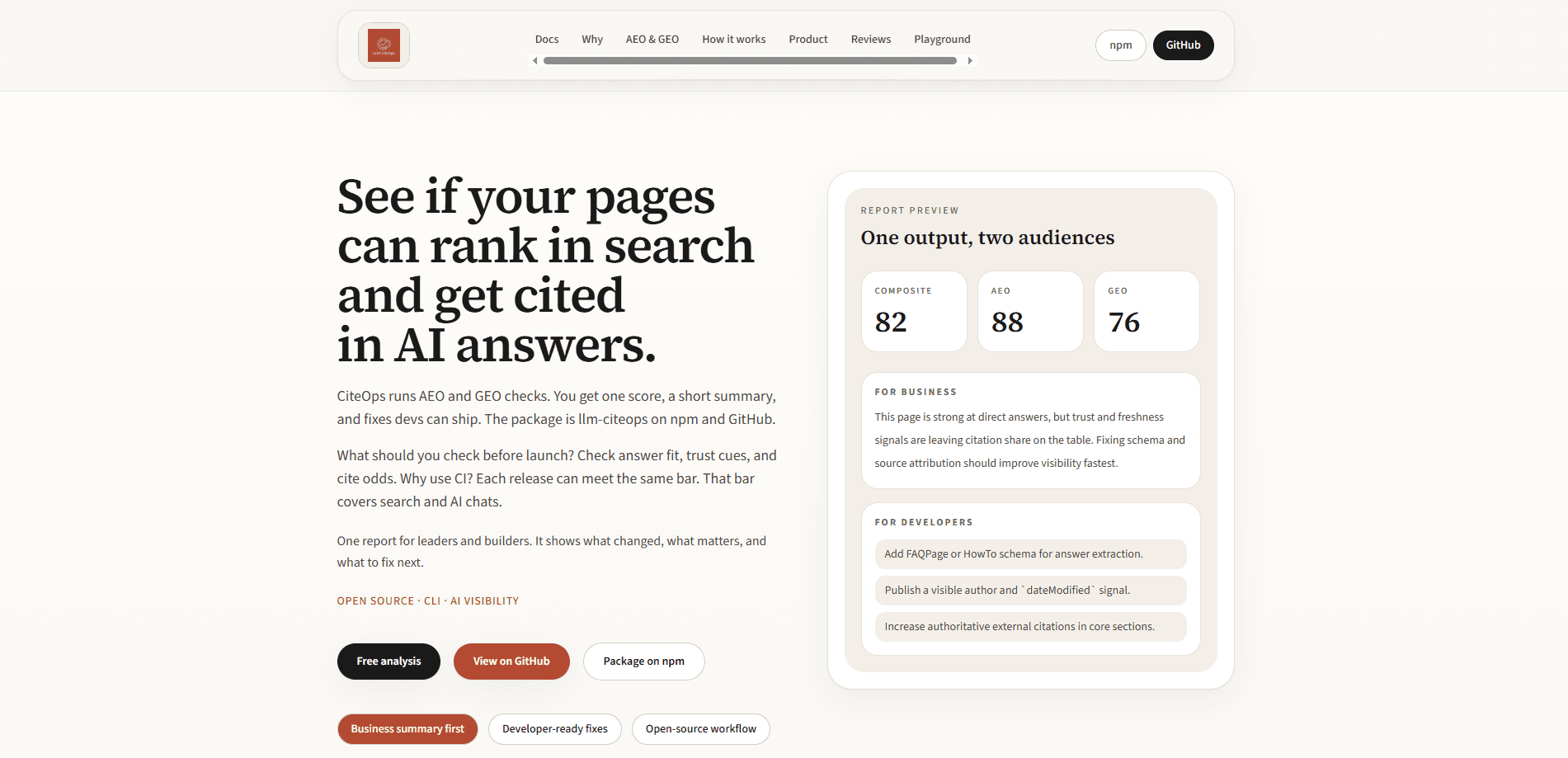
LLM-CiteOps is a free, open-source command-line tool that audits web pages for AEO and GEO, the two disciplines that decide whether AI systems can understand, trust, and cite your content. It runs locally through npm, scores each page with a composite number plus separate AEO and GEO subscores, and points to the exact signals holding a page back. Content teams use it to turn vague "are we ready for AI search" worries into a repeatable AI citation readiness checklist they can run before every launch.
About LLM-Citeops
What Is LLM-CiteOps
LLM-CiteOps (published on npm as answerlint) is a local, deterministic answer-readiness coach for content teams. It reads a URL, a Markdown file, a folder, or a sitemap, then checks whether the page answers cleanly, carries enough trust signals, and exposes the structure a model needs to quote it. No LLM sits behind the scoring, so the same page gets the same score every time.
The tool lives at the intersection of two newer ideas. AEO, or answer engine optimization, targets engines that pull short answers such as snippets and voice results. GEO, or generative engine optimization, targets AI that reads many pages at once and picks which sources to trust. LLM-CiteOps measures both in one pass, so you see a combined risk profile instead of a single vanity number.
The main catch is the field itself. AEO and GEO scoring is young, and no standard governs what a "good" score means. LLM-CiteOps also ships under its AnswerLint name on the official site, so the branding can confuse first-time users searching for it.
Getting Started
- Install Node.js 18 or newer, then run
npx answerlint@latest audit --url https://your-site.comin your terminal. Nothing gets uploaded. - Point the tool at what you want to check. It takes a single URL, a local Markdown or HTML file, a folder, or a whole sitemap.
- Read the output. Each page gets a composite score plus separate AEO and GEO scores, and every failing check names the missing signal.
- Fix the flagged items yourself, then rerun the audit to compare scores before and after.
- Add a
.answerlint.jsonconfig and a CI threshold so merges get blocked when a page drops below your bar.
Product Information
A quick look at LLM-Citeops's pricing, supported platforms, and performance.
Best for
The users, tasks, and scenarios where this tool fits best.
Users
- Content teams
- SEO specialists
- Developers
Tasks
- Auditing a launch page before it ships
- Benchmarking against a rival
- Batch-checking a sitemap
Scenarios
- Wiring an AI visibility gate into a pull request
- Coaching writers on drafts
- Preparing for an AI-heavy buying cycle
Key features
AEO and GEO Scoring in One Pass
Most tools pick a lane. LLM-CiteOps scores AEO and GEO side by side, then rolls them into a composite number. That matters because a page can rank well and still lose the AI answer. Seeing both scores together tells you whether the problem is clarity, trust, or the way the page is structured for a model to read.
Deterministic, Local Checks
The scoring runs on rules, not on a language model. Same input, same score, every time. Every check happens on your machine, and the docs keep the claim narrow: read-only fetches, configurable rate limits, and robots awareness. Can you paste client pages into a chat box? Many teams can't. For them, that's the whole point.
Evidence Behind Every Score
A score without a reason is just noise. Each failing check names the missing signal, shows the affected content, explains why it matters, and suggests the change. That's the useful part. Writers get plain guidance. Developers get the schema, markup, and metadata fixes they can commit.
CI Release Gates
The CLI returns exit codes for pass, score failure, network errors, and bad input, so it slots into a pipeline like a linter. You set a threshold, the audit runs against the deploy URL, and a low GEO score blocks the merge. The same inspection can run locally, in preview, and in CI.
Reports for Two Audiences
LLM-CiteOps exports HTML, JSON, and CSV. HTML gives business readers a readable summary with the commercial risk front and center. JSON feeds pipelines and diffs. CSV suits sitemap and folder runs where you need to scan many URLs at once.
Competitor Comparison
You can run one live URL against a competitor URL to see score deltas, parity gaps, and the first fixes that close the distance. That turns a lonely score into a benchmark, which is how you know whether 74 is fine or a rival is quietly winning the citations.
llms.txt Generator
A companion free tool turns a public website into an llms.txt file, the AI-readable roadmap some teams now publish alongside robots.txt. You inspect the output before downloading, so you're not shipping a generated file blind.
Pros and cons
Pros
- Free and open source under the MIT license, with no paid tier gating core scoring. The whole audit is free.
- Deterministic scores mean you can track progress across releases instead of guessing.
- Runs fully local with no LLM calls, which keeps private or client pages off third-party servers.
- Fits existing developer habits through npm, exit codes, and CI thresholds.
- Splits AEO from GEO, so you can tell a clarity problem from a trust problem.
Cons
- Scoring rules are still young, so a low score flags a direction to investigate rather than a proven ranking penalty.
- It diagnoses problems but won't rewrite content for you, which means you still need someone to act on the findings.
- The npm package is called `answerlint` while the official site brands it AnswerLint, so searching for LLM-CiteOps can send people to the wrong page.
- No official API, so batch automation depends on scripting the CLI yourself.
Frequently asked questions
It measures AI citation readiness. One run returns a composite score plus separate AEO and GEO scores, covering clarity, structure, trust signals, dates, and citation fit. Put plainly, it checks whether a page can be quoted in AI answers and trusted in search.
Related content
Explore related tools, skills, and articles for LLM-Citeops.
LLM-Citeops Alternatives
Forefront
Forefront · CodingForefront is a web platform for building with open-source AI. It lets you fine-tune leading open-source language models on your own data, evaluate how they perform, and run them through an API or export them to host yourself. Developers who want the convenience of a closed-source platform but insist on owning their models and data are the target audience here.

Startkit
StartKit.AI · CodingStartkit is a boilerplate for building AI SaaS and AI wrapper products. Think of it as an AI startup boilerplate with the boring parts already wired up: authentication, Stripe and Lemon Squeezy payments, usage limits, transactional email, and an AI API starter that talks to OpenAI, Anthropic, Groq, or Llama. You clone the repo, set your price, and start on the part of your product that people actually pay for. It's Next.js under React and Tailwind, so most of the boilerplate code already feels familiar.
Testim
Tricentis · CodingTestim is an AI-powered test automation platform for building and running end-to-end tests across web, mobile, and Salesforce applications. It leans on machine learning to keep tests stable when an interface changes, so teams spend less time fixing broken selectors. Not bad for an automated testing tool you can start using today. You create tests by recording actions in a browser, then optionally add JavaScript when you need more control. It's a solid pick for busy QA teams.