

Meta Video Seal
Meta (Facebook Research) · Video
Meta Video Seal is Meta's open-source AI watermarking tool. It hides an invisible watermark in images and video to trace where a clip came from.
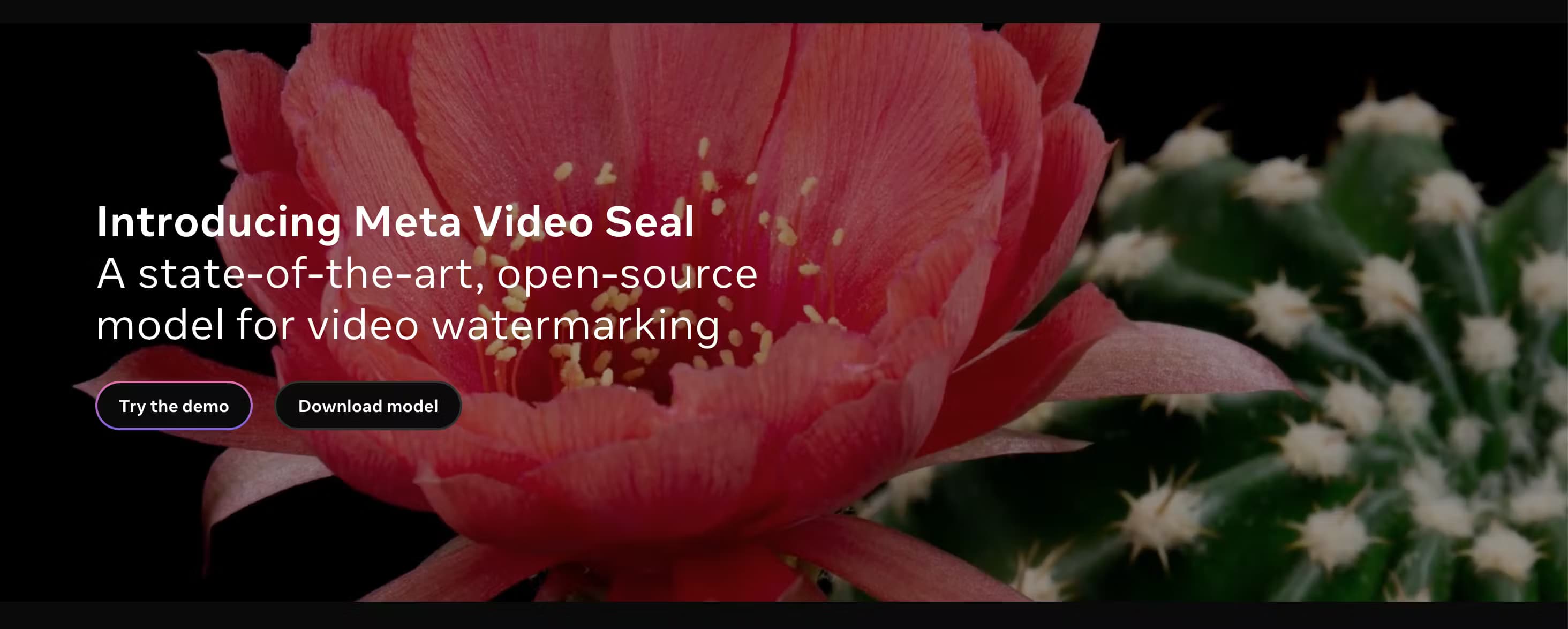
About Meta Video Seal
What Is Meta Video Seal
Meta Video Seal is a watermarking library for anyone who needs to know whether a video or image is genuine. It embeds an invisible signature into the pixels, then detects that signature later, even after the file has been compressed, cropped, or re-encoded. Meta built it for the age of AI-generated media, where a convincing fake can spread across platforms faster than any fact-checker can track it down.
The pitch is narrow on purpose. This isn't a video editor or a content platform. It's a Python library you install and run. Meta also hosts a demo so you can try it in a browser first. The team's research papers describe several models: VideoSeal v1.0 carries a 256-bit message, ChunkySeal pushes that to 1024 bits, and PixelSeal targets the best balance of invisibility and survival under edits.
That last trade-off is the whole game. A watermark that's easy to see is easy to remove, and a watermark that's hard to remove tends to show. Meta tunes this with a setting called scaling strength, and a masking trick that hides the mark inside busy, textured areas while leaving smooth ones alone. The catch is that Video Seal is a research-grade tool that assumes you're comfortable setting up Python, installing PyTorch, and running code from a terminal rather than clicking through an app.
Getting Started
- Set up a Python 3.10 environment with PyTorch, then install the repository with pip and its dependencies.
- Load a model by name, like
videoseal.load("videoseal"), which downloads the checkpoint on first use. - Feed in an image or video file, then call
embed()to write the watermark into it. - Call
detect()on a suspect file later to read back the hidden message and confirm it's yours. - For long videos, use the streaming script so the file is processed clip by clip instead of all at once.
Product Information
A quick look at Meta Video Seal's pricing, supported platforms, and performance.
Best for
The users, tasks, and scenarios where this tool fits best.
Users
- AI researchers
- Platforms that host user media
- Developers building AI content provenance checks
Tasks
- Watermarking AI-generated video
- Detect AI-generated video
- Comparing watermark strength
Scenarios
- Publishing AI-generated content at scale
- Tracking a leaked file
- Research on watermark attacks
Key features
Invisible, long-lasting watermarks
The core job is hiding a message in the pixels so a viewer can't see it, while keeping it readable after the file gets re-ended. Compression, resizing, and re-encoding all chip away at most hidden marks. Video Seal is built to survive those steps. That's what makes it useful for tracking media that's already spread across the internet.
Several models with different trade-offs
Meta ships more than one model rather than a single fixed tool. VideoSeal v1.0 is the stable 256-bit option. ChunkySeal raises capacity to 1024 bits for cases that need a longer message. PixelSeal aims for the best pairing of invisibility and durability. What should you pick? It depends on whether you need more message room or a mark that's harder to scrub out.
Strength and masking controls
Two settings give you direct control over the visibility-versus-robustness balance. Scaling strength sets how hard the mark is written. Higher values survive more edits but show more. Attenuation switches on masking that concentrates the mark in textured parts of the frame, where the eye is less likely to notice it. This is the small piece of engineering that makes the whole idea work.
Image and video support
The same library handles stills and moving pictures. Videos get a temporal step so the mark stays consistent from frame to frame instead of flickering. Why does that matter? A mark that jumps around is both easier to spot and easier to strip.
Streaming mode for long files
Watermarking a full movie in one pass eats memory fast. The streaming script reads a video clip by clip. It runs on a laptop. And it holds up on long footage. Meta's own docs flag this as the practical way to handle anything bigger than a short clip.
Open source under MIT
Everything is public: model weights, training code, and evaluation tools, all under an MIT license. You can retrain the models on your own data. You can audit exactly how detection works. And you can run it without paying anyone or calling a remote server.
Pros and cons
Pros
- Completely free and open source, since the weights, training code, and evaluation tools are all published under an MIT license that lets you inspect and reuse everything.
- Detection holds up after common edits like compression and re-encoding, which is the hard part of watermarking.
- Multiple models cover different needs, from a stable default to a high-capacity option.
- Runs locally, so your videos and detection results never leave your own machine.
Cons
- It's a Python library, not a click-and-go app, so non-coders will find the setup rough going.
- There's no hosted API, which means you can't call it as a service from another product without running the code yourself.
- Marking an entire video is compute-heavy, so long files need a decent machine or the streaming script.
- Watermarks can still be attacked; Meta's own research shows that specialized tools can forge or remove marks, so treat detection as one signal rather than proof of authenticity.
Frequently asked questions
It hides an invisible mark inside images and video, then detects that mark later to trace where a file came from. It's aimed at verifying AI-generated media and tracking how content spreads.
Related content
Explore related tools, skills, and articles for Meta Video Seal.
Meta Video Seal Alternatives

ngram 2.0
ngram · Video · Marketingngram 2.0 is an AI video generator for teams. It turns a prompt, a screen recording, or a product URL into a narrated explainer, product demo, or AI avatar video, and every scene stays editable.

OpenScreen 2
OpenScreen (open-source project) · Video · ProductivityOpenScreen 2 is a free, open-source screen recorder and demo video editor for Windows, macOS, and Linux, with automatic zooms, styled frames, local captions, and agent edits.

Skreno
Skreno · Video · ProductivitySkreno is a browser screen recorder that captures a tab, a window or your whole display, then attaches AI transcripts, summaries and console logs to one share link.