

Metoro
Metoro · Coding
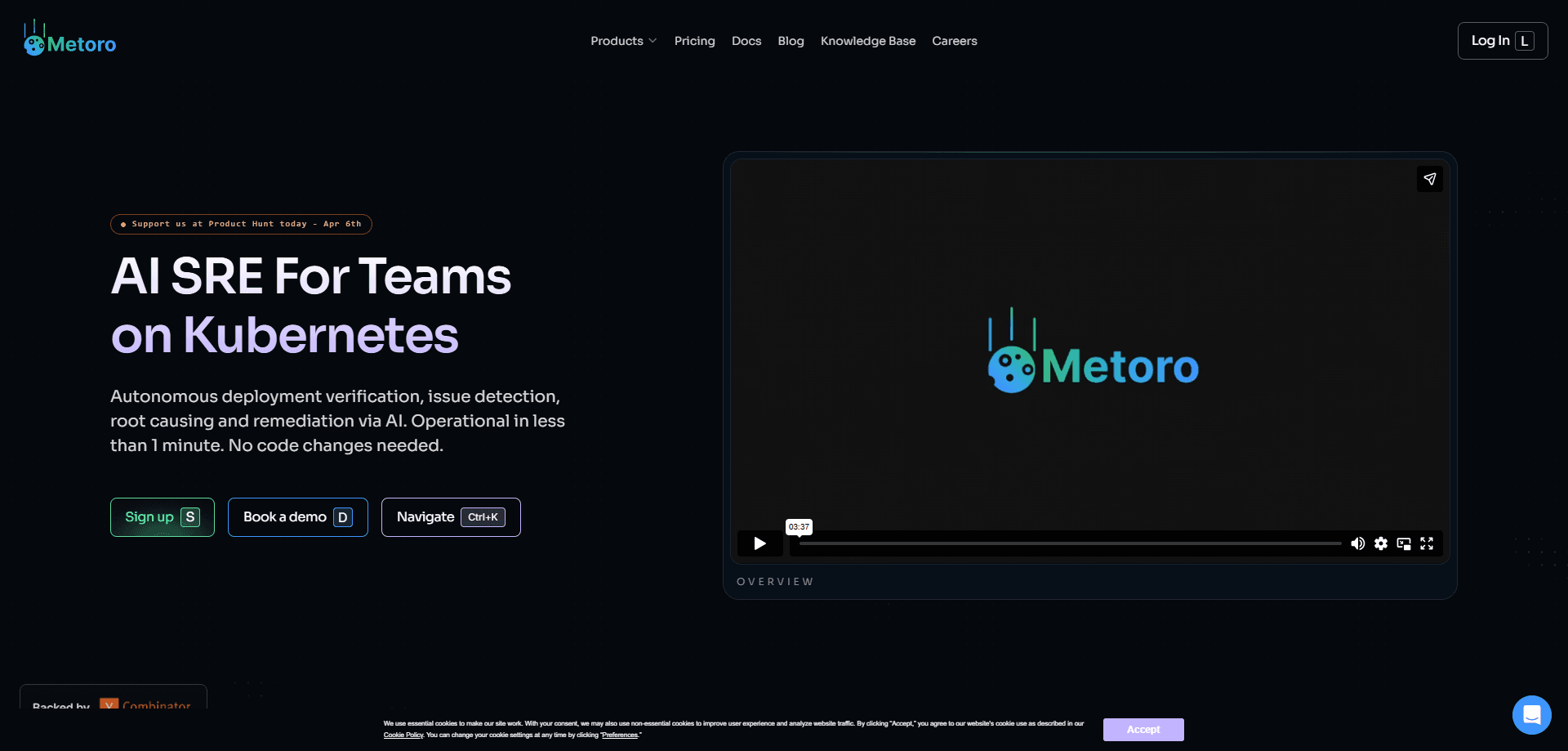
Metoro is an AI SRE platform for Kubernetes teams. It runs one eBPF collector inside your cluster, pulls logs, metrics, traces, profiling, and Kubernetes events into a single store, then points AI agents at that data to detect problems, explain root causes, and draft fix pull requests. You install it with a single Helm command, and there's nothing to change in your application code. Setup is quick. The value shows up later.
About Metoro
What Is Metoro
Metoro is an observability and AI SRE service built specifically for Kubernetes. Instead of asking you to instrument services by hand, it collects telemetry at the kernel level with eBPF, so logs, traces, and metrics show up without SDKs, sidecars, or restarts. The same collection layer feeds AI agents that watch production, investigate alerts, and verify deployments.
That's the whole pitch. Fewer tools, faster answers.
The problem it targets is familiar to anyone running clusters: alerts pile up, the on-call engineer burns hours tracing a regression, and by the time a fix lands the customer has already complained. Metoro tries to close that gap by doing the first pass of investigation for you and handing back a root cause with evidence, plus a pull request you can review. Whether it works depends on how much you trust the agent's read of your system.
The main limitation is scope. Metoro is a Kubernetes product through and through, so if your workloads don't run in a cluster, most of it won't apply. The AI features also depend on usage-based model costs, which the company passes through at cost rather than bundling into a flat fee. You'll want to set spending limits if you're experimenting. That's just sensible.
Getting Started
- Sign up on the Metoro site and pick your cluster's region.
- Run the single Helm install command into your Kubernetes cluster. Metoro deploys as a DaemonSet, one pod per node.
- Wait about five minutes for signals to flow. Collection starts automatically, no code changes needed.
- Connect Slack so alerts, root causes, and fix proposals land where your team already works.
- Set a limit on AI SRE usage to keep model costs predictable, then let the agent monitor production.
Product Information
A quick look at Metoro's pricing, supported platforms, and performance.
Best for
The users, tasks, and scenarios where this tool fits best.
Users
- Platform and SRE teams
- Backend developers on call
- Startups scaling a cluster
Tasks
- Reducing MTTR during incidents
- Verifying deployments
- Cutting observability tool sprawl
Scenarios
- Weekend and after-hours incidents
- Migrating off an expensive monitoring stack
- Tightening release quality
Key features
Zero-Code Kubernetes Telemetry
Metoro's collector runs as a DaemonSet and hooks into the kernel with eBPF. That means you get stdout/stderr logs, RED and USE metrics, distributed traces, and continuous CPU and memory profiling without adding an SDK or restarting a single container. The setup works the same on managed and bare-metal clusters, so a migration between providers doesn't force a new instrumentation project. It's eBPF monitoring at its least painful.
AI Root Cause Analysis
The agent doesn't just flag that request latency jumped. It correlates the anomaly across metrics, logs, traces, and Kubernetes events, then returns a root cause backed by evidence. Each detection is investigated and validated before it reaches your team, which is how Metoro claims to filter the noise that normally triggers a page. That validation step matters. Nobody wants an agent that cries wolf at 3 a.m.
Automated Fix Pull Requests
When the agent pinpoints the offending change, it drafts a pull request with the fix, an RCA summary, telemetry links, and supporting evidence. Engineers stay in control because nothing merges on its own; the workflow is review before merge. This is the automated remediation piece, and for teams tired of hunting the exact commit, it's the part that saves real time.
AI Deployment Verification
Every rollout is tied to its git SHA, author, PR, and the workloads it touched. Metoro compares the new deployment's per-service and per-endpoint behavior against the baseline, and if something regresses it flags it in Slack and pre-drafts a rollback PR. Catching a bad deploy minutes after it ships beats finding out from a customer. Big difference.
AI Alert Investigation
If your team already has alerts from other tools, Metoro can investigate them too. It separates noisy pages from genuine incidents and delivers the likely cause, evidence, and a proposed fix in Slack. You keep your existing alerting and add a layer that explains what the alert actually means.
Unified Query Across Signals
One store holds all seven signal types, and one query language spans them. Anything eBPF can't see is covered through OpenTelemetry and Prometheus compatibility, so your existing exporters still work. Fewer tabs. Less copy-pasting between tools during an incident.
Runtime-to-Code Context
Metoro maps runtime behavior back to the code and configuration that produced it, storing every change to deployments, ConfigMaps, and CRDs with full history. Point-in-time diffs let you see exactly what shifted between a healthy state and a broken one.
Pros and cons
Pros
- Setup is genuinely fast: one Helm install, no code changes, useful telemetry in about five minutes.
- The eBPF approach sidesteps manual instrumentation, which is often the slowest part of adopting observability.
- Detection, root cause, and fix drafts happen in one place rather than across separate tools.
- AI model usage is passed through at cost, and you can set limits or bring your own Bedrock keys.
- Works across major managed Kubernetes platforms and bare metal without rewriting anything.
Cons
- It only makes sense if your workloads run in Kubernetes, so mixed or VM-heavy environments get limited value.
- AI SRE usage is billed separately from the platform subscription, which adds a variable cost you have to monitor.
- The free Hobby tier caps you at 2 nodes and 1 user, so it's really a trial rather than a workable plan for a team.
- The deeper automation, like RBAC, audit logs, and SSO, sits behind higher tiers, which matters for regulated teams.
Frequently asked questions
Metoro is a Kubernetes observability and AI SRE platform. It collects telemetry with eBPF and uses AI agents to detect issues, find root causes, verify deployments, and propose code fixes, all without you changing application code.
Related content
Explore related tools, skills, and articles for Metoro.
Metoro Alternatives
Forefront
Forefront · CodingForefront is a web platform for building with open-source AI. It lets you fine-tune leading open-source language models on your own data, evaluate how they perform, and run them through an API or export them to host yourself. Developers who want the convenience of a closed-source platform but insist on owning their models and data are the target audience here.

Startkit
StartKit.AI · CodingStartkit is a boilerplate for building AI SaaS and AI wrapper products. Think of it as an AI startup boilerplate with the boring parts already wired up: authentication, Stripe and Lemon Squeezy payments, usage limits, transactional email, and an AI API starter that talks to OpenAI, Anthropic, Groq, or Llama. You clone the repo, set your price, and start on the part of your product that people actually pay for. It's Next.js under React and Tailwind, so most of the boilerplate code already feels familiar.
Testim
Tricentis · CodingTestim is an AI-powered test automation platform for building and running end-to-end tests across web, mobile, and Salesforce applications. It leans on machine learning to keep tests stable when an interface changes, so teams spend less time fixing broken selectors. Not bad for an automated testing tool you can start using today. You create tests by recording actions in a browser, then optionally add JavaScript when you need more control. It's a solid pick for busy QA teams.