

MindsDB
MindsDB · Coding
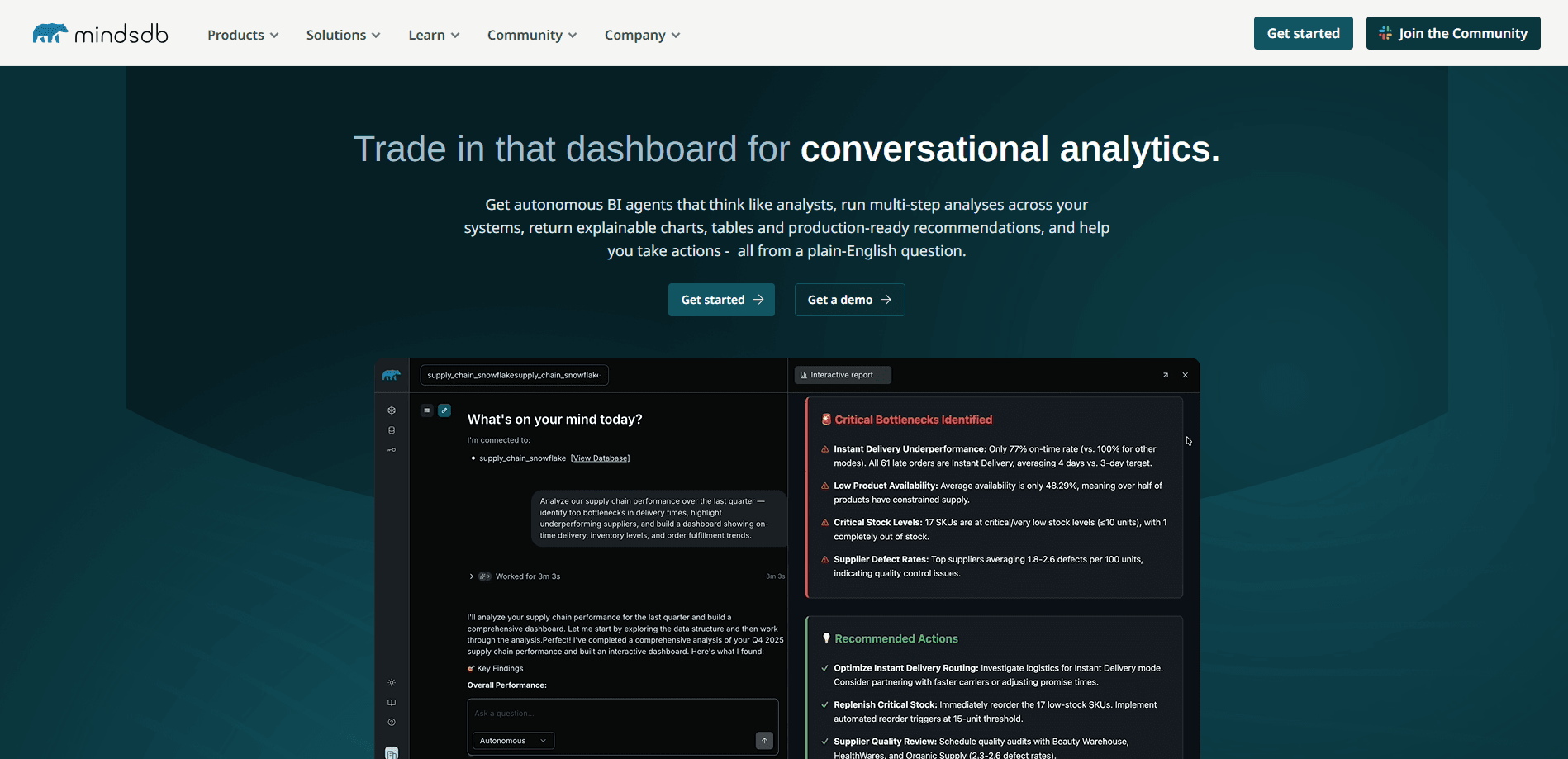
MindsDB is an open-source AI data platform that connects to more than 200 databases, data warehouses, and SaaS apps. It then lets you question all of them in plain English or SQL. Instead of moving your data into a new warehouse, it federates queries across the sources where your data already lives. Teams use it as a SQL query engine for conversational analytics, automated reports, and internal tools that pull live numbers without an ETL pipeline. You'll also see it called MindsDB MindsHub now. Both a self-hosted open-source version and a hosted product exist, and you can start on the hosted one for free.
About MindsDB
What Is MindsDB
MindsDB started as a way to bring machine learning to ordinary databases. The core idea stuck: treat AI models and remote data sources like virtual tables you can join in a single query. You'll write SQL you already know. The platform figures out which system to ask, translates the request, and merges the answer.
That "AI data platform" framing is what separates it from a standard warehouse. Your rows never have to leave Postgres, Stripe, or Gmail for a model to reason over them. The engine handles the federation. You'll get one interface across sources that don't normally talk to each other, so unified data access stops being a separate project.
The trade-off is setup and scope. Self-hosting needs someone comfortable with Docker or Python, and the most useful features live behind a hosted account. Think of it as an open-source AI database with a hosted front end. It's built for people who are fine tinkering with a query console, not for someone who wants a finished dashboard on day one.
Getting Started
- Pick a path: open the hosted web app at mindshub.ai, download the desktop app, or self-host the open-source stack from GitHub.
- Create an account and, for the hosted product, grab an API key from the console so your agents and code can authenticate.
- Connect your data. A secure vault links Postgres, BigQuery, Gmail, Drive, HubSpot, Notion, and Linear, keeping each credential scoped so agents never see the raw key.
- Ask a question in natural language or write SQL directly, and let the platform route it across whichever sources hold the answer.
- Turn the result into something shareable, like a live app or a recurring report, and publish it to a URL your team can open.
Product Information
A quick look at MindsDB's pricing, supported platforms, and performance.
Best for
The users, tasks, and scenarios where this tool fits best.
Users
- Data analysts
- Developers
- Operations and strategy teams
Tasks
- Cross-source reporting
- Ad-hoc business questions
- Automated recurring work
Scenarios
- A revenue team ranking customer feedback themes by real dollar impact.
- Building an internal KPI app that reads live from Postgres and Stripe and lets teammates drill into the numbers.
- Reconciling subscriptions and signups across billing and product data without a one-off script.
Key features
Query 200+ data sources in one place
MindsDB connects to traditional databases like PostgreSQL, MySQL, and MongoDB, SaaS tools like Stripe and Slack, vector stores, and plain files. You query them through one interface. The engine handles cross-source joins. For teams with data scattered across a dozen systems, that removes the usual copy-paste shuffle. No small win.
Natural language and SQL side by side
Ask a question conversationally, or drop into SQL when you want precision. Both route to the same federated layer, so a natural language query and a hand-written one hit the same sources. Analysts who think in SQL stay happy. So do teammates who'd rather just describe the question.
No ETL, no data movement
The platform reads from sources where they live, so you skip building and maintaining extract-transform-load pipelines. Less infrastructure to babysit. Fewer places for data to go stale. The catch is that query speed depends on how fast the underlying source responds.
A secure connection vault
Credentials for each system stay scoped inside a vault rather than being handed to the agent. Agents and apps query through the platform and never see the raw key. That's a meaningful safety detail when you're pointing an automated agent at production data.
Model routing across providers
You can switch between frontier models like Claude, GPT, and Gemini and open models like DeepSeek, Qwen, and Kimi without wiring up a separate key for each provider. One bill covers the usage, and models are billed per million tokens. Benchmarking several models on real prompts stops being a plumbing exercise.
Build and publish internal apps
Beyond querying, you can turn results into shareable web apps, dashboards, and reports that refresh on their own. A finished app gets a live URL the team can open and explore. That's the difference between sending someone a static snapshot and handing them a tool that keeps working.
Open-source core you can self-host
The core is open source and runs on your own machine, a VPC, or a hosted setup. If data residency matters, or you simply want to avoid a vendor dependency, run the whole stack yourself. The price of that freedom is doing your own install and upkeep.
Pros and cons
Pros
- Connects 200+ sources, so you don't have to consolidate everything into one warehouse first.
- Natural language and SQL both work against the same federated data layer.
- No ETL pipelines to build or maintain.
- Free tier and pay-as-you-go credits keep the entry cost low.
- Open-source core lets you self-host if you need to.
Cons
- Self-hosting requires comfort with Docker or Python, so it's not a one-click install.
- Query speed depends on the slowest source in a federated join, which can feel sluggish on large datasets.
- The most useful automation and app features lean on the hosted product and an account.
Frequently asked questions
It's an AI data platform that connects many databases and apps, then answers questions across all of them using natural language or SQL. You don't move the data first, which is what makes conversational analytics possible without a warehouse migration.
Related content
Explore related tools, skills, and articles for MindsDB.
MindsDB Alternatives
Forefront
Forefront · CodingForefront is a web platform for building with open-source AI. It lets you fine-tune leading open-source language models on your own data, evaluate how they perform, and run them through an API or export them to host yourself. Developers who want the convenience of a closed-source platform but insist on owning their models and data are the target audience here.

Startkit
StartKit.AI · CodingStartkit is a boilerplate for building AI SaaS and AI wrapper products. Think of it as an AI startup boilerplate with the boring parts already wired up: authentication, Stripe and Lemon Squeezy payments, usage limits, transactional email, and an AI API starter that talks to OpenAI, Anthropic, Groq, or Llama. You clone the repo, set your price, and start on the part of your product that people actually pay for. It's Next.js under React and Tailwind, so most of the boilerplate code already feels familiar.
Testim
Tricentis · CodingTestim is an AI-powered test automation platform for building and running end-to-end tests across web, mobile, and Salesforce applications. It leans on machine learning to keep tests stable when an interface changes, so teams spend less time fixing broken selectors. Not bad for an automated testing tool you can start using today. You create tests by recording actions in a browser, then optionally add JavaScript when you need more control. It's a solid pick for busy QA teams.