

Minicart
Minicart · Productivity · Marketing · Business
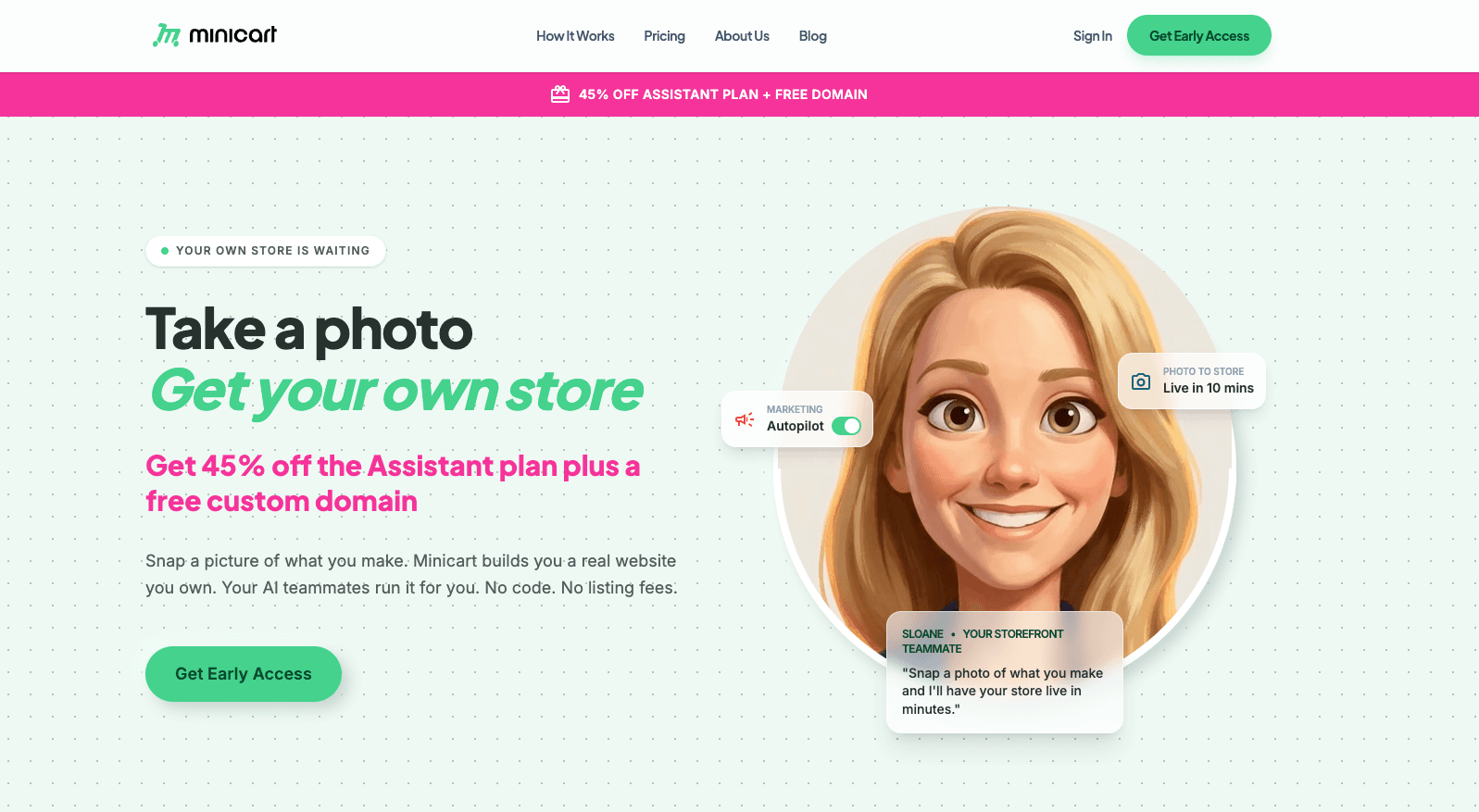
Minicart is an AI ecommerce store builder that turns a photo of what you make into a live online store you own. It works as a chat-driven ecommerce website builder. You snap a picture, answer a few questions, and the platform writes the product listing, builds the site, and puts AI teammates to work running daily tasks. It's aimed at makers who sell on marketplaces like Etsy and want a storefront without listing fees or design work.
About Minicart
What Is Minicart
Minicart is a chat-driven website builder for people who sell physical products. Instead of dragging blocks around a page editor, you talk to it. Snap a photo of a resin coaster, a candle, or a canvas, and the AI generates product images, a listing, and a full site around them. The pitch is simple: you own the domain and the site, and you don't pay a marketplace a cut of every sale.
The bigger idea is that the store keeps running after launch. Minicart assigns "AI teammates" to handle jobs a solo seller usually does alone, like writing listings, planning marketing, and answering common customer questions. If you already sell elsewhere, a one-click import pulls your Etsy or Shopify catalog across, titles, prices, photos, and variations included, so you don't rebuild everything by hand.
The main limits are worth knowing up front. Minicart is built around physical products, so sellers of pure digital goods will find less to use. You also need actual photos to start, and the AI output reflects whatever you give it. Think of the tools as a head start, not a replacement for your own eye on product and pricing. Garbage in, garbage out, as the saying goes. That's still true here, no matter how clever the AI gets.
Getting Started
- Go to minicart.com and sign up for an account.
- Snap a photo of the product you want to sell and upload it.
- Answer a few quick questions about the item and your brand.
- Let Minicart generate your product listing and build the store site.
- Connect your domain, go live, and share the link to start taking orders.
Product Information
A quick look at Minicart's pricing, supported platforms, and performance.
Best for
The users, tasks, and scenarios where this tool fits best.
Users
- Makers and crafters
- Etsy and Shopify sellers
- Solo founders
Tasks
- Turning product photos into listings
- Launching a store website
- Migrating a catalog
- Running day-to-day store ops
Scenarios
- Selling a handmade product line after a weekend of crafting, when you'd rather ship orders than build a website.
- Keeping a marketplace shop open while building an owned store on the side.
- Testing a new product idea fast, with a real storefront instead of a landing page and a spreadsheet.
Key features
Photo to Store
This is the hook. You take one photo of what you make. Minicart turns it into product shots, a listing, and a complete website. The AI generates multiple product photos from that single image, writes the copy, and assembles the pages around it, all from a snapshot you took on your phone in the middle of a workbench covered in the offcuts and sawdust of whatever you were making that afternoon. In practice you can go from "I made this" to "this is for sale" in under ten minutes. Crafter who's never touched a website builder? That gap is the whole point.
AI Teammates That Run the Store
Minicart is a builder and a store that keeps working. It assigns named AI teammates to jobs like storefront management, marketing planning, and customer support. The storefront teammate handles product details and site upkeep, while others draft campaigns and answer routine questions. The value shows up weeks later. You stop being the only thing keeping the shop moving.
One-Click Catalog Import
If you already sell on Etsy or Shopify, you don't start from zero. Paste your shop link and Minicart pulls in every listing with its titles, prices, photos, and variations, then rebuilds them on a site you control. You can leave the marketplace shop running while the new store comes up, so there's no risky cutover where you're dark for a day and lose sales you can't easily recover while buyers look for you elsewhere. Sellers who've spent years building listings elsewhere get to keep that work, which is no small thing when you're moving a catalog of hundreds of items across platforms without wanting to redo any of it by hand.
You Own the Domain and the Customer List
Minicart gives you a real website with your own domain, and no listing fees. That matters because on most marketplaces you're a tenant: they set the rules, hold the customer relationship, and take a cut of each sale. Owning the domain and the buyer contact list changes the economics of a small shop over time. It's the difference between building an asset and renting a shelf. Rent goes up. A shelf you own doesn't disappear when a platform changes its terms.
Chat-Based Setup
There's no drag-and-drop editor to learn. You interact by chatting, answering questions about your product and brand, and the store takes shape from your answers. For users who bounce off traditional website builders, this removes the biggest friction point: figuring out where things go. You describe what you want. Minicart does the configuring. That split is why people who'd never build a site on their own can get one live.
Pros and cons
Pros
- Launch a real store from a single product photo, with no design or coding work.
- No listing fees and your own domain, so you keep the customer relationship and margin.
- One-click import brings an existing Etsy or Shopify catalog across with photos and variations.
- AI teammates keep handling listings, marketing, and support after launch.
- Fast setup makes it easy to test a new product without a big time investment.
Cons
- Focused on physical products, so sellers of digital or service products get less value.
- The AI output depends on the quality of your own photos and product information.
- You're trusting generated listings and marketing copy, which still needs a human eye before publishing.
- Pricing is subscription-only, with no free plan to test the workflow first.
Frequently asked questions
Minicart turns a photo of a product you make into a live online store you own, complete with listings, product images, and a website on your own domain. It also keeps running the store with AI teammates for marketing and support.
Related content
Explore related tools, skills, and articles for Minicart.
Minicart Alternatives

Swms
Swms AI · Writing · Productivity · BusinessSwms is an AI safety compliance tool that turns a plain description of a job into ready-to-use safety documents. Describe your project, trade, and known hazards, and it writes a safe work method statement, job hazard analysis, safe work procedure, RAMS, or safety data sheet in seconds. It also ships with Oscar, a chat assistant that answers workplace safety questions in any language. Teams in construction, mining, transport, and warehousing use it to cut the paperwork that usually eats into a workday.

Wordly AI Translation
Wordly · Voice & Language · ProductivityWordly AI Translation is a real-time AI translation and captioning platform built for meetings, conferences, and events. It delivers live translation, captions, transcripts, and summaries in more than 60 languages, and attendees join by scanning a QR code or opening a link instead of using dedicated headsets. The platform works with Zoom, Microsoft Teams, Google Meet, and Webex, and it's designed for organizations that want multilingual access without hiring human interpreters for every session. Simple as that.

Rows
Rows (Superhuman) · Productivity · BusinessRows is an AI spreadsheet and data analysis tool that imports live data from more than 50 sources, then lets you work with it using plain language instead of SQL queries or nested formulas. You can pull numbers out of PDFs, connect ad platforms, databases, and bank accounts, and ask the AI to build reports, merge datasets, or set up models that recalculate themselves. It runs in the browser, works like a spreadsheet, and now sits under the Superhuman umbrella.