

Miros
Miros · Image · Coding
Miros is an AI product discovery platform for online retailers. It reads shopper behaviour and product images, then personalizes retail product search, browsing, and recommendations.
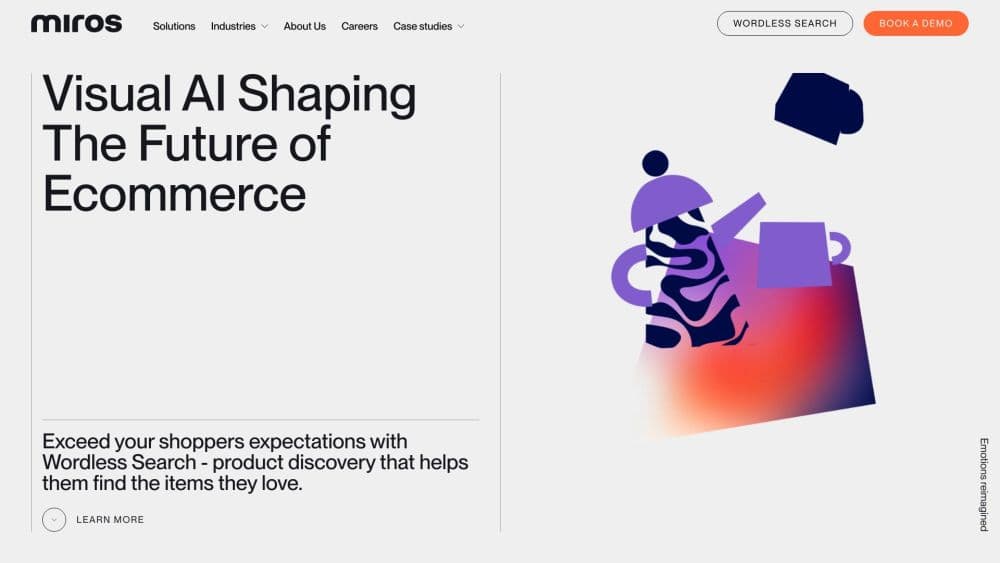
About Miros
What Is Miros
Miros is a product discovery layer that online stores install on top of their existing catalog. The company behind it is based in Tallinn, with offices in London and Lisbon, and its computer vision work came out of research at the University of Tartu in Estonia. Retailers plug it in to show shoppers products they never manage to search for.
The gap in ecommerce search is real. Miros says 85% of fashion shoppers never touch the search bar, and 90% of the searches that do happen are too vague to return a useful result. Text search assumes a shopper can name what they want. Someone hunting for a wedding guest dress in the right shade and neckline usually can't.
Its main limits follow from that focus. Miros is a business tool, sold through a demo and an implementation project rather than a self-serve signup. It shines on visually rich catalogs like apparel, furniture, and home decor, and it does far less for a store whose shoppers already search by exact model number.
Getting Started
- Request a demo through the Miros site, using your own catalog so the trial runs on real products.
- Review the head-to-head test against your current search, then agree on scope: wordless search, recommendations, shop-the-look, or the full set.
- Let Miros index your catalog. The AI extracts visual and semantic attributes from product images, so no manual tagging is required.
- Install the JavaScript widgets or connect through the GraphQL API, on a headless or a traditional storefront.
- Track sessions in your analytics platform and expand to more discovery surfaces once the first one proves out.
Product Information
A quick look at Miros's pricing, supported platforms, and performance.
Best for
The users, tasks, and scenarios where this tool fits best.
Users
- Fashion and apparel retailers
- Furniture and home decor stores
- Growth and ecommerce teams
Tasks
- Raising conversion on browse traffic
- Cutting zero-result searches
- Building personalized recommendations
- Curating collections from demand
- Testing search replacements
Scenarios
- A shopper on a first visit with no account
- A holiday or sale peak
- Cross-category outfit discovery
- A marketplace with a very large catalog
Key features
Wordless Search
Shoppers get relevant products by browsing, with no query and no filters. Miros builds a real-time preference profile from scroll speed, clicks, dwell time, and the items they skip. The vendor reports adoption rates of 20% to 55% across deployments, which matters because that covers the share of visitors who never open a search box.
Discovery Bar
The Discovery Bar upgrades a standard search box rather than replacing it. Shoppers type in natural language across 48 languages, and each query is merged with their current preference profile. Miros says this removes most "0 results found" dead ends, a common reason shoppers leave.
Inline Recommendations
Most AI product recommendations rely on purchase history, which a new visitor doesn't have. Miros combines visual similarity between products with the shopper's live profile, so suggestions stay personal from the first click. Retailers using it report higher average order value and more clicks through to checkout.
Shop the Look
Shop the Look builds outfits and room sets from items in different categories, matched to the shopper's evolving taste. Unlike static "complete the look" widgets, the compositions update as the profile changes. This is the feature that most directly serves stores selling outfits rather than single items.
Find by Image
Shoppers upload a photo, and Miros returns visually similar products. Results are ranked by behaviour as well as pixel similarity, so two people uploading the same image can see different ordering. That combination is what separates it from plain image matching.
Style Collections
Merchandising teams normally build collections by hand and refresh them on a schedule. Style Collections are generated from signal data, so they track demand as it shifts. The catalogue teams spend less time curating and more assets stay aligned with what shoppers want.
Pros and cons
Pros
- Works on visual catalogues where text search fails, without any manual tagging of product images.
- Integrates in about two weeks on the retailer side, and the vendor estimates under one engineer week of work.
- Runs alongside an existing search engine such as Algolia or Elasticsearch rather than forcing a full replacement.
- Outcomes are measured in randomised A/B splits, so the lift can be checked against a retailer's own traffic.
- Supports very large catalogs, with response times in the 50 to 300 millisecond range.
Cons
- No public pricing. Retailers must book a demo and a sales conversation before they know the cost.
- Built for businesses, so individual developers and small shops can't sign up and try it on their own.
- Gains depend on visual, browse-driven catalogs. A store selling parts by model number sees much less benefit.
- Preference profiles need interaction data, so the first moments of a high-traffic campaign won't be fully personalized.
Frequently asked questions
Miros reads how shoppers behave on a store site and uses that to reorder products across search, browse, and recommendations. Instead of asking people to describe what they want, it guesses from what they click, how long they look, and what they skip.
Related content
Explore related tools, skills, and articles for Miros.
Miros Alternatives

Tractionwave
TractionWave · Image · MarketingTractionWave is an AI attention heatmap tool for static ads. Upload a PNG or JPG and it returns predicted attention, ranked hotspots, and fixes before you spend budget.

Imejis.io
Imejis.io · Image · MarketingImejis.io is an AI design studio for agents and marketing teams. Describe an image in plain words, and it writes the copy, builds the layout, reflows it to every size, then exports a finished file.

Layoutr
Van Dijk Ontwikkeling · Image · China AILayoutr is a browser floor plan tool that scales your own plan, places furniture at true size, shows the room in 3D and renders it with AI.