

Mnexium AI
Mnexium · Chatbot
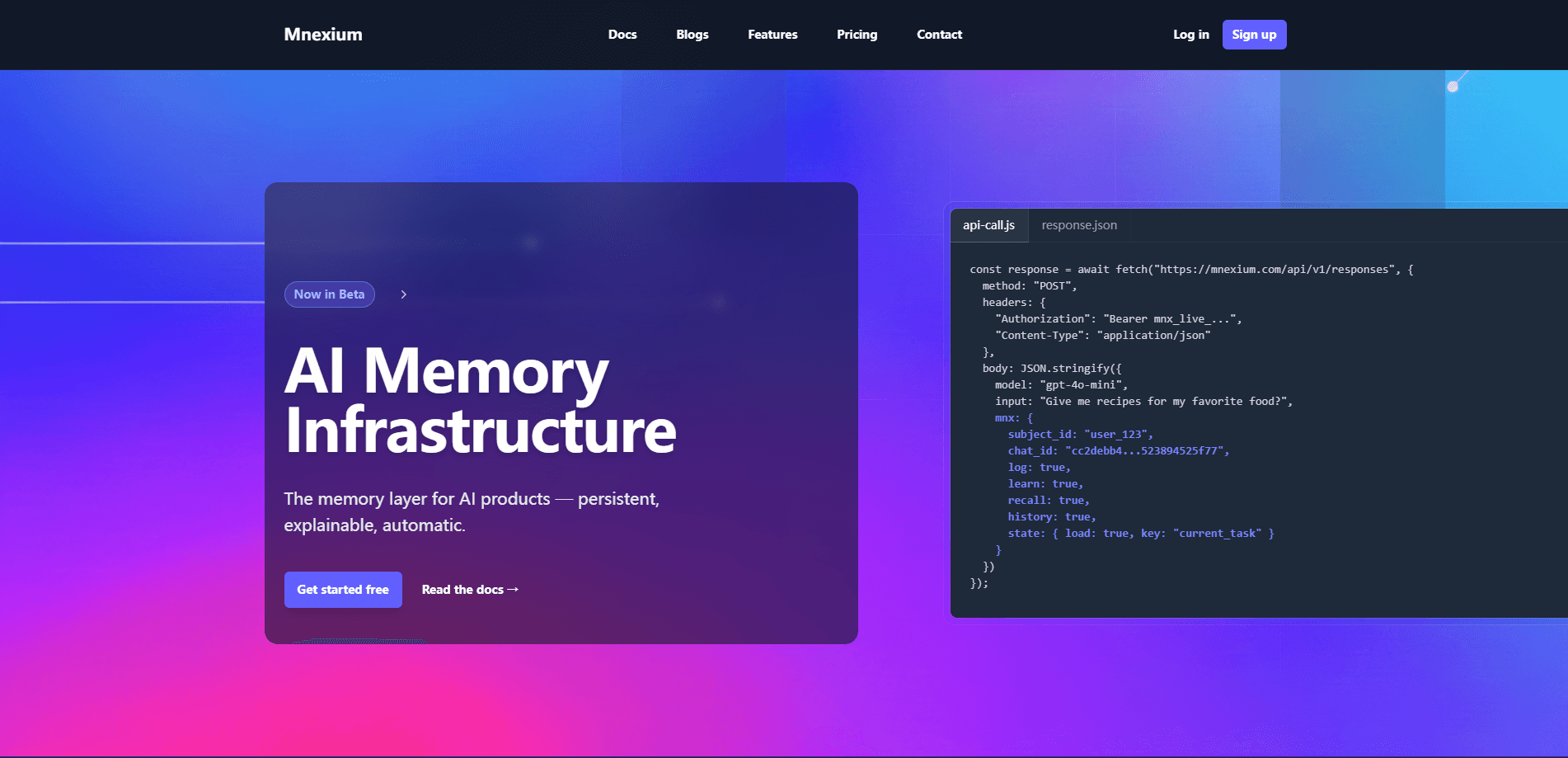
Mnexium AI is an AI memory infrastructure platform that adds persistent memory to AI apps and agents with about two lines of code. Think of it as an AI memory API. It sits between your application and your model, then injects chat history, long-term memory for AI agents, and structured context into every request. It works with OpenAI, Anthropic, and Gemini models through one endpoint.
About Mnexium AI
What Is Mnexium AI
Mnexium AI is a memory layer for LLM apps and agents. Most AI products forget everything once a session ends. Every new conversation starts from zero. Mnexium fixes that by storing what an agent learns about a user and feeding it back on later requests, without you building your own database and orchestration stack. It's persistent memory for LLM apps, packaged as a service.
The platform splits context into four systems: chat history for the current conversation, agent memory for long-term facts about a user, agent state for multi-step task progress, and records for schema-backed entities like tickets or accounts. You enable each one with a flag such as history: true or recall: true, and Mnexium assembles the final prompt for the model.
The main limit is that Mnexium is developer-facing. No drag-and-drop builder. No chat UI for non-coders. You need to be comfortable editing code and wiring up an API key, and pricing scales with usage, which can push costs up on high-volume apps.
Getting Started
- Sign up on the Mnexium site, or start from the free tier that requires no signup for basic API testing.
- Install a client library with
npm install @mnexium/sdkfor Node.js orpip install mnexiumfor Python. - Initialize the client and configure learning, recall, and history options once at the client level.
- Create a subject for each user, then call
process()on your requests so Mnexium assembles memory and context automatically. - Open the logs and recall events to check exactly what memory was stored and injected for a given request.
Product Information
A quick look at Mnexium AI's pricing, supported platforms, and performance.
Best for
The users, tasks, and scenarios where this tool fits best.
Users
- Indie developers building their first AI assistant
- Small product teams running production apps
- Engineering leads on high-traffic platforms
Tasks
- Giving a chatbot a memory of past conversations
- Resuming multi-step agent workflows
- Managing structured data inside an AI app
Scenarios
- A support bot that remembers a customer's prior tickets
- A coding assistant that recalls a developer's stack and preferences
- A switched model stack
Key features
Persistent Memory in Two Lines of Code
Mnexium is built to drop into an existing app instead of replacing it. You add an mnx object to your cURL or HTTP calls, or use the official SDKs for Node.js and Python. That's it. That small change turns on long-term memory, so your LLM app remembers users across sessions without a custom vector database.
Four Systems for Context Management
The platform separates context into chat history, agent memory, agent state, and records. Each runs independently. It's a context management API where you can keep session-level continuity without touching long-term memory, or store task state without polluting user facts. Keeping them apart is what lets the same API serve both personalized chat and deterministic data workflows.
Model Agnostic by Design
Mnexium routes to OpenAI's Chat Completions and Responses APIs, Anthropic, and Google's Gemini without locking you to one provider. Memories and records stay accessible across providers when you keep the same subject_id. Switch models whenever you like. Your agent's memory doesn't reset.
Automatic Fact and Record Extraction
With learn: true set, the platform pulls facts and preferences out of conversations on its own. Records go further: set records.learn to auto or force and Mnexium extracts structured entities from the dialogue. That means you get clean data without writing extraction prompts yourself.
Deterministic Prompt Assembly
Every request goes through a fixed assembly order: system prompt, agent state, memories, records, chat history, then your user message. Because the order is predictable, you can reason about exactly what the model sees. Logs, traces, and recall events show what was injected and why, which makes debugging far easier than guessing.
Built-In Observability
Mnexium exposes logs and recall events for every step. You can inspect which memories were retrieved, which records were updated, and what prompt the model received. For teams shipping an AI memory feature, that visibility is the difference between shipping and shipping blind.
Pros and cons
Pros
- Persistent memory arrives with a small code change rather than a full rebuild.
- One API spans OpenAI, Anthropic, and Gemini, so model swaps don't reset memory.
- The free tier is genuinely usable, with no signup needed for basic API access.
- Records and agent state cover structured workflows that pure vector memory can't.
- Logs and recall events make it clear what the model actually saw.
Cons
- No visual builder, so non-coders can't use it without a developer on hand.
- Costs scale with requests and memory operations, which adds up on large apps.
- Tying product memory to a third-party API means an extra dependency in your stack.
Frequently asked questions
Mnexium adds memory and context to AI apps and agents. Your app sends a normal API request with a few mnx options, and Mnexium retrieves history, long-term memory, agent state, and records before building an enriched prompt for the model.
Related content
Explore related tools, skills, and articles for Mnexium AI.
Mnexium AI Alternatives

Knocket
Knocket (Tencent RTC team) · Productivity · Business · ChatbotKnocket is a free live chat and contact page tool that lets visitors message you from your website, app, or a shareable link, with every reply handled from Telegram or one inbox.
Agibot
Agibot · Productivity · AI Assistant · ChatbotAgibot is a personal AI agent for Mac that keeps running after you close the window, runs routines on a schedule, and works from Telegram or Slack with your own API keys.

Melete
Melete · Productivity · AI Assistant · ChatbotMelete is an AI workspace for teams where agents research, draft, and act in Slack, Notion, Linear, and GitHub. Shared memory and approval gates keep people in control.