

Model Diplomat
Model Diplomat · Leaning
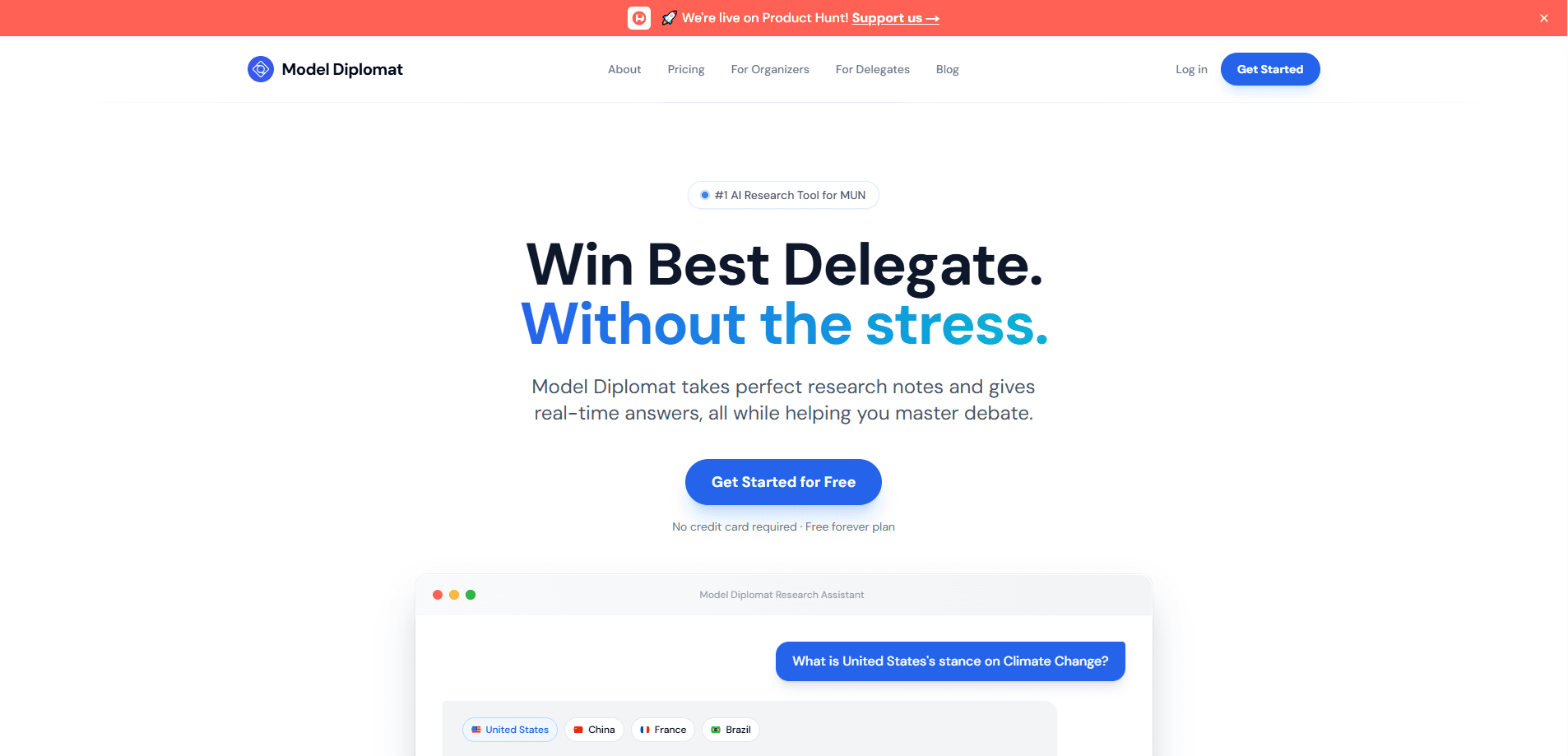
Model Diplomat is an AI research tool built specifically for Model UN, debate, and politics. You ask a question about a country, committee, or crisis, and it answers with primary source citations you can check: UN documents, treaty text, and foreign ministry statements. It doubles as a position paper generator, drafting memos and speeches from that same research. A free plan covers everyday prep with a daily search cap, while Pro removes the cap and adds document drafting, deep research, and file analysis. Over 100,000 students, delegates, and researchers use it.
About Model Diplomat
What Is Model Diplomat
Model Diplomat is an AI research platform for anyone working through political or diplomatic questions, from first-time MUN delegates to graduate students and think-tank analysts. It picks up where general AI tools fall short. Ask a chatbot for a country's position on a treaty and it may simply invent one. Sound familiar? Model Diplomat holds a firm sourcing rule instead: every answer cites the primary record, so you can trace where a claim came from before you put it in a speech.
The product centers on research, but it does more than look things up. You can research any country, committee, or crisis, then turn that work into position papers, memos, and opening speeches. Pro adds deep research, file analysis, automations, and a memory that carries context across sessions. You still do the thinking. The company's stated stance is that the tool speeds up your research without doing it for you.
The honest limits matter here. General AI tools fabricate UN resolutions and country positions, and Model Diplomat's whole pitch is that it doesn't. Still, no AI research tool is right 100% of the time. The company itself says it gives a straight "the record doesn't say" when a source is silent, and you should treat citations as a starting point, not a finished argument. It's also web-based, with a desktop assistant that's still in beta and only open to waitlist seats.
Getting Started
- Go to modeldiplomat.com and start on the free plan, which needs no card to try.
- Ask your first research question about a country, committee, or crisis and read the cited sources underneath the answer.
- Build a research thread with follow-up questions so the context carries forward while you narrow your angle.
- Move to drafting when you have enough material, turning your research into a position paper, memo, or speech.
- Upgrade to Pro if the daily cap gets in the way or you need deep research and file analysis before a conference.
Product Information
A quick look at Model Diplomat's pricing, supported platforms, and performance.
Best for
The users, tasks, and scenarios where this tool fits best.
Users
- Model UN delegates
- High school and college students
- Debate competitors
- Chairs and conference organizers
Tasks
- Drafting position papers
- Writing opening speeches and memos
- Deep research on a crisis
- Checking a claim fast
- Analyzing a document you upload
Scenarios
- The night before a conference
- Practicing for an unfamiliar committee
- Building a debate case
- Studying politics and global affairs
- Fact-checking a rival's argument
Key features
Primary source citations on every answer
Every response ties its claims back to a document you can open: UN resolutions, treaty text, foreign ministry releases, and voting histories. That's the core of the product. Instead of trusting the AI, you can click through and judge the source yourself. If the record is silent on a question, the tool says so. It doesn't guess.
Country, committee, and crisis research
You can research any country, committee, or crisis, not just the handful of topics a starter database covers. Ask about a specific clause, a member state's voting pattern, or how a crisis has been handled, and the answer comes with the record attached. It's built for the kind of narrow, specific question that a general chatbot tends to fumble.
Position papers, memos, and speeches
Model Diplomat drafts the written work that MUN and debate actually run on: position papers, memos, and opening speeches. The drafts pull from your research, so the claims line up with the sources you've already gathered. You still shape the argument and the voice, but you're editing a draft instead of starting from nothing.
Deep research
On Pro, deep research goes past a single search result. It works several primary documents into a fuller picture. It's aimed at the hard questions, the ones where one source isn't enough and you need to see how several documents line up. Think of it as the step between a quick lookup and a finished case. Big difference.
File analysis
Pro also lets you upload a file and have it analyzed. You can hand it a resolution, a report, or a set of notes and get back what matters inside, which saves reading a dense document line by line. Useful when a conference packet or a course reading is longer than your evening. What a pain otherwise.
Research memory
It remembers where you've been. Research memory carries context across sessions, so the tenth question in a thread lands in the same headspace as the first. You don't re-explain your country, committee, and angle every time you come back. That saves real time.
Automations and morning briefings
Pro adds automations and custom morning briefings. You set what you want tracked and get it ready when you start your day, so the day's developments on your topic are waiting instead of needing to be hunted down. It's a small feature. It adds up over a long prep cycle.
Free courses, briefings, and reference data
Beyond the AI, there's a free layer: Learn courses and lessons, daily Discover briefings and stories, plus country profiles, treaties, and voting data. A glossary and tutorials round it out. The reference material is free for everyone. Most first-timers lean on it before they hit the search cap.
Pros and cons
Pros
- Every answer cites verifiable primary sources, so claims can be checked rather than taken on trust.
- Research is built for politics and diplomacy specifically, which beats general chatbots on country positions and treaty questions.
- Free plan covers everyday prep with 200 searches on day one and 50 a day afterward, no card needed to start.
- Pro adds document drafting, deep research, file analysis, and memory, which cover a full conference workflow.
- Free reference material, including courses, country profiles, treaties, and voting data, is useful even without a paid plan.
Cons
- The free plan's 50-search daily cap runs out fast during heavy conference prep, and the cap doesn't stack or roll over.
- Pro requires a card at checkout before the trial, which is a hurdle for students without one.
- The desktop assistant is still in private beta and only opens when a waitlist seat is ready, so you can't count on it yet.
- It's a research and drafting aid, not a fact-checker. Citations point to real documents, but you still have to judge whether a source supports the argument you're making.
Frequently asked questions
It's an AI research engine for Model UN, debate, and politics. You use it to research a country or committee, then draft position papers, memos, and speeches from sources you can verify. It's aimed at anyone doing political research who needs the claims to hold up.
Related content
Explore related tools, skills, and articles for Model Diplomat.
Model Diplomat Alternatives
Coddy
Coddy · Coding · LeaningCoddy is a gamified platform to learn to code through short interactive lessons in 20+ languages, with a browser editor, an AI tutor and free certificates.

Marv
Cameron (independent developer) · Coding · Productivity · LeaningMarv is an AI cursor companion for Windows and Mac. It sees your screen, answers out loud, and draws arrows and highlights that show you the next click.

Teachoo
iAsk AI · Leaning · ChatbotTeachoo is a free AI homework helper that walks students through math, science, writing and coding problems one step at a time, with photo input, hints and flashcards.