

Mycel
Mycel · Productivity · Business
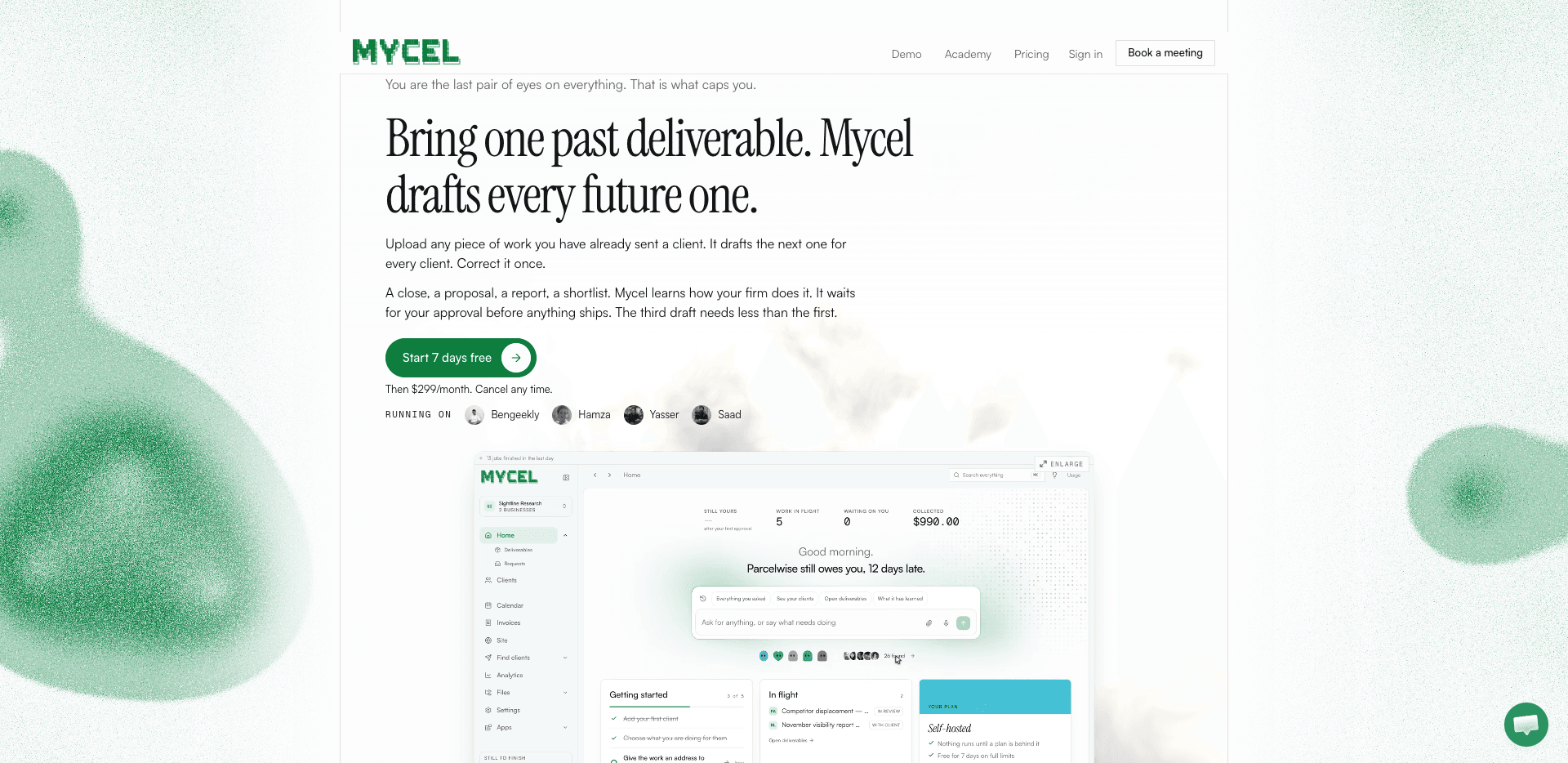
Mycel is an AI back office for service businesses that still run on one person's desk. You upload a single deliverable you already sent a client, describe the service you sell, and it drafts the next ones for every client in your own style. Nothing goes out until you approve it. It's built for agencies, bookkeepers, recruiters, and other small firms where the founder is the last pair of eyes on everything, and it starts at $299 a month or self-hosts for free.
About Mycel
What Is Mycel
Mycel is a scheduling layer for the work that keeps coming back. You give it one past deliverable and it learns how your firm writes that kind of document, then produces drafts for every client on the list. A report, a proposal, a shortlist, a close: the format stays yours because it learned from your own file.
The pitch is aimed at a specific kind of bottleneck. In a lot of small service firms, every deliverable waits on one person, and that person is the founder. Hiring costs money and ramp time, and an offshore contractor still needs your review on each piece. Mycel's answer is narrower, and it says so: it doesn't replace you, it makes you the only person who needs to look at the draft. The corrections you make get kept, so the third draft needs less than the first.
The honest limits matter here. It's not a chatbot you drop a question into, and the site is upfront that it works best when you have a repeatable deliverable to show it. It works best with a repeatable deliverable. Nothing ships without you. You also stay in the loop by design. Approval is on until you decide otherwise, and one person's review is still the last step. The company hosts the AI on its own plan, and the source is open under Apache-2.0 if you would rather run it yourself.
Getting Started
- Start the seven-day free trial at mycelai.dev, or run the self-host script if you want the code on your own servers.
- Describe the service you sell, in the words you would use with a new hire.
- Upload one past deliverable you have already sent a client.
- Give it this week's work so it can draft against the current list.
- Review each draft, correct what needs fixing, and approve it before it ships.
Product Information
A quick look at Mycel's pricing, supported platforms, and performance.
Best for
The users, tasks, and scenarios where this tool fits best.
Users
- Solo founders and owners of small service firms who are the last pair of eyes on every client deliverable.
- Agencies and consultancies with two to ten people who have more client demand than hours.
- Bookkeepers, recruiters, and GEO or legal shops that send the same kind of document every month.
Tasks
- Drafting recurring client reports, closes, and packs in your own house style, which is most of agency back office automation.
- Writing first passes of proposals, closes, and shortlists for several clients at once.
- Chasing late invoices and accounts receivable without asking twice.
Scenarios
- A founder who can't take a week off because every draft waits for a free afternoon.
- A firm deciding between hiring a junior account manager, offshoring more work, or automating the first draft.
- A team that wants a client portal where clients sign in under the firm's name, not the vendor's.
Key features
Drafts From One Past Deliverable
The whole system starts with a single file. Upload a deliverable you have already sent, describe the service, and Mycel learns its shape. Structure, headings, tone. Then it drafts the next one for each client on your list. The output begins close to how your firm actually works, instead of a generic template.
Approval Before Anything Ships
Nothing reaches a client without your sign-off. Mycel waits for approval on every draft, and that gate stays on until you turn it down yourself. For firms that carry the risk on the work, this is the difference between a tool that helps and a tool that creates a new thing to worry about.
Corrections That Stick
Fix a draft, and the next one already carries that fix. That's the loop the product is built around: correct it once, and the third draft needs less than the first. Over time the corrections are the setup, so the first week is mostly you teaching it your standards rather than writing from scratch.
A Client Portal Under Your Brand
Clients sign in to your name, not Mycel's. Each client has its own session and sign-in, so logins stay apart, and the work they open is the page you actually produced. If you serve several businesses, that separation is the point, because it keeps one client's material out of another's view.
A Chart of What No Longer Needs You
The product puts a number on the thing you care about. How much of the work no longer needs your review? It tracks that across client work rather than asking you to trust a claim, which matters if you would rather measure how to automate client reporting than read another promise about it. For an owner who measures the week in hours, that's a more useful signal than a feature list.
Runs the Same Loop Across Trades
Mycel is built for service businesses in general, not one niche. Bookkeeping, recruiting, GEO, legal, web, ops, and contract desks all run the same loop on it. The trades change. The judgment stays yours. You aren't locked into a canned menu of services, because you describe the piece you send and that becomes the job.
Self-Hosting and Open Source
If you would rather not hand your client data to a hosted service, you can run the same code yourself. The license is Apache-2.0, you bring your own model key, and nothing is metered. Setup is a single command on macOS, Linux, or Windows. That option is rare for a tool with a client portal attached.
Pros and cons
Pros
- One past deliverable is enough to start, so setup takes an afternoon, not a project.
- The approval gate means you keep control of what a client sees.
- Corrections carry forward, so recurring work gets lighter over time.
- Self-hosting under Apache-2.0 keeps client data on your own servers if you want that.
- A client portal makes a small firm look bigger. Good news.
Cons
- Starter is $299 a month, which is real money for a one-person shop and only pays off if you bill enough recurring work.
- It works best with a repeatable deliverable; if every job is bespoke, there is less for it to learn.
- The self-hosted route asks for technical comfort, since you supply and pay for your own model key.
- Monthly job limits on Starter and Growth mean heavy months can wait for the next cycle.
Frequently asked questions
It drafts recurring client work for a service firm. You upload one past deliverable and describe your service, and it produces the next drafts for each client in your own style, then waits for your approval before anything is sent.
Related content
Explore related tools, skills, and articles for Mycel.
Mycel Alternatives

Swms
Swms AI · Writing · Productivity · BusinessSwms is an AI safety compliance tool that turns a plain description of a job into ready-to-use safety documents. Describe your project, trade, and known hazards, and it writes a safe work method statement, job hazard analysis, safe work procedure, RAMS, or safety data sheet in seconds. It also ships with Oscar, a chat assistant that answers workplace safety questions in any language. Teams in construction, mining, transport, and warehousing use it to cut the paperwork that usually eats into a workday.

Wordly AI Translation
Wordly · Voice & Language · ProductivityWordly AI Translation is a real-time AI translation and captioning platform built for meetings, conferences, and events. It delivers live translation, captions, transcripts, and summaries in more than 60 languages, and attendees join by scanning a QR code or opening a link instead of using dedicated headsets. The platform works with Zoom, Microsoft Teams, Google Meet, and Webex, and it's designed for organizations that want multilingual access without hiring human interpreters for every session. Simple as that.

Rows
Rows (Superhuman) · Productivity · BusinessRows is an AI spreadsheet and data analysis tool that imports live data from more than 50 sources, then lets you work with it using plain language instead of SQL queries or nested formulas. You can pull numbers out of PDFs, connect ad platforms, databases, and bank accounts, and ask the AI to build reports, merge datasets, or set up models that recalculate themselves. It runs in the browser, works like a spreadsheet, and now sits under the Superhuman umbrella.