

Negotyum
Negotyum · Productivity · Business
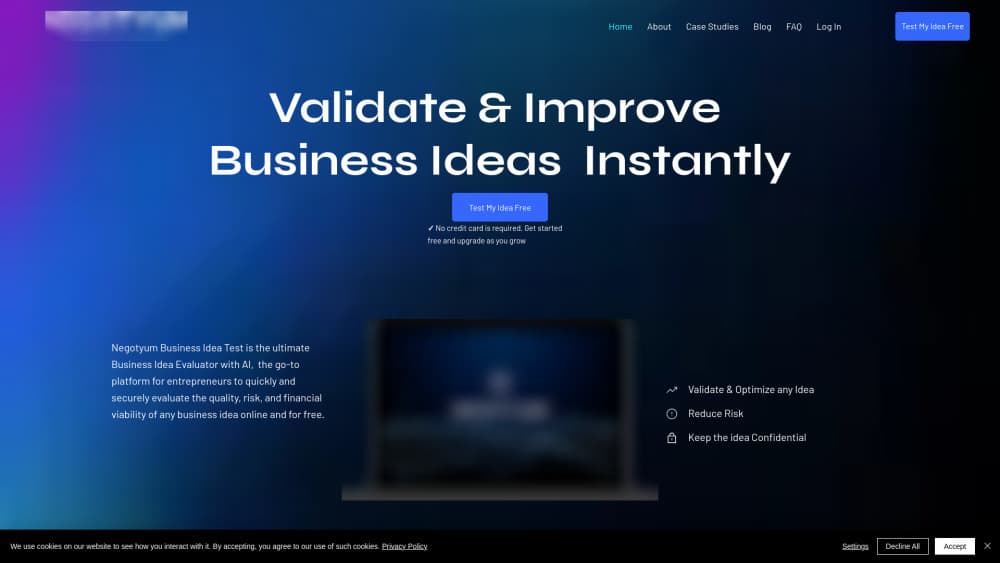
Negotyum was an AI business idea testing platform that helped founders and early teams evaluate a concept and measure risk before launching it.
About Negotyum
What Is Negotyum
Negotyum was a business idea testing platform built for founders who wanted evidence before they committed time and money. Instead of guessing whether a concept had legs, you submitted your idea and the system returned a startup idea evaluation of its commercial risk. The pitch was simple: test first, spend later.
The company ran from 2021 to 2025. Over that stretch it says it helped more than 4,000 entrepreneurs measure and reduce risk before launching. That number reflects a specific audience. Mostly early-stage founders, mostly small teams without a research budget of their own.
The important caveat: Negotyum no longer operates. In 2025 its evaluation algorithm and codebase were acquired by a third party and the service was closed. The domain and the registered "Negotyum" trademark stayed with the original owners, but the platform isn't available. Nobody can sign up today. So why read on? Because the idea is still worth understanding. If you need idea validation right now, you'll have to look at platforms that are still running.
Getting Started
Negotyum is offline, so the old signup flow no longer works. Gone. Here's how it worked while it was live, which is what the Getting Started path used to look like.
- Create an account on the Negotyum site to access the evaluation workspace.
- Describe your business idea, including the target customer and the problem it solves.
- Submit the concept for analysis so the platform could run its evaluation algorithm.
- Review the results, which framed your idea's risk and where it looked weakest.
- Use the feedback to adjust the concept before spending on a build.
Product Information
A quick look at Negotyum's pricing, supported platforms, and performance.
Best for
The users, tasks, and scenarios where this tool fits best.
Users
- Early-stage founders
- Solo entrepreneurs
- Small startup teams
Tasks
- Business idea validation
- Risk assessment
- Pre-launch screening
Scenarios
- Deciding whether to pursue a new venture
- Comparing early concepts
- Limited research budget
Key features
AI Idea Evaluation
The core of Negotyum was an evaluation algorithm that scored a submitted business idea and returned a read on its likely risk. You gave it a concept, it gave you a structured judgment you could act on. What made it notable was that the judgment came back framed as commercial risk rather than a simple thumbs up or thumbs down, which is a harder thing to fake and a more useful thing to receive when you're deciding whether to keep going or walk away from a concept you've already grown attached to. That algorithm was the asset a third party acquired in 2025. What they do with it now isn't public, and the original team has said nothing about whether the same evaluation logic will resurface in some new product under a different name, so anyone hoping for a quiet reboot is working from hope rather than evidence.
Confidential Submission
The platform was positioned around confidential idea testing, so founders didn't have to expose a concept publicly to get feedback. For anyone worried about someone else running with their idea before they'd had a chance to build it, that single promise was often the whole reason to open the site at all, especially given how quickly a good concept travels once it's posted in the wrong forum or shared with the wrong group of people.
Risk Measurement
Rather than a simple pass or fail, Negotyum framed results around risk, which pushed you to ask where an idea was weakest. The company's own framing was about measuring and reducing risk before launch, not promising success, and that distinction is worth holding onto if you're comparing it against tools that advertise guaranteed winners. Most of those tools are selling a feeling, not an analysis, and the difference shows up the moment you ask what their scoring is actually based on.
Founder-Focused Reporting
Output was built for people who aren't analysts. The point was a usable verdict on your idea, not a wall of raw data you'd have to interpret yourself. Simple as that.
Early-Stage Positioning
Negotyum aimed at the pre-build stage, the window where a bad idea is cheap to drop and expensive to discover later. That timing is the reason the tool made sense to founders in the first place, and it's also the reason its closure in 2025 left a gap that nothing else has obviously filled for teams working at the very earliest stage of a new venture.
Pros and cons
Pros
- Focused on the pre-build stage, where changing direction costs the least.
- Confidential testing meant founders didn't have to expose an idea publicly.
- Framed results around risk, which is far more useful than a vague score.
- Reported use by more than 4,000 entrepreneurs between 2021 and 2025.
Cons
- It no longer operates, so the platform can't be used today.
- The algorithm and codebase were sold in 2025 with no public successor product.
- No published API, and pricing details are no longer available.
- Early founders lost a tool mid-flight, so any workflow built on it had to move elsewhere.
Frequently asked questions
No. The service shut down in 2025 after its evaluation algorithm and codebase were acquired by a third party. You can't sign up, submit ideas, or buy a plan anymore.
Related content
Explore related tools, skills, and articles for Negotyum.
Negotyum Alternatives

Swms
Swms AI · Writing · Productivity · BusinessSwms is an AI safety compliance tool that turns a plain description of a job into ready-to-use safety documents. Describe your project, trade, and known hazards, and it writes a safe work method statement, job hazard analysis, safe work procedure, RAMS, or safety data sheet in seconds. It also ships with Oscar, a chat assistant that answers workplace safety questions in any language. Teams in construction, mining, transport, and warehousing use it to cut the paperwork that usually eats into a workday.

Wordly AI Translation
Wordly · Voice & Language · ProductivityWordly AI Translation is a real-time AI translation and captioning platform built for meetings, conferences, and events. It delivers live translation, captions, transcripts, and summaries in more than 60 languages, and attendees join by scanning a QR code or opening a link instead of using dedicated headsets. The platform works with Zoom, Microsoft Teams, Google Meet, and Webex, and it's designed for organizations that want multilingual access without hiring human interpreters for every session. Simple as that.

Rows
Rows (Superhuman) · Productivity · BusinessRows is an AI spreadsheet and data analysis tool that imports live data from more than 50 sources, then lets you work with it using plain language instead of SQL queries or nested formulas. You can pull numbers out of PDFs, connect ad platforms, databases, and bank accounts, and ask the AI to build reports, merge datasets, or set up models that recalculate themselves. It runs in the browser, works like a spreadsheet, and now sits under the Superhuman umbrella.