

Notra
Notra · Coding · Productivity
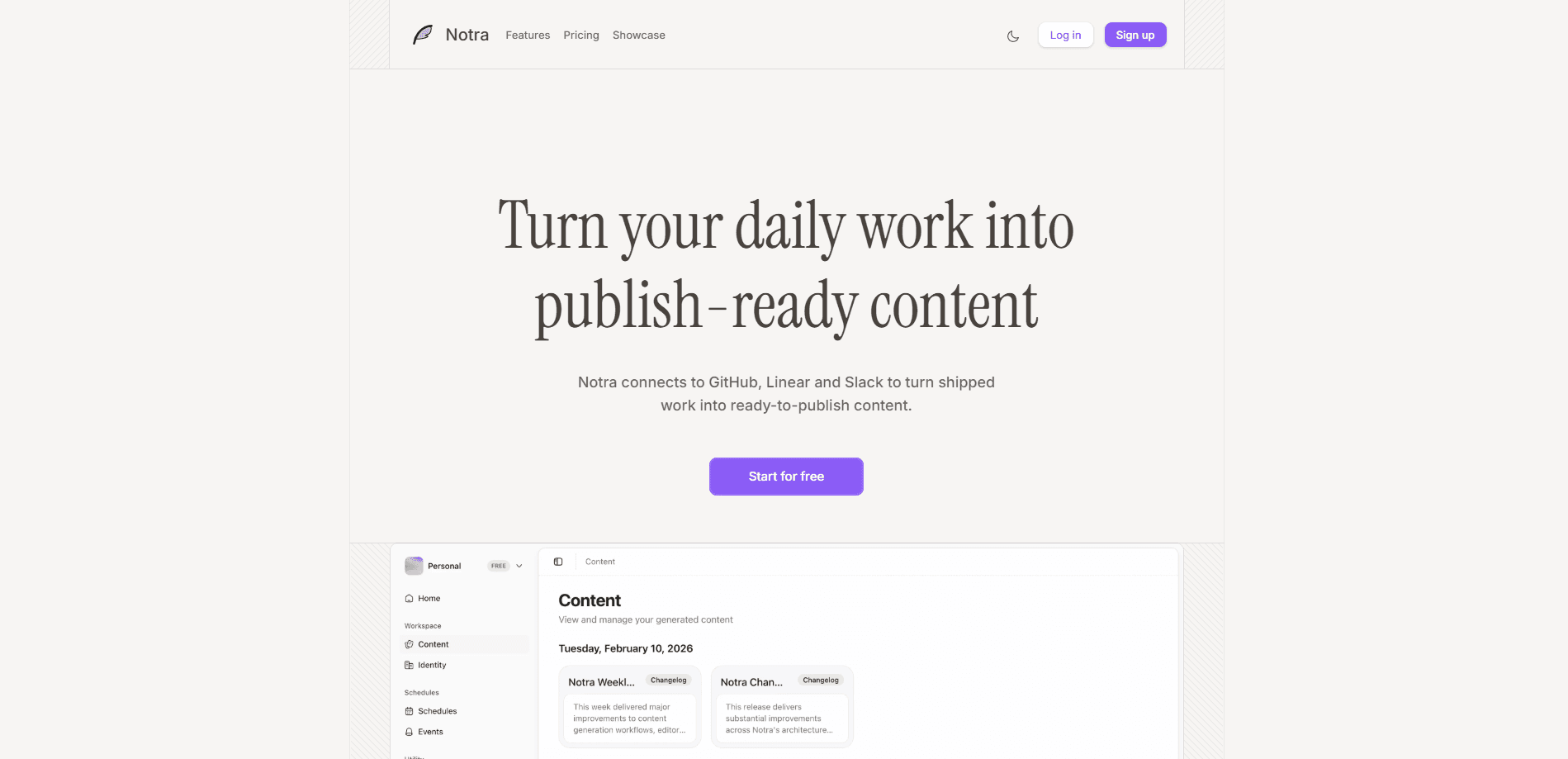
Notra is a generative engine optimization platform that asks ChatGPT, Claude, Gemini and Perplexity the questions your buyers type, then shows whether your brand comes up in the answer. Think of it as brand monitoring for AI: it tracks your visibility across engines and languages, attributes traffic from AI agents, and drafts content for the prompts you're losing. It's a GEO tool for teams that publish every week. You see who gets recommended in your place.
About Notra
What Is Notra
Notra answers a question most marketing teams can't see: when a buyer asks an AI assistant what to buy, do you show up? The platform sends your target prompts to ChatGPT, Claude, Gemini and Perplexity with web search turned on, stores the full answers, and reports your mention rate next to your competitors.
The core problem it solves is measurement. Traditional analytics tell you what happened on your own site. They say nothing about the answer ChatGPT gave before anyone arrived. Notra fills that gap. It tracks mentions, position in the response, share of voice and the AI traffic behind them.
The main limit is scope. Notra is built for teams with an existing site and content operation, and its paid plans start at $100/month. Solo founders may balk at that. Small blogs too. The entry price is hard to justify before you have steady traffic to defend.
Getting Started
- Sign up at app.usenotra.com and connect your website.
- Add the prompts you want to track, or let Notra pull candidate questions from your site and import a CSV.
- Choose which engines to scan, the languages to run, and how often scans repeat.
- Install the @usenotra/geo package as a proxy or middleware to attribute AI traffic (no script tag needed).
- Open Content Gaps to find the prompts you lose, then generate a draft guide, listicle or comparison.
Product Information
A quick look at Notra's pricing, supported platforms, and performance.
Best for
The users, tasks, and scenarios where this tool fits best.
Users
- Marketing teams at growing SaaS companies
- SEO and content leads
- Founders running a content engine
Tasks
- Tracking brand mentions in AI answers
- Analyzing AI referral traffic
- Finding content gaps
Scenarios
- Watching a new competitor appear in answers about your category
- Expanding into a new language market
- Preparing a comparison page
Key features
Prompt tracking across AI engines
Notra sends each prompt to ChatGPT, Claude, Gemini and Perplexity with web search on, plus Google AI Overview and live coding agents. You pick which engines run. The model list refreshes as new releases ship. Every scan stores the complete answer, the searches the engine ran and the pages it cited.
Share of voice and competitor tracking
When you're absent from an answer, someone else is in it. Add up to 25 direct and indirect competitors, including the misspellings people use for them, and see the split by prompt, language and engine. Each competitor opens to a timeline of mentions and the exact prompts where they replace you. This is the part of the dashboard teams check first. It turns a vague worry into a specific gap.
AI traffic analytics
The platform sorts hits from 66 known AI agents. Each hit gets a label that says what the agent was doing. Maybe it trained a model, built an index, read a page to answer someone, or was a person clicking through from an answer. A fetch and a citation stay in separate buckets. The tracking package runs as a proxy or middleware in Next.js, Nuxt, TanStack Start, Astro or SvelteKit, so there's no script tag to manage. Human traffic gets dropped before anything is stored.
Content gap tool turned into drafts
Notra ranks the questions where engines answer and you don't, sorted by how winnable they look. This content gap tool plans a guide, listicle or comparison, and the draft lands in Content. It's a shortcut from "we're missing here" to "here's something to publish."
Multi-language and conversation tracking
Run the same prompts in up to five languages, with a separate mention rate for each, so you can see where you win and where you fall short. Notra also replays multi-turn conversations of up to five turns against every engine. That matters. The follow-up question is usually where a recommendation actually happens.
Flexible scan schedules
Scans run daily by default, or on a 48-hour, 3-day, weekly, biweekly or 30-day cycle. You can also connect Google Search Console. That's optional. Notra turns your real search queries into prompt suggestions every week. Zero data retention is available as an add-on for teams with stricter rules.
Pros and cons
Pros
- Measures AI visibility across four major engines plus AI Overview, which most analytics tools ignore entirely.
- Separates crawl fetches from real citations, so traffic numbers reflect actual referrals.
- Share-of-voice view names the competitors beating you and the exact prompts involved.
- The writer closes the loop, going from a content gap to a draft without a handoff.
- No script tag, and human traffic is dropped before storage.
Cons
- No free plan, so you can't test the measurement loop before committing to $100/month.
- Tracking is capped by plan (2,000 to 12,000 AI answers a month), and busy prompt sets use those up fast.
- The traffic package currently supports JavaScript frameworks like Next.js, Nuxt, Astro and SvelteKit, so sites on other stacks can't use attribution out of the box.
Frequently asked questions
GEO stands for generative engine optimization: getting your brand into the answer when someone asks an AI assistant what to buy. Notra measures where you stand across engines and languages, then helps you move that number with content. It's the measurement and workflow side of GEO, not a separate content service.
Related content
Explore related tools, skills, and articles for Notra.
Notra Alternatives
Forefront
Forefront · CodingForefront is a web platform for building with open-source AI. It lets you fine-tune leading open-source language models on your own data, evaluate how they perform, and run them through an API or export them to host yourself. Developers who want the convenience of a closed-source platform but insist on owning their models and data are the target audience here.

Startkit
StartKit.AI · CodingStartkit is a boilerplate for building AI SaaS and AI wrapper products. Think of it as an AI startup boilerplate with the boring parts already wired up: authentication, Stripe and Lemon Squeezy payments, usage limits, transactional email, and an AI API starter that talks to OpenAI, Anthropic, Groq, or Llama. You clone the repo, set your price, and start on the part of your product that people actually pay for. It's Next.js under React and Tailwind, so most of the boilerplate code already feels familiar.
Testim
Tricentis · CodingTestim is an AI-powered test automation platform for building and running end-to-end tests across web, mobile, and Salesforce applications. It leans on machine learning to keep tests stable when an interface changes, so teams spend less time fixing broken selectors. Not bad for an automated testing tool you can start using today. You create tests by recording actions in a browser, then optionally add JavaScript when you need more control. It's a solid pick for busy QA teams.