

Starchild-1 by Odyssey
Odyssey · Video
Starchild-1 by Odyssey is the first real-time multimodal world model, built to generate synchronized audio and video on the fly while reacting to streaming input from a person or an agent. Unlike clip-based AI video generation tools that lock a finished clip the moment rendering starts, this world model keeps predicting the next audio and video state as the scene unfolds. It's a research preview from Odyssey, an AI lab that raised a $310M Series B. No consumer app yet. No public pricing either.
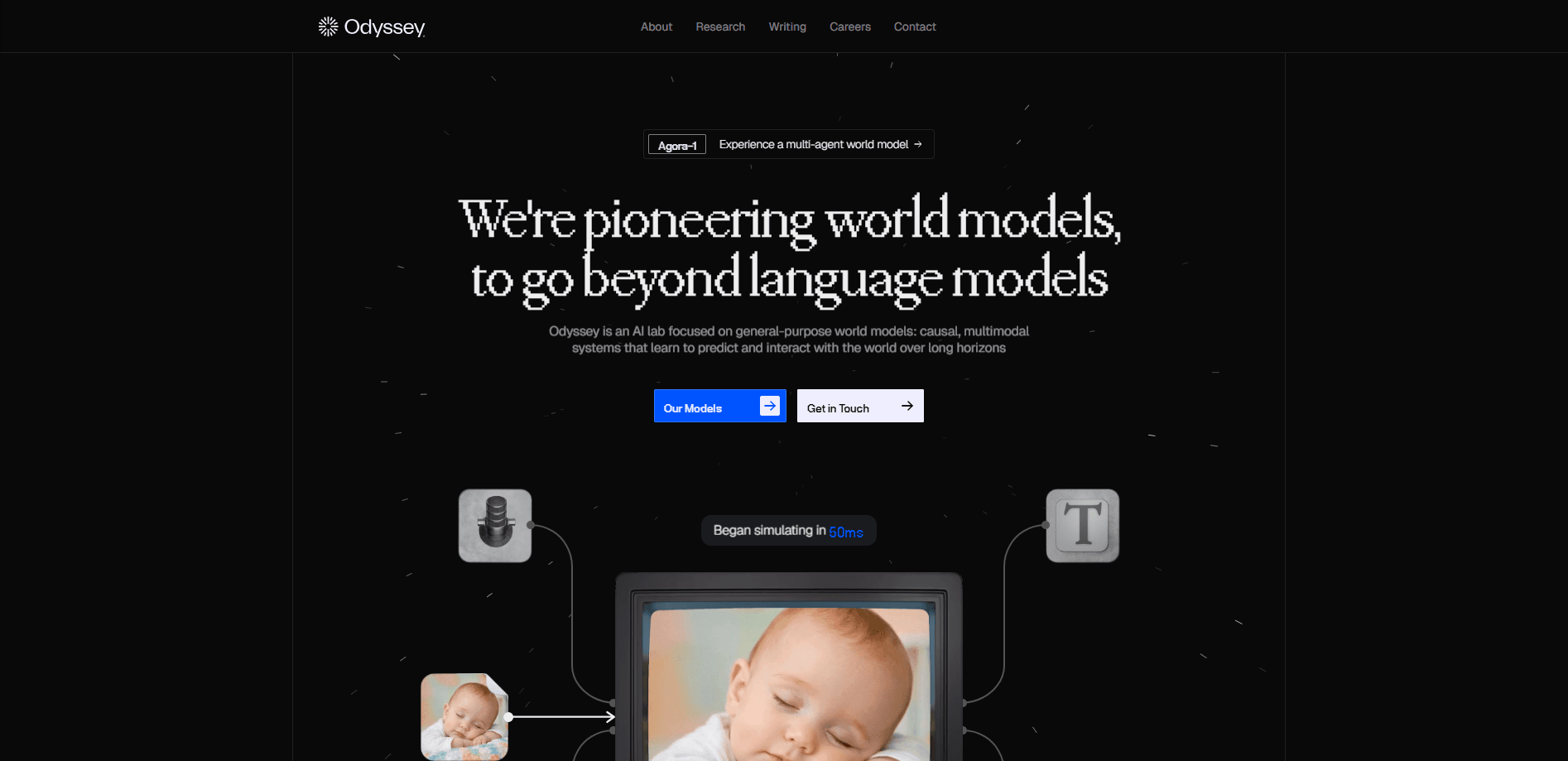
About Starchild-1 by Odyssey
What Is Starchild-1 by Odyssey
Starchild-1 is a world model, which means it learns how the world behaves rather than how text is written. It studies pixels, motion, and actions from large-scale video, then uses that understanding to simulate an approximation of a scene in real time. Odyssey trained it to autoregressively predict the next chunk of audio and video at the same time. Earlier world models couldn't do that. Sound was left out of the picture entirely.
The problem it solves is a timing one. Audio and video move at very different paces and carry different amounts of information, so keeping them in sync across a long simulation is hard. Get it wrong and the visuals drift away from the sound. Odyssey's fix is a causal distillation pipeline that turns a slower bidirectional audio-video foundation model into a real-time autoregressive one, plus an asynchronous KV-cache setup that holds the two modalities in phase during long-horizon rollouts. That's the core trick.
The main limitation is that Starchild-1 is a research preview, not a product you can download today. There's no public app, no published pricing, and no open API. Odyssey also acknowledges that visual identity and acoustic character can drift over longer sequences, and that interactive causal audio-video generation still lacks a clear benchmark for measuring quality. So what does that leave you with? A look at where world models are heading, not a tool you can put to work this week.
Getting Started
- Read the official announcement and technical report on Odyssey's site to understand what Starchild-1 actually does.
- Watch the demo footage to see how audio and video stay in phase during a live scene.
- Compare it against clip-based AI video generation tools to see where real-time interaction differs.
- Follow Odyssey's news page and research channels for updates on access and successor models.
- Reach out through Odyssey's contact page if you're researching world models for robotics, gaming, or simulation work.
Product Information
A quick look at Starchild-1 by Odyssey's pricing, supported platforms, and performance.
Best for
The users, tasks, and scenarios where this tool fits best.
Users
- AI researchers
- Robotics and simulation engineers
- Game and interactive media developers
Tasks
- Studying real-time audio-video generation
- Evaluating world models against clip-based AI video tools
- Understanding causal multimodal training
Scenarios
- Planning a research project around interactive simulation
- Deciding whether to build on a world model or a video model
- Following the world model field
Key features
Real-Time Audio and Video Generation
Starchild-1 generates sound and picture together as the scene plays out, rather than rendering a clip and stopping. It's the first world model to do this in real time. If you've watched AI video tools produce a finished clip with no soundtrack, this is the gap it closes. Big difference.
Streaming Input Response
The model keeps responding to input that arrives mid-simulation, like speech or actions. The output can change after generation starts. Clip-based tools don't allow that. It's what turns a generated scene into something closer to an interactive environment.
Causal Distillation Pipeline
Odyssey takes a bidirectional audio-video foundation model and distills it into a real-time autoregressive one. Bidirectional models can look at the whole sequence, which is accurate but slow. Distilling toward causality is what lets Starchild-1 run live without losing the foundation model's quality.
Asynchronous KV-Cache Architecture
Audio and video carry different information at different rates, and a naive setup lets one drag the other out of sync. Odyssey's asynchronous cache handles those mismatched frequencies so the two modalities stay in phase during long-horizon rollouts.
Native PROWL Research Integration
Starchild-1 supports Odyssey's PROWL framework, a reinforcement learning approach where agents probe a generated world to find its weak points. Those failures become training data that can push the next model toward more believable physics and behavior.
Long-Horizon Stability Work
Keeping a simulation coherent over time is the hard part. Starchild-1's stack is built to hold visual identity and acoustic character together longer than earlier attempts. Odyssey is upfront that drift still shows up over extended sequences.
Pros and cons
Pros
- First world model to generate synchronized audio and video in real time, not just visuals.
- Keeps responding to streaming input, so the output can change after generation begins.
- The causal distillation pipeline shows a practical path from slow foundation models to live inference.
- Native PROWL integration gives a route to improving the model through adversarial testing.
- Comes from a well-funded lab with published technical details, so the claims are checkable.
Cons
- There's no public app, pricing, or open API, so you can't actually use it yet.
- Visual identity and acoustic character can drift over long sequences, which limits long simulations.
- Interactive causal audio-video generation has no agreed benchmark, so quality is hard to compare against alternatives.
Frequently asked questions
It's a real-time multimodal world model that generates synchronized audio and video while responding to streaming input. Odyssey calls it the first world model to do both at once. It's a research preview, not a shipping product. A demo, in short.
Related content
Explore related tools, skills, and articles for Starchild-1 by Odyssey.
Starchild-1 by Odyssey Alternatives

ngram 2.0
ngram · Video · Marketingngram 2.0 is an AI video generator for teams. It turns a prompt, a screen recording, or a product URL into a narrated explainer, product demo, or AI avatar video, and every scene stays editable.

OpenScreen 2
OpenScreen (open-source project) · Video · ProductivityOpenScreen 2 is a free, open-source screen recorder and demo video editor for Windows, macOS, and Linux, with automatic zooms, styled frames, local captions, and agent edits.

Skreno
Skreno · Video · ProductivitySkreno is a browser screen recorder that captures a tab, a window or your whole display, then attaches AI transcripts, summaries and console logs to one share link.