

Ogoron
Ogoron · Coding
Ogoron is an AI test automation platform that handles automated test development and maintenance on its own. It plans, writes, and maintains tests for your software. Instead of asking you to describe tests in plain English, it reads your codebase, Git diffs, and API contracts, then generates and updates test scripts across API, UI, and mobile layers. It runs on a fixed monthly cost, so release frequency doesn't change the bill.
About Ogoron
What Is Ogoron
Ogoron is an AI test automation platform built around the idea that tests should keep pace with code without a person hand-editing every script. It reads your repository, works out what your application is supposed to do, and then writes tests that check whether it still does. The company describes it as "a QA team of autonomous agents," split into three roles: one reads requirements from the code, one builds a test plan and reads results, and one writes the automated tests and keeps them current.
The problem it targets is familiar to anyone who has shipped software. Tests go stale the moment code changes, and keeping them alive takes real time. Ogoron's pitch is that a closed-loop cycle runs on every commit: repository changes get analyzed, tests get generated or updated, and execution results plus coverage changes feed back into the system to improve what it writes next.
The main limit is that it's a helper, not a replacement for judgment. The company describes Ogoron as a tool that supports engineering teams rather than one that replaces them, and notes that complex workflows and critical paths may still need human review. Its docs put it plainly: output should be reviewed and owned by the team. So if you want fully hands-off QA with zero oversight, this isn't it. Not even close.
Getting Started
- Create an account at app.ogoron.ai with GitHub or Bitbucket, and start the 14-day free trial.
- Initialize the repository by running
ogoron init, then configure it in the.ogoron/configs/folder. - Build the project understanding with
ogoron analyze businessso the agents know what your code is meant to do. - Generate tests with
ogoron generate, and keep them current withogoron heal. - Connect your pipeline. GitHub Actions is supported today, and a Bitbucket Pipes integration is also available.
Product Information
A quick look at Ogoron's pricing, supported platforms, and performance.
Best for
The users, tasks, and scenarios where this tool fits best.
Users
- Developers and small engineering teams
- QA leads at growing teams
- Teams already on GitHub Actions or Bitbucket
Tasks
- Generating a first round of tests from existing code
- Keeping regression tests alive across frequent releases
- Building test plans that span layers
Scenarios
- Shipping with every merge request
- Covering a codebase that changes faster than your test suite
- Adding coverage without hiring
Key features
Autonomous Test Development From Your Codebase
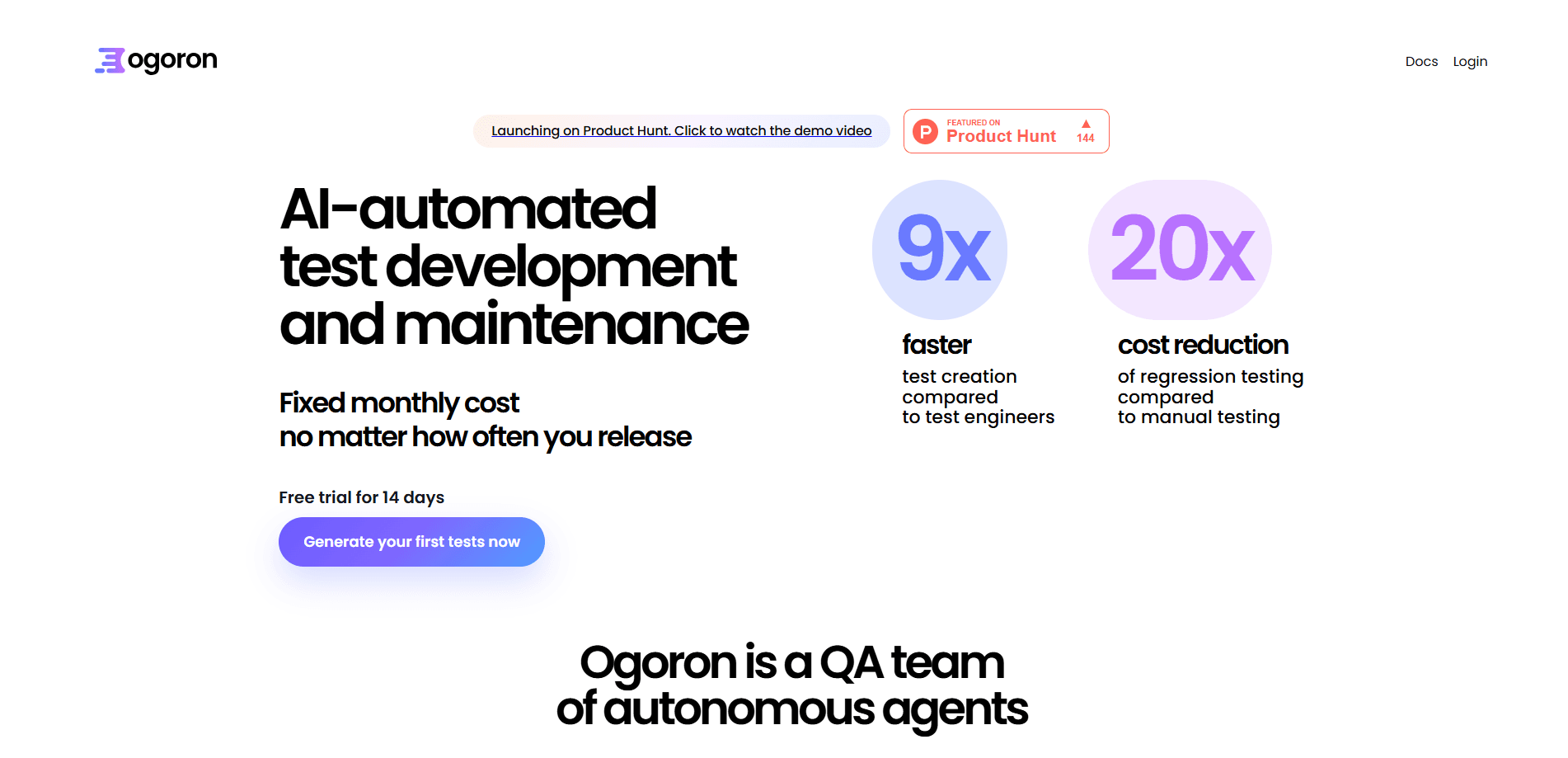
The core difference between Ogoron and other AI-first testing tools comes down to how tests get their instructions. Most competitors ask you to write test steps in plain English, which still leaves you doing the thinking. Ogoron works differently. It analyzes your code structure, UI behavior, and API contracts, and uses LLM reasoning over Git diffs, application architecture, and runtime behavior to decide what to test. No hand-holding required. You get a starting test plan without hand-authoring it. According to the company, that makes test creation 9x faster than a test engineer.
Self-Maintaining Tests That Heal After Changes
Tests break when code moves, and that's the part teams quietly hate. Ogoron runs a closed-loop cycle on every commit: repository changes are inspected with AST analysis, heuristics, and LLM reasoning, tests are generated or refreshed, and execution results plus coverage deltas feed back to improve future runs. You can also trigger healing directly with ogoron heal. Either way, the suite doesn't quietly rot between releases. Sound too good to be true? The company is upfront that human review still matters.
Coverage Across API, UI, and Mobile Tests
One platform handles three layers instead of three separate tools. Ogoron agents replace manually written scripts for API, UI, and mobile testing, and the system builds test plans that include unit, API, integration, and UI tests. Fewer tools means fewer moving parts. It also means one place to look when something fails.
Fixed Monthly Cost With No Per-Call Limits
Pricing is a flat monthly fee, and the company states it doesn't cap the number of calls or charge more as you make them. That's the unusual part. Most usage-based testing services get more expensive the more you run them, which pushes teams toward running less. Here your bill stays put whether you test once a week or on every commit. So the cost doesn't argue against thorough testing. That's rare. Most tools quietly reward you for testing less.
Integrates Into Existing Pipelines
Ogoron plugs into pipelines you already use rather than asking you to change how you work. GitHub Actions support is live, Bitbucket Pipes is available, and GitLab CI and Jenkins are planned. Custom CI setups are already possible through the CLI. The company says no changes to existing developer workflows are required, and developers get reports that explain failures and coverage changes in plain terms. Setup stays out of your way.
Human Oversight and Safety Gates
The agents don't run unchecked. Ogoron enforces safety gates, confidence thresholds, and rollback mechanisms, and the company positions the tool as supporting engineers rather than replacing them. Complex workflows and critical paths may still need a person to review the output. If you're uneasy about letting autogenerated tests reach production unsupervised, these controls are the answer. Simple as that.
Pros and cons
Pros
- Tests get generated from your actual codebase, so you don't have to write step-by-step instructions in plain English first.
- Automatic test maintenance after commits means regression suites stay usable as the product changes.
- One platform covers API, UI, and mobile tests, which cuts down on juggling separate frameworks.
- Fixed monthly pricing with no per-call limits makes running tests on every merge request affordable.
- Works inside GitHub Actions and Bitbucket Pipelines today, with no changes to existing developer workflows.
Cons
- Output still needs human review, so it doesn't remove the need for someone to own test quality.
- GitLab CI and Jenkins support is planned, not shipped, so teams on those pipelines have to set up custom CI through the CLI for now.
- Pricing isn't published, so you have to talk to the company before you can compare it against other tools; the free trial runs 14 days.
- There are no refunds, which the company states openly and works around by settling terms before charging.
Frequently asked questions
It's an AI test automation platform that writes and maintains automated tests for your software. It reads your codebase, Git diffs, and API contracts, then generates tests across API, UI, and mobile layers, and updates them as your code changes.
Related content
Explore related tools, skills, and articles for Ogoron.
Ogoron Alternatives
Forefront
Forefront · CodingForefront is a web platform for building with open-source AI. It lets you fine-tune leading open-source language models on your own data, evaluate how they perform, and run them through an API or export them to host yourself. Developers who want the convenience of a closed-source platform but insist on owning their models and data are the target audience here.

Startkit
StartKit.AI · CodingStartkit is a boilerplate for building AI SaaS and AI wrapper products. Think of it as an AI startup boilerplate with the boring parts already wired up: authentication, Stripe and Lemon Squeezy payments, usage limits, transactional email, and an AI API starter that talks to OpenAI, Anthropic, Groq, or Llama. You clone the repo, set your price, and start on the part of your product that people actually pay for. It's Next.js under React and Tailwind, so most of the boilerplate code already feels familiar.
Testim
Tricentis · CodingTestim is an AI-powered test automation platform for building and running end-to-end tests across web, mobile, and Salesforce applications. It leans on machine learning to keep tests stable when an interface changes, so teams spend less time fixing broken selectors. Not bad for an automated testing tool you can start using today. You create tests by recording actions in a browser, then optionally add JavaScript when you need more control. It's a solid pick for busy QA teams.