

Opviva
Opviva · Coding
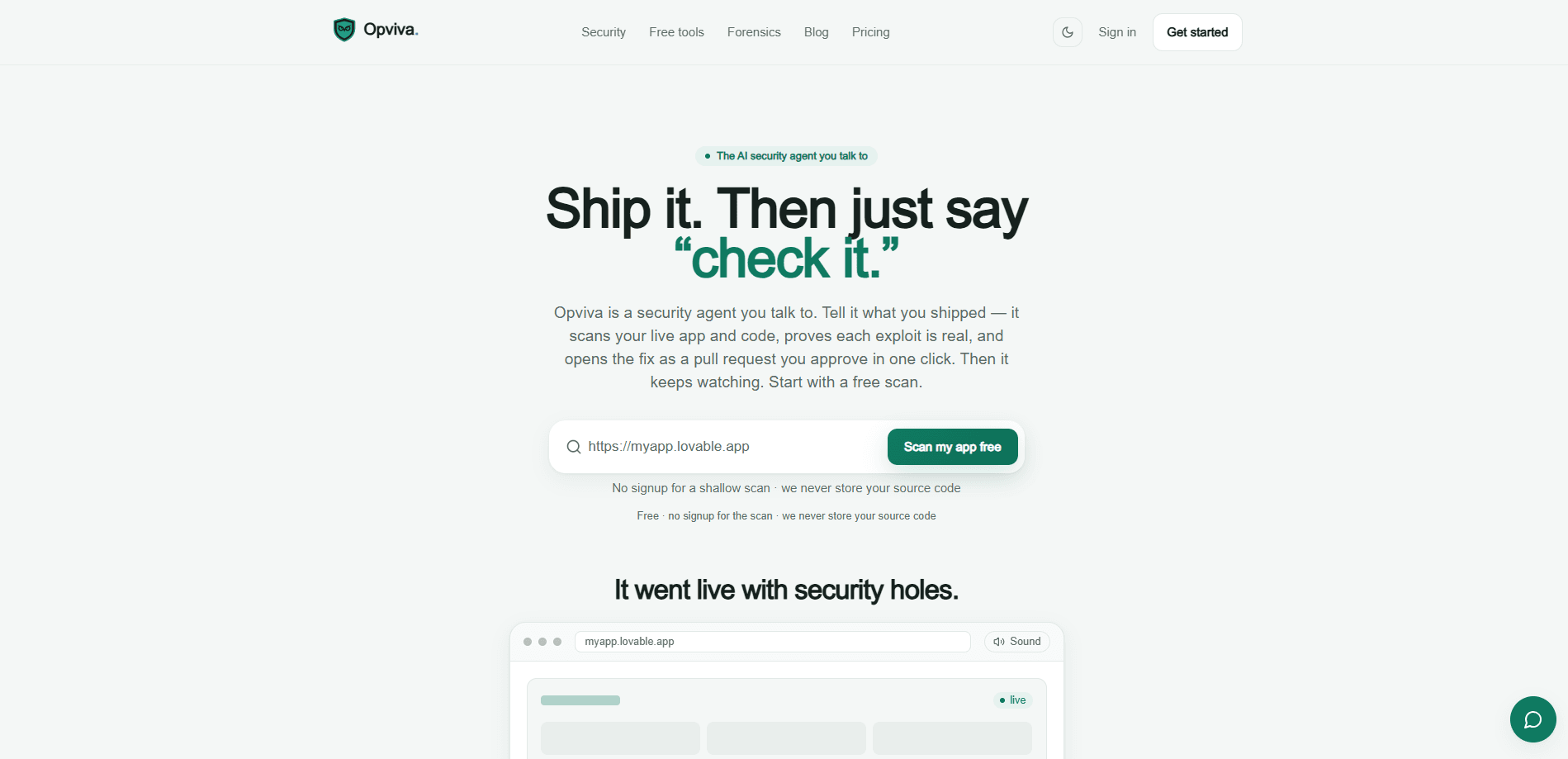
Opviva is an AI security agent for AI-built and vibe-coded apps. Instead of handing you a dashboard of red findings, it scans your live site and code, reproduces each real vulnerability, and opens the fix as a pull request you approve. Every remediation is then re-scanned in a sandbox and signed with Ed25519, so you get an app security scanner that fixes and proves rather than just reports.
About Opviva
What Is Opviva
Opviva is a post-deploy security agent aimed at people who ship apps fast with AI coding tools. You paste a live URL or connect your GitHub repo, and it grades the app from A to F while explaining each finding in plain English. The pitch is simple: AI ships features fast, and it ships vulnerabilities just as fast. What happens when a weekend build goes live with an open database? That's the problem it targets.
The product's core bet is that remediation matters more than reporting. Most vulnerability scanning tools stop at a list of problems and leave the work to you. Opviva writes the fix as a pull request you review and merge. That's the difference. You get software that turns findings into patches instead of homework.
It also leans on proof. Each fix is re-scanned and signed on a tamper-evident ledger, so you or an auditor can verify exactly what was found, what changed, and whether the patch actually closed the hole before anyone signs off on it. The main limits? Paid tiers for fixing and monitoring, and a credit model you have to budget around.
Getting Started
- Go to the Opviva homepage and paste your app's URL for a free, instant security grade. No signup or card is needed for the scan.
- If you don't have a live site yet, connect your GitHub repo instead. The agent scans your code, dependencies, and secrets with no domain required.
- Review your A-F grade and the 0-100 score, then read each finding explained in plain English on the Evidence Canvas.
- Upgrade to a paid plan to let the agent open fix pull requests, then review and merge them with one click.
- Turn on 24/7 monitoring once a verified domain is connected, so new issues get caught after launch.
Product Information
A quick look at Opviva's pricing, supported platforms, and performance.
Best for
The users, tasks, and scenarios where this tool fits best.
Users
- Indie developers and vibe coders who build with tools like Cursor, Lovable, Bolt, or v0 and want the exposed keys and missing auth caught without a security background.
- Non-technical founders who can describe their app in plain English and let the agent do the security work, provided they're willing to approve fixes.
- Security engineers who want fixes as reviewable pull requests and signed evidence for compliance, with CI-friendly GitHub scanning.
Tasks
- Grading an app's security posture from A to F and a 0-100 score before launch.
- Turning a scan into concrete fix pull requests that get re-scanned and signed.
- Monitoring uptime, errors, and new CVEs after an app goes live.
Scenarios
- Shipping a weekend build and wanting to know whether secrets or an open database were left exposed.
- Running a daily code scan on a side project or half-finished app that has no domain yet.
- Preparing evidence for an auditor who needs verifiable proof that a vulnerability was fixed.
Key features
Fixes as pull requests, not a PDF
Most scanners hand you a list of problems and walk away, leaving you to triage severity, find the file, write the patch, and hope it doesn't break something else. Opviva writes the fix as a pull request in your repo, and you review and merge it in one click. Small fixes can be auto-merged on higher plans, so the gap between "found it" and "fixed it" shrinks to a single approval.
Signed, tamper-evident evidence
Every remediation is re-scanned in a sandbox and signed with Ed25519, then hash-chained on a ledger you or your auditor can verify independently. That's the trust model: verifiable proof instead of a wall of borrowed logos. For teams prepping a compliance review, this is the difference between a claim and a record. No more guessing.
Talk-to-it agent in plain English
You don't have to read a security report. Describe what you shipped, or paste a URL, and the agent plans the scan, runs it, and explains each finding in everyday language. It reproduces exploits to prove they're real, like retrieving another test user's data for an IDOR instead of flagging a guess.
Attack-surface recon on live apps
For apps with a verified domain, Opviva checks the outside in: exposed endpoints, open ports, leaked keys, and reachable .env files. This external view catches the configuration mistakes that AI-built apps tend to ship, which a code-only review would miss. It matters most when the app is already public.
Continuous Watch after launch
Post-deploy security doesn't stop at the first scan. Continuous Watch monitors uptime, errors, and new CVEs, and wires alerts straight to auto-fix. A day-two vulnerability doesn't have to become a week-two breach. That's the whole point.
Credit-based pricing you can plan around
Everything runs on one credit balance, so a plan's credits tell you exactly how much you can do. A code scan costs 50 credits and a fix costs 250, and unused credits roll over, so you're not forced to burn them in a single month.
Pros and cons
Pros
- Fixes arrive as reviewable pull requests, so nothing merges without your one-click approval.
- Each fix is re-scanned and signed with Ed25519 on a verifiable ledger, useful for audits.
- The free tier gives you a daily code scan and an A-F grade with no signup or card.
- A repo can be scanned without owning a domain, which fits half-finished projects.
- The agent explains findings in plain English, so a non-technical founder can act on them.
Cons
- Fix pull requests and monitoring sit behind paid plans, so the free tier only reports.
- The credit model means heavy users have to track scan and fix costs rather than pay a flat fee.
- 24/7 monitoring needs a verified domain, so a repo-only project gets no post-launch watch.
- API availability isn't documented on the site, which makes custom integrations hard to plan.
Frequently asked questions
Yes, there's a free tier that gives one code scan a day, a 0-100 security score, and a letter grade with no card required. Fix pull requests and 24/7 monitoring need a paid plan.
Related content
Explore related tools, skills, and articles for Opviva.
Opviva Alternatives
Forefront
Forefront · CodingForefront is a web platform for building with open-source AI. It lets you fine-tune leading open-source language models on your own data, evaluate how they perform, and run them through an API or export them to host yourself. Developers who want the convenience of a closed-source platform but insist on owning their models and data are the target audience here.

Startkit
StartKit.AI · CodingStartkit is a boilerplate for building AI SaaS and AI wrapper products. Think of it as an AI startup boilerplate with the boring parts already wired up: authentication, Stripe and Lemon Squeezy payments, usage limits, transactional email, and an AI API starter that talks to OpenAI, Anthropic, Groq, or Llama. You clone the repo, set your price, and start on the part of your product that people actually pay for. It's Next.js under React and Tailwind, so most of the boilerplate code already feels familiar.
Testim
Tricentis · CodingTestim is an AI-powered test automation platform for building and running end-to-end tests across web, mobile, and Salesforce applications. It leans on machine learning to keep tests stable when an interface changes, so teams spend less time fixing broken selectors. Not bad for an automated testing tool you can start using today. You create tests by recording actions in a browser, then optionally add JavaScript when you need more control. It's a solid pick for busy QA teams.