

Orchestro
Orchestro · Productivity
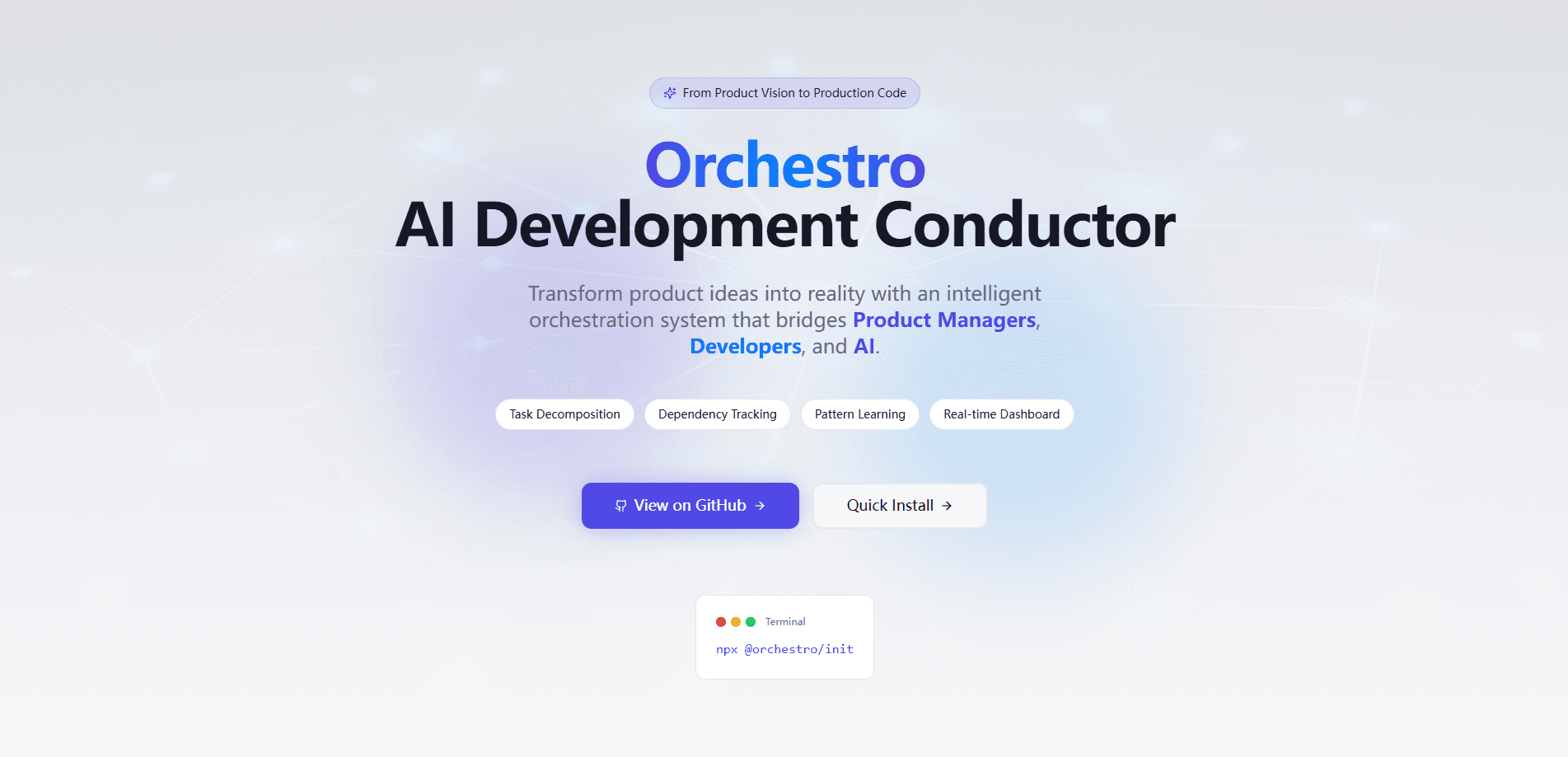
Orchestro is an AI-powered development orchestration platform that connects product managers, developers and coding agents around one shared picture of what an app must keep doing. It maps capabilities, traces failures back to their root cause, hands bounded work to your coding agent and checks whether the released fix actually worked. Think of it as AI coding agent orchestration with a memory. The product is now evolving under the public name Agent Factory, with a legacy MCP package still available for existing installs.
About Orchestro
What Is Orchestro
Orchestro started with a simple goal: help people and coding agents turn product ideas into working software. It has since grown into an orchestration layer that sits between your product, its codebase and whichever AI agent you already pay for. The idea is simple. Keep the map, not just the code.
The platform keeps a living map of your product. Capabilities like "new users finish onboarding" or "reports load reliably" are linked to the journeys, screens, services, data pipelines and external tools behind them. When something breaks, the same failure often shows up in feedback, a runtime error and a GitHub issue at once. Orchestro groups those signals. One cause, one investigation. That stops three agents from chasing the same problem independently.
The current direction rebrands the site as Agent Factory. The old landing page and install pitch are gone, and there's no automatic migration of existing Orchestro tasks, memory or MCP configuration. If you run an existing install, it stays a separate project with its own repository and docs.
Getting Started
- Bring your project and its current evidence: connect the repository, runtime events and logs you already have.
- Map the capabilities that matter, so each user goal points to the code, services and checks that support it.
- Set up a measured target for each capability, such as accounts activated within 24 hours.
- Connect your coding agent so it receives the same issue, history and checks with bounded permissions.
- Review the Advisor's recommendation, accept it, and let a verified fix or a reopened issue close the loop.
Product Information
A quick look at Orchestro's pricing, supported platforms, and performance.
Best for
The users, tasks, and scenarios where this tool fits best.
Users
- Product managers
- Developers
- Engineering teams already paying for a coding agent
Tasks
- Root cause analysis
- Governed remediation
- Benefit verification
Scenarios
- A bug that comes back weeks after it was supposedly fixed, where the reopened issue keeps its identity and prior repair.
- Onboarding funnels that quietly drop off, where a single missing value explains the lost accounts.
- Early product research, where a team wants to map capabilities to code and evidence before committing to a build.
Key features
Product Map Tied to Real Code
Orchestro links business capabilities to the journeys, screens, agents, services and data pipelines that support them. Repository history helps reconstruct what happened before. Connected runtime evidence shows what's happening now. Code sitting in a repo doesn't mean it's released or even used, and missing evidence stays visible instead of turning into a reassuring green light.
Root Cause Grouping
A failed sign-up can surface in user feedback, a server error and an issue tracker all at once. Orchestro treats those as evidence about one problem, so a team doesn't send three agents after a single cause. Each issue keeps its identity across repairs. That matters most when a bug comes back.
Governed Agent Execution
The platform hands bounded work to your coding agent within the permissions you set. Work runs across days, not one sitting. Why does that matter? Most real fixes aren't a single prompt. That changes how coding agent workflows feel. Provider integrations pass the same issue, history and checks to the agent, so the second fix starts with the first agent's evidence attached.
Advisor Recommendations and Owner Decisions
An Advisor V1 suggests next steps grounded in known work and available evidence. Recommendations stay separate from authorization. Accepting a suggestion and starting execution are two distinct steps, and the project's permission settings still govern what may happen. Decisions are recorded durably. That way the reasoning survives staff changes.
Verification Separate From Release
Orchestro keeps a merged pull request, a deployed release, a behavioral check and a product measurement as four separate things, because each one answers a different question about whether the work landed. A behavioral check shows whether the fix works. A product measurement helps judge whether it was useful. That distinction is the point. The same bug can reappear through a new code path, and a green build won't catch it.
Metric-First Targets
Every capability gets one main metric and up to two supporting measures. Each one needs a definition, a population and a time window. You need fresh data too. Guardrails protect other outcomes. And "we can't measure this yet" counts as a valid answer, not a failure.
Pros and cons
Pros
- Reuses a coding subscription you already pay for, so there's no separate model API bill.
- Groups scattered signals before agents act, which cuts duplicated fixes on one cause.
- Keeps verification and release as separate steps, so a deployed change isn't mistaken for a working one.
- Records owner decisions durably, which helps when the original engineer moves on.
- Bounded permissions mean agent work stays inside limits the team sets.
Cons
- The site now presents itself as Agent Factory with no automatic migration of existing Orchestro tasks, memory or MCP configuration, so current users must reconnect from scratch.
- Much of the product is still in private development, and the onboarding walkthrough uses sample data rather than production metrics.
- The wider loop that turns opportunities into measured outcomes is under development, so the "make it more useful" path isn't fully there yet.
Frequently asked questions
It maps the capabilities your product must keep doing, traces failures to a shared root cause, hands bounded work to a coding agent and then checks whether the released fix worked. Think of it as the coordination layer between your product, your code and your AI agent.
Related content
Explore related tools, skills, and articles for Orchestro.
Orchestro Alternatives

Swms
Swms AI · Writing · Productivity · BusinessSwms is an AI safety compliance tool that turns a plain description of a job into ready-to-use safety documents. Describe your project, trade, and known hazards, and it writes a safe work method statement, job hazard analysis, safe work procedure, RAMS, or safety data sheet in seconds. It also ships with Oscar, a chat assistant that answers workplace safety questions in any language. Teams in construction, mining, transport, and warehousing use it to cut the paperwork that usually eats into a workday.

Wordly AI Translation
Wordly · Voice & Language · ProductivityWordly AI Translation is a real-time AI translation and captioning platform built for meetings, conferences, and events. It delivers live translation, captions, transcripts, and summaries in more than 60 languages, and attendees join by scanning a QR code or opening a link instead of using dedicated headsets. The platform works with Zoom, Microsoft Teams, Google Meet, and Webex, and it's designed for organizations that want multilingual access without hiring human interpreters for every session. Simple as that.

Rows
Rows (Superhuman) · Productivity · BusinessRows is an AI spreadsheet and data analysis tool that imports live data from more than 50 sources, then lets you work with it using plain language instead of SQL queries or nested formulas. You can pull numbers out of PDFs, connect ad platforms, databases, and bank accounts, and ask the AI to build reports, merge datasets, or set up models that recalculate themselves. It runs in the browser, works like a spreadsheet, and now sits under the Superhuman umbrella.