

OrioSearch: Your AI Agent need WebSearch
vkfolio · Coding
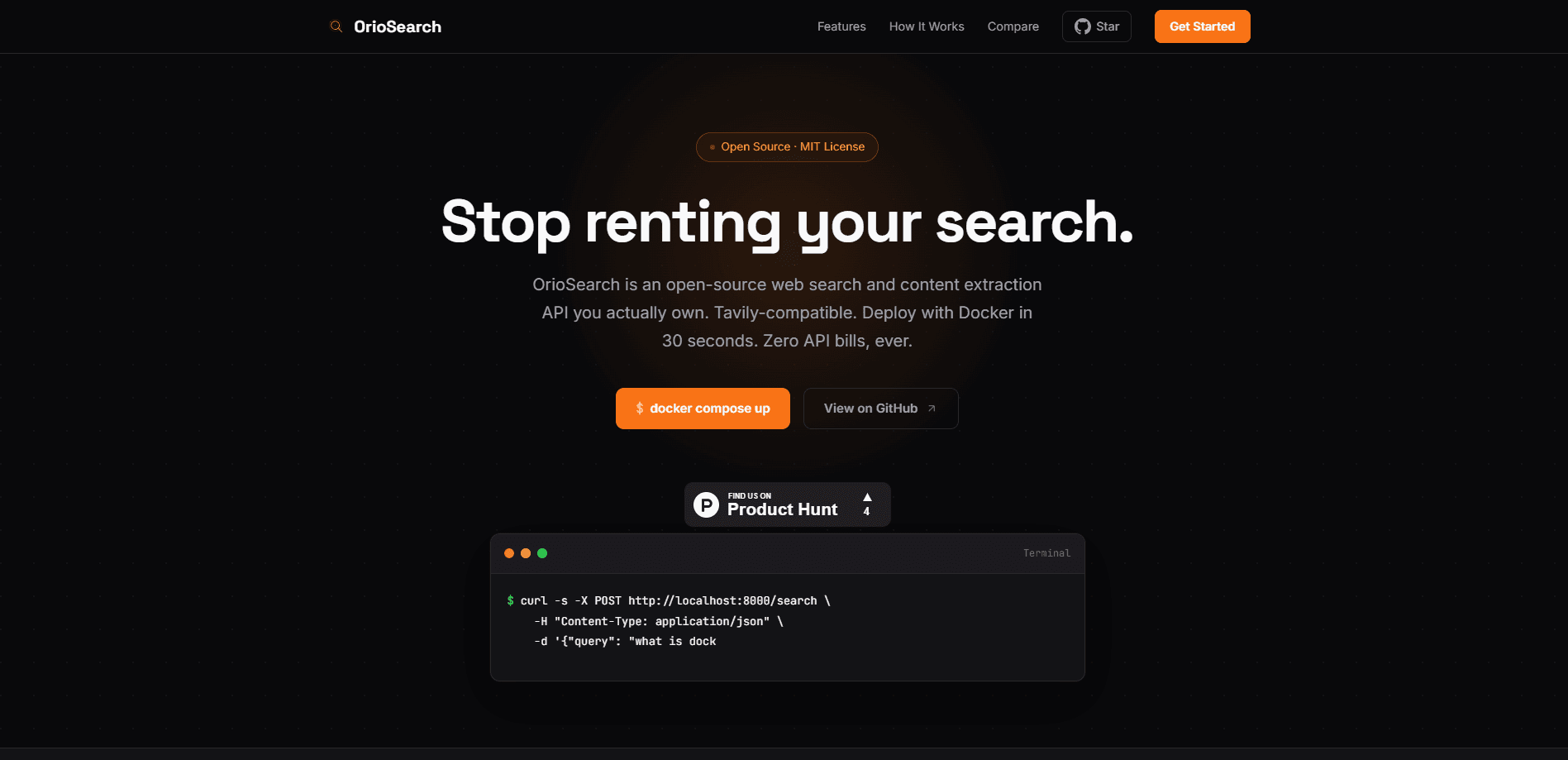
OrioSearch is an open-source, self-hosted web search and content extraction API built for AI agents. It mimics Tavily's interface. So you swap one URL and keep your existing code running. The catch? You host it yourself and pay nothing per query. That's the trade. It bundles SearXNG, FastAPI, and Redis into a single Docker deployment you control, which means your search stack runs wherever you decide to put it.
About OrioSearch: Your AI Agent need WebSearch
What Is OrioSearch
OrioSearch is a search backend you run on your own machine or server. It answers the same /search and /extract calls Tavily does, pulls results from a SearXNG meta-search layer, and can also return clean page text or AI-written answers. The pitch is simple: your agents get web search without a metered bill and without sending every query through someone else's servers.
The project is aimed at developers building AI agents, RAG pipelines, or research tools who don't want per-query costs to scale with usage. Everything ships under the MIT License, so you can read the code, modify it, and deploy it commercially. That freedom is rare. Most hosted search APIs keep the internals closed, and you accept whatever pricing they set, which usually grows as your usage does and leaves you with little say when terms change.
The main catch is that self-hosting is now your job. You need Docker, a place to run three services, and someone who can handle updates and outages. If a search engine goes down, that's on your infrastructure, not a vendor's support desk. There's no managed cloud option from the team, so you trade convenience for control. Fair warning. So who should skip it? Anyone without a server to run it on.
Getting Started
- Install Docker and Docker Compose on the machine that will host the service.
- Clone the repo from GitHub, then run
docker compose up --buildto start the API, SearXNG, and Redis at once. - Check that the API is live with a request to
/health, which should return a status of ok. - Send a test
POST /searchcall with a query andmax_results, and confirm you get back titles, URLs, and snippets. - Point your agent's existing Tavily code at
http://localhost:8000and drop the API key.
Product Information
A quick look at OrioSearch: Your AI Agent need WebSearch's pricing, supported platforms, and performance.
Best for
The users, tasks, and scenarios where this tool fits best.
Users
- AI agent developers
- Hobbyist builders and indie hackers
- Teams with data privacy rules
Tasks
- AI agent web search
- Content extraction
- AI answer generation
Scenarios
- Long research jobs that fire hundreds of queries
- Privacy-sensitive pipelines
- Self-hosted agent stacks
Key features
Tavily-Compatible Drop-In
The API mirrors Tavily's /search, /extract, and /tool-schema endpoints, so switching over usually means changing a base URL and clearing the API key. Your existing agent code and response parsing keep working. That compatibility is the whole reason the migration is painless, since a normal API swap means rewriting request builders, response handlers, and error paths before you can ship anything. No rewrites. No new SDK to learn, either.
70+ Search Engines via SearXNG
OrioSearch leans on SearXNG to aggregate results from Google, Bing, DuckDuckGo, and dozens more, with an automatic fallback to DuckDuckGo if SearXNG is unreachable. More sources mean better odds of catching a result a single engine would miss. Which engine actually wins depends on the query, and that's the point of pooling them.
Multi-Tier Content Extraction
When you point it at a URL, the extraction pipeline uses trafilatura first and falls back to readability-lxml if that fails. It hands back clean markdown or plain text rather than raw HTML. That saves you a parsing step before the content goes into a model. Small thing. It adds up across thousands of pages.
AI Answers With Citations
Flip on include_answer: true and OrioSearch synthesizes an answer from the returned results using an OpenAI-compatible model, then attaches sources. You can run it against Ollama locally, or route it to OpenAI or Groq if you'd rather use a hosted model. Your choice. The answer quality tracks whatever model you wire in, so a small local model and a frontier model won't read the same. Pick carefully.
SSE Streaming Results
The /search/stream endpoint pushes results over Server-Sent Events as they arrive instead of waiting for the full response. For agents that act on the first useful hit, that shaves real time off each turn. Not a small win when your agent fires dozens of searches per task and each round trip stacks up into minutes of dead waiting.
Redis Caching and Reranking
Redis batches lookups with configurable TTLs and graceful stale-cache fallback, so repeated queries come back fast. On top of that, a small FlashRank ONNX model reranks results by semantic relevance, all on CPU with no PyTorch dependency. No GPU needed. That keeps the footprint small enough to run next to your app on a modest box, so you're not renting a bigger instance just to host the search layer.
Pros and cons
Pros
- Zero per-query cost, so heavy agent usage doesn't turn into a growing bill. The math stays the same.
- Drop-in Tavily compatibility keeps migration to a one-line URL change.
- Queries and data stay on your own infrastructure, which matters for privacy-sensitive work.
- MIT license means you can inspect, modify, and use it commercially without strings.
Cons
- You handle hosting, updates, and outages yourself, and there's no managed cloud fallback if your box goes down at a bad moment.
- Setup needs comfort with Docker and a bit of ops know-how, which puts off non-technical users.
- AI answers depend on a separate LLM you supply. That's another piece to configure and pay for.
- No official mobile app or plugin store, so everything runs through the API.
Frequently asked questions
Yes. It's open source under the MIT License and costs nothing per query, no matter how much your agents search. Your only costs are whatever you pay to run the Docker host and any LLM you connect for answers.
Related content
Explore related tools, skills, and articles for OrioSearch: Your AI Agent need WebSearch.
OrioSearch: Your AI Agent need WebSearch Alternatives
Forefront
Forefront · CodingForefront is a web platform for building with open-source AI. It lets you fine-tune leading open-source language models on your own data, evaluate how they perform, and run them through an API or export them to host yourself. Developers who want the convenience of a closed-source platform but insist on owning their models and data are the target audience here.

Startkit
StartKit.AI · CodingStartkit is a boilerplate for building AI SaaS and AI wrapper products. Think of it as an AI startup boilerplate with the boring parts already wired up: authentication, Stripe and Lemon Squeezy payments, usage limits, transactional email, and an AI API starter that talks to OpenAI, Anthropic, Groq, or Llama. You clone the repo, set your price, and start on the part of your product that people actually pay for. It's Next.js under React and Tailwind, so most of the boilerplate code already feels familiar.
Testim
Tricentis · CodingTestim is an AI-powered test automation platform for building and running end-to-end tests across web, mobile, and Salesforce applications. It leans on machine learning to keep tests stable when an interface changes, so teams spend less time fixing broken selectors. Not bad for an automated testing tool you can start using today. You create tests by recording actions in a browser, then optionally add JavaScript when you need more control. It's a solid pick for busy QA teams.