

Ovren
Ovren · Coding
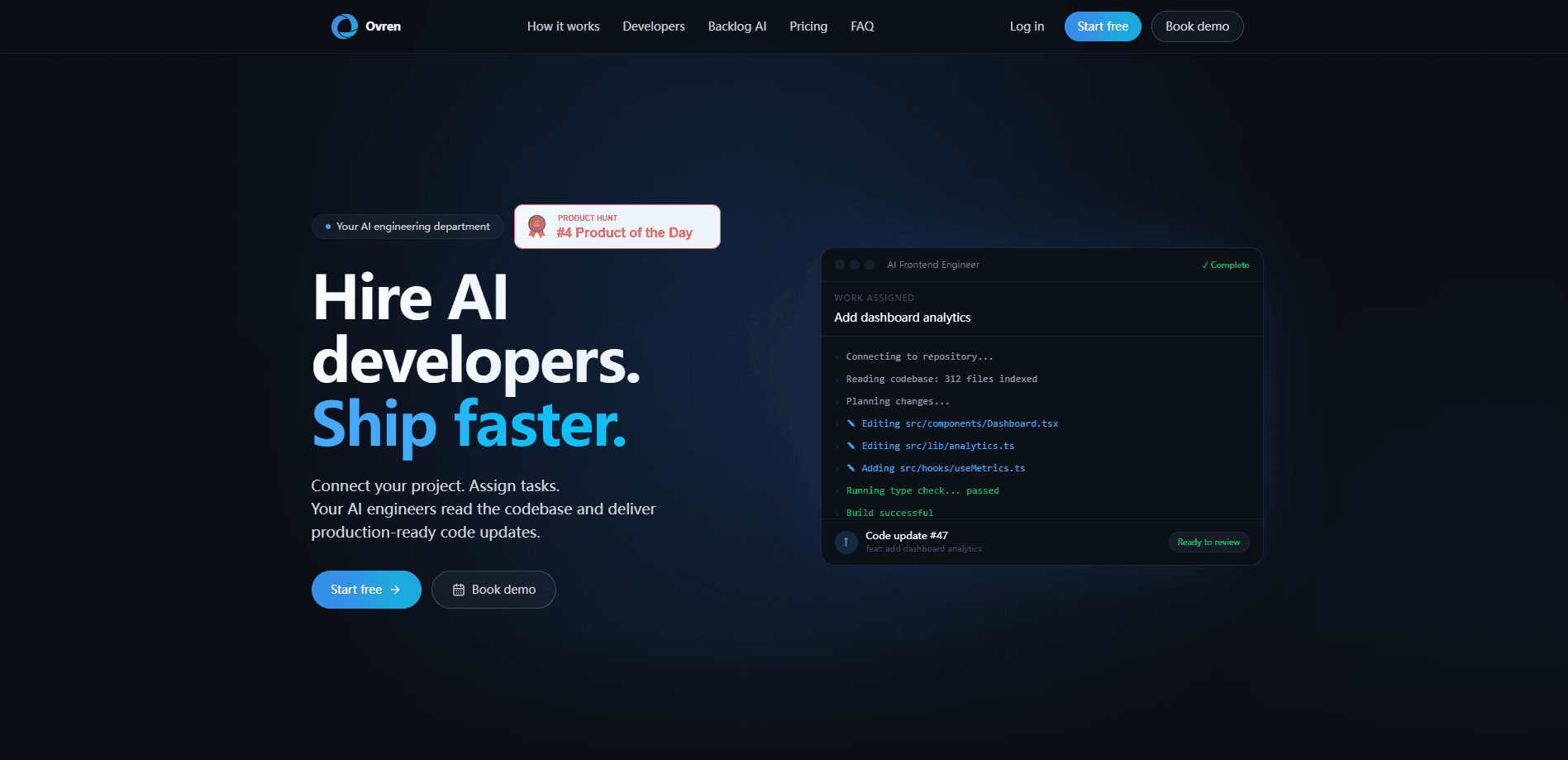
Ovren is an AI engineering platform built to ship coding tasks without waiting on developers. It deploys autonomous AI developers on the codebase you already have. You describe a change in plain language, Ovren writes it on a safe copy of your project, and it hands the result back as a pull request your team reviews before anything ships. It's built for teams with a backlog of small fixes, integrations, and internal tools that keep waiting for engineering time.
About Ovren
What Is Ovren
Ovren is an AI software engineering platform that connects to your existing GitHub project and turns plain descriptions into working code changes. Instead of generating a brand new app in a sandbox, it works on the product your customers already use, which matters if you have a live site with real users and no appetite for a rewrite.
The core promise is speed on small things. A banner, a bug fix, or a Stripe integration is often a few hours of work but weeks of waiting, because it competes with bigger priorities in the sprint. Ovren writes those changes in minutes and delivers them as a pull request, so the only bottleneck left is review.
That's also its main limit. Ovren doesn't touch settings inside someone else's dashboard. If the job is code, it's in scope; if it's a toggle in a third-party admin panel, it isn't. Every change still needs human approval, so it won't quietly ship anything on its own.
Getting Started
- Install the GitHub App on the project you want Ovren to work on. This is the one setup step your developer handles.
- Connect the repo and let Ovren read the codebase so it understands your stack.
- Describe the change the way you'd explain it to a colleague, like "add a promo banner on the pricing page."
- Watch the live preview of any frontend change before anything ships.
- Review the pull request and the execution report, then approve it to go live.
Product Information
A quick look at Ovren's pricing, supported platforms, and performance.
Best for
The users, tasks, and scenarios where this tool fits best.
Users
- Non-technical founders and product managers
- Small engineering teams
- Marketing and ops teams
Tasks
- Fixing small bugs
- Connecting a service
- Building internal tools
Scenarios
- A promo banner needs to go up today and no engineer is free
- An experiment needs a feature flag before a campaign launches
- A landing page update is stuck in the backlog
Key features
Plain-Language Task Requests
You type what you want the way you'd explain it to a colleague, no technical phrasing required. "Add a banner on the pricing page" is enough for Ovren to understand the task and start working. This lowers the barrier for anyone on the team who isn't a developer.
Live Previews Before Shipping
Ovren works on a safe copy of your project first. It shows a live preview of every frontend change. You see exactly what a banner or page update looks like before it reaches production. No guessing about how a change will render.
Pull Requests with Execution Reports
Every change arrives as a pull request alongside a report. That report explains what Ovren understood, which files it changed, and any risks it flagged. Your developer reviews one thing instead of chasing context. Nothing ships without that approval.
Works on Your Existing Stack
Ovren fits projects already built on React, Vue, Node.js, and services like Stripe, Google Tag Manager, and SendGrid. It also runs on hosting like Vercel and Netlify. No new stack to learn. Because it edits your real product rather than scaffolding something new, the output is code your team can maintain.
Broad Task Coverage
The platform handles marketing work like trigger-based emails and landing pages, product work like onboarding flows and feature flags, operations work like admin UIs and dashboards, and engineering work like bug fixes and API connections. Most requests that live in your codebase are fair game.
GitHub App Setup
Getting connected is a GitHub App install. It's the only thing your developer does to set things up. There's nothing to document or restructure beforehand. That keeps onboarding short for teams that just want to try it on one repo.
Pros and cons
Pros
- Turns plain descriptions into reviewed pull requests, so non-developers can move work forward
- Live previews make frontend changes easy to check before they go live
- Works on the codebase you already have instead of generating a disconnected new app
- Execution reports cut the back-and-forth by showing what changed and what Ovren flagged
Cons
- Can't change settings inside third-party dashboards, so those tasks still need a human
- Every change waits on a manual approval, which means it's not fully hands-off
- Setup is limited to GitHub for now, with GitLab and Bitbucket marked as coming soon
Frequently asked questions
Ovren is an AI coding agent that ships small and medium development tasks for you. You describe a change, it writes the code on your existing project, and you approve it as a pull request. It's aimed at teams whose backlogs are stuck waiting for engineering time.
Related content
Explore related tools, skills, and articles for Ovren.
Ovren Alternatives
Forefront
Forefront · CodingForefront is a web platform for building with open-source AI. It lets you fine-tune leading open-source language models on your own data, evaluate how they perform, and run them through an API or export them to host yourself. Developers who want the convenience of a closed-source platform but insist on owning their models and data are the target audience here.

Startkit
StartKit.AI · CodingStartkit is a boilerplate for building AI SaaS and AI wrapper products. Think of it as an AI startup boilerplate with the boring parts already wired up: authentication, Stripe and Lemon Squeezy payments, usage limits, transactional email, and an AI API starter that talks to OpenAI, Anthropic, Groq, or Llama. You clone the repo, set your price, and start on the part of your product that people actually pay for. It's Next.js under React and Tailwind, so most of the boilerplate code already feels familiar.
Testim
Tricentis · CodingTestim is an AI-powered test automation platform for building and running end-to-end tests across web, mobile, and Salesforce applications. It leans on machine learning to keep tests stable when an interface changes, so teams spend less time fixing broken selectors. Not bad for an automated testing tool you can start using today. You create tests by recording actions in a browser, then optionally add JavaScript when you need more control. It's a solid pick for busy QA teams.