

Parsewise
Parsewise Labs · Coding
Parsewise is an AI document intelligence platform that reads entire document packages and turns them into structured, traceable answers. Instead of parsing one file at a time, it links entities across dozens of files, flags contradictions, and exports decision-ready data as JSON, CSV or Excel. Teams in insurance, asset management and lending use it to speed up underwriting, claims and due diligence review without adding headcount. If your week disappears into reading dossiers, that's the gap this multi-document analysis tool targets.
About Parsewise
What Is Parsewise
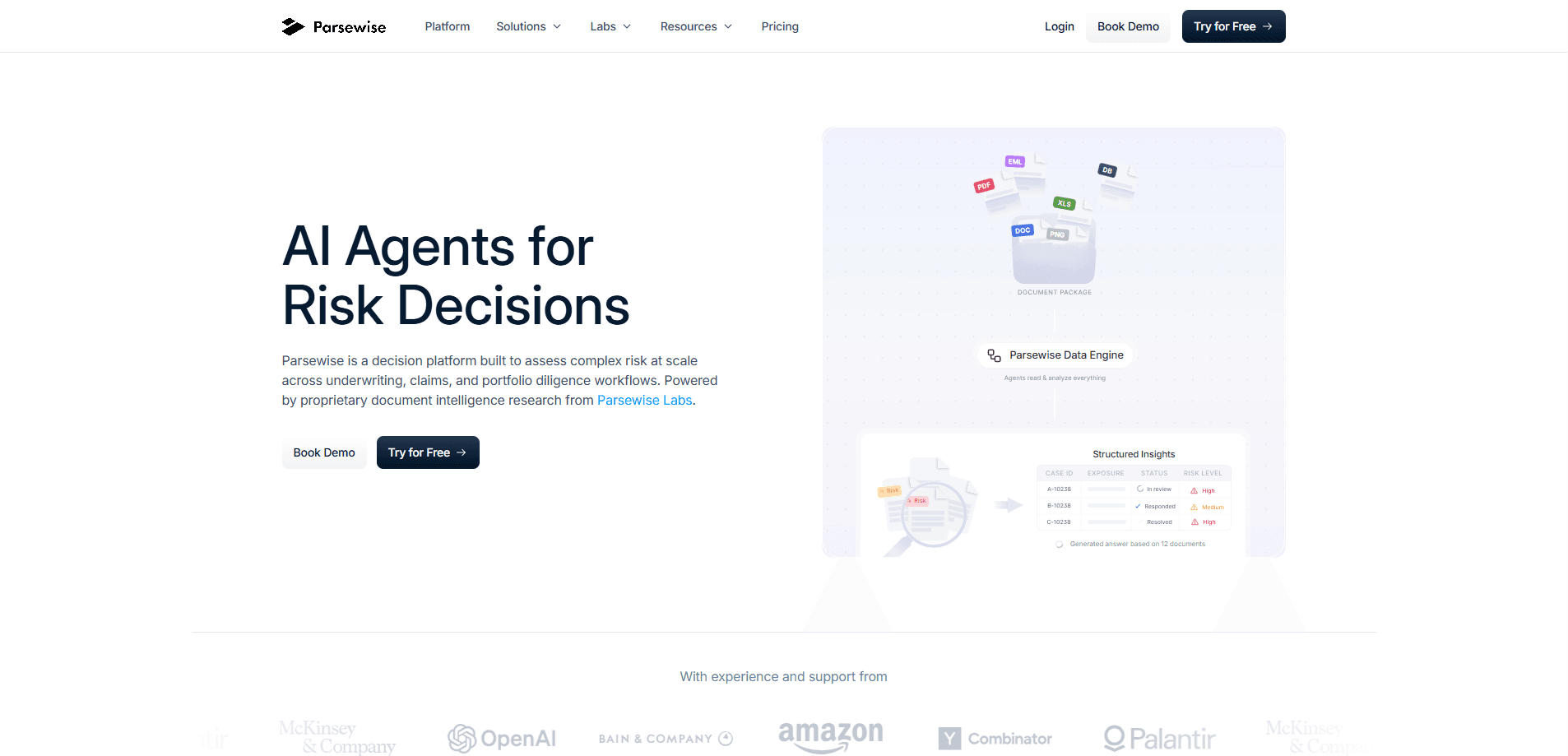
Parsewise is a document intelligence platform built for high-stakes decisions. It targets the kind of work where someone has to read a 100-page dossier and pull out the numbers that matter, whether that means exposure, loss runs, KPIs or loan terms. The platform's data engine reads every file in a package, links the same entity across documents, and returns results you can trace back to the exact word on the exact page.
The problem it solves is fragmentation. An underwriter might get submissions in PDF, Word, Excel, email and scanned images, often from several parties. Single-document parsers handle one file well but miss what happens between files. So what happens when two disclosures in the same package contradict each other? A parser that never looks across files won't tell you. Parsewise is built around cross-document reasoning, so a contradiction between two disclosures shows up instead of slipping through.
The main limits are scope and access. This isn't a general-purpose chatbot. It won't draft your emails or answer trivia. It's aimed at organizations with document-heavy workflows, and the serious features (custom schemas, VPC deployment, template filling) live behind the Enterprise tier. There's no public self-serve signup form with instant access from what the site shows. You start with the API's free credits or contact sales.
Getting Started
- Sign up for the free API tier with no credit card. You get $50 in credits, which the vendor says covers roughly 1,600 pages with 5 agents.
- Upload documents by dragging and dropping files in any supported format, or push them through the processing API.
- Ask questions in plain English. Navi, the built-in assistant, generates custom agents to handle the extraction you describe.
- Review the output with bounding-box highlighting, so you can verify each value against its source.
- Export the results as JSON, CSV or Excel, or fill DOCX, PDF and XLSX templates deterministically.
Product Information
A quick look at Parsewise's pricing, supported platforms, and performance.
Best for
The users, tasks, and scenarios where this tool fits best.
Users
- Underwriters and insurance analysts
- Asset managers running diligence
- Loan officers and mortgage processors
- Non-technical reviewers
Tasks
- Submission triage
- KPI validation in data rooms
- Loan file validation
- Contradiction detection
- Risk assessment tooling
- Template filling
Scenarios
- Quarterly portfolio diligence with a fixed set of documents to review each cycle.
- Claims handling where adjusters need severity signals from scattered correspondence and reports.
- Pre-investment review where an analyst has a weekend to read a stack of disclosure files.
- Ongoing submission intake where new broker packages arrive in mixed formats.
Key features
Cross-Document Entity Linking
Most parsers stop at the edge of a single file. Parsewise connects the same person, account or figure across every document in a package, which is what real multi-document analysis requires. That matters when a KPI is stated one way in a summary and another way in the supporting spreadsheet, because a single-document tool would report both numbers without noticing they conflict. The platform catches those mismatches and shows both sources side by side, so an analyst sees the disagreement instead of inheriting it. Big difference.
Traceable Extraction with Bounding Boxes
Every extracted value ties back to word-level coordinates in the original page. API endpoints return those coordinates, so you can build a review screen that highlights the exact source region. For a claims or underwriting analyst, that's the difference between trusting a number and being able to defend it when a manager or a regulator asks where the figure came from and why it should be believed.
Plain-English Querying with Navi
You don't write extraction rules in code first. You ask Navi in plain English, and it auto-generates the custom agents needed for the job. The same assistant handles quick analysis, document summaries and portfolio analysis. Simple. It's as easy to use as a chat tool, which lowers the bar for business users.
Structured Output and Template Filling
Results come back as JSON, CSV or Excel. Beyond raw data, Parsewise fills DOCX, PDF and XLSX templates deterministically, so a report template comes out populated rather than half-formatted and you skip the error-prone copy-paste stage that usually follows an extraction run. Anyone who has spent an afternoon copying extracted figures into a report template by hand knows exactly how much time that single feature can return over a busy quarter.
Coding Tools and Web Search
Agents can write and run code, and search the web to backfill missing values or verify what they pulled. This helps with gaps, like when a document references a figure it never states outright. Not every field in a real dossier is spelled out. This feature covers some of those holes, which matters because a missing value that gets silently guessed is worse than one that gets flagged for a human to check.
Ad-Hoc Corpus Queries
Once a corpus is processed, you can run follow-up questions against it without re-ingesting or re-extracting anything. Investigations rarely end after the first pass. Being able to query the same processed set again means a second round of questions doesn't cost another round of processing, which keeps a long investigation from turning into a long processing bill every time a new angle appears.
Enterprise Security and Deployment
Parsewise encrypts data at rest and in transit and states it doesn't train on your data. Enterprise plans add VPC and on-prem deployments, bring-your-own-models, regional data residency and SSO with SAML. That's a lot. For regulated teams, that set of controls is often the deciding factor.
Pros and cons
Pros
- Reads across documents rather than one file at a time, which is where most document workflows break down.
- Word-level bounding boxes make every extracted value verifiable against its source.
- Free API tier with $50 in credits lets you test the platform before committing.
- Outputs cover JSON, CSV, Excel and filled DOCX, PDF and XLSX templates.
- Enterprise options include VPC deployment and bring-your-own-models.
Cons
- Pricing is usage-based per page and per field, so costs scale with document volume in ways a flat plan wouldn't. A hundred-page submission with a dozen fields to extract adds up faster than a per-seat subscription would. Budget accordingly.
- Free tier caps you at 2 platform UI seats, which is tight for a real team.
- No published public signup flow for full platform access; getting started beyond the API leans on contacting sales.
- Advanced workflow features like custom schemas and template filling sit behind the Enterprise tier.
Frequently asked questions
It reads entire document packages and returns structured, traceable answers. You upload files, ask questions in plain English, and export the extracted data as JSON, CSV, Excel or filled templates.
Related content
Explore related tools, skills, and articles for Parsewise.
Parsewise Alternatives
Forefront
Forefront · CodingForefront is a web platform for building with open-source AI. It lets you fine-tune leading open-source language models on your own data, evaluate how they perform, and run them through an API or export them to host yourself. Developers who want the convenience of a closed-source platform but insist on owning their models and data are the target audience here.

Startkit
StartKit.AI · CodingStartkit is a boilerplate for building AI SaaS and AI wrapper products. Think of it as an AI startup boilerplate with the boring parts already wired up: authentication, Stripe and Lemon Squeezy payments, usage limits, transactional email, and an AI API starter that talks to OpenAI, Anthropic, Groq, or Llama. You clone the repo, set your price, and start on the part of your product that people actually pay for. It's Next.js under React and Tailwind, so most of the boilerplate code already feels familiar.
Testim
Tricentis · CodingTestim is an AI-powered test automation platform for building and running end-to-end tests across web, mobile, and Salesforce applications. It leans on machine learning to keep tests stable when an interface changes, so teams spend less time fixing broken selectors. Not bad for an automated testing tool you can start using today. You create tests by recording actions in a browser, then optionally add JavaScript when you need more control. It's a solid pick for busy QA teams.