

Perception
Perception Systems, Inc. · Image
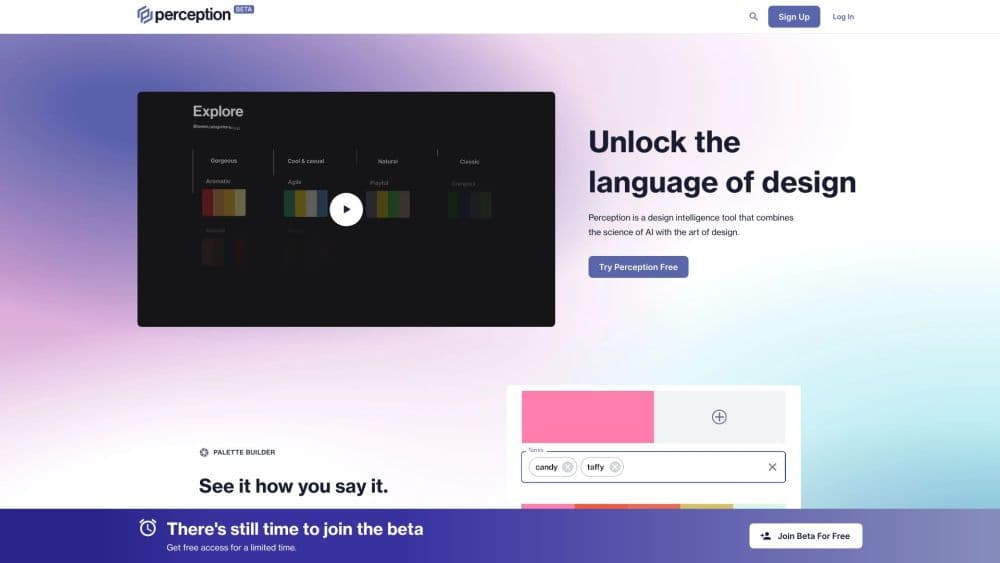
Perception turns a word into a color palette and checks existing palettes against color psychology research, backed by a 50 million palette library.
About Perception
What Is Perception
Perception is an AI color palette generator for people who would rather start from a brief than a blank color wheel. You type a word such as "calm" or "citrus," add a brand color if you have one, and the tool returns palettes built from that idea. A separate validator goes the other way: paste a palette you already use and it tells you which moods the combination tends to carry.
The company behind it, Perception Systems, pitches this as design intelligence rather than inspiration. Its model, called PaletteRank, was trained on color psychology research and existing palette data to map words to color relationships. That matters because most palette sites rank by likes or votes. Perception argues its results come from research patterns instead, which is a fair claim for a starting point, not a substitute for testing a design with real people.
The limits show up fast. It's a color psychology tool with a narrow job, and everything runs in a browser, so there's no desktop app and no Figma or Adobe plugin, only file export. The free tier caps palettes at three colors and holds just three generated palettes at a time. And the audience is designers, marketers, and brand teams who care about color meaning. If you just need a random hex code, a free picker will do.
Getting Started
- Create a free account at perception.io, then open the palette generator.
- Type a word or phrase that describes the feeling you want, and optionally lock in a brand color.
- Review the generated palettes, then adjust individual swatches or lock the ones that work.
- Run the palette through the validator to see the moods it reads as.
- Export the finished set to Adobe tools, or save it to your favorites for later.
Product Information
A quick look at Perception's pricing, supported platforms, and performance.
Best for
The users, tasks, and scenarios where this tool fits best.
Users
- Brand designers
- Marketing teams
- Web and product designers
- Students and self-taught creatives
Tasks
- Turning a mood word into colors
- Auditing an existing palette
- Pulling a color palette from image
- Building a brand color palette
Scenarios
- A freelance designer starting a landing page
- An agency reviewing a client's old branding
- A small team without a design system
Key features
Word to Palette Generation
The core tool takes any word or short phrase and returns palettes tied to it. You can add up to seven colors on paid plans, lock the ones you want to keep, and regenerate the rest. Results come in sets of three on the free plan and nine on Perception Studio, so you compare options side by side instead of accepting the first suggestion.
Palette Validator
The validator reads a palette and reports the moods it associates with the combination, using the same research base as the generator. Free accounts see the top three moods, and paid accounts see the full set. It's the feature that separates Perception from a plain color wheel, since it gives you a reason to defend a choice in a review.
Color Extraction From Images
Upload an image and Perception pulls its colors into a working palette. Designers use it to match a photo shoot, a product shot, or a competitor's ad without sampling pixels by hand. The extracted colors can then be adjusted, validated, or exported like any other palette.
Palette Dictionary and Color Pages
The library holds more than 50 million palettes, indexed by word and by individual color. Alongside it sit 16 million color reference pages, each covering one shade and the palettes it appears in. Free users can bookmark 10 pages, and paid users get unlimited bookmarks, which makes the dictionary usable as a research archive.
PaletteRank Model
PaletteRank is Perception's own model, and the company says the patent is pending. It analyzes text and maps it to color combinations using published color psychology findings rather than crowd voting. The practical effect is consistency: the same word tends to return a family of related palettes instead of a random assortment of popular ones.
Adobe Export and Shared Libraries
Finished palettes export to Adobe tools, so the colors move into a design file without retyping hex values. Studio accounts add unlimited favorites and support teams of up to 10, which keeps a shared palette library in one place. Enterprise adds brand color integration, dedicated support, and single sign-on, which the company lists as coming soon.
Pros and cons
Pros
- Generating from a word is faster than browsing galleries when you already know the feeling you want.
- The validator gives a research-based reading of a palette, which helps in client reviews where taste alone won't settle the question.
- The free plan is genuinely usable for a small project, with image extraction and Adobe export included.
- The 50 million palette dictionary and 16 million color pages make it a decent reference archive, not just a generator.
- Export to Adobe tools fits an existing workflow, so you don't rebuild the palette by hand.
Cons
- It's browser only, with no mobile app and no Figma or Adobe plugin, so the export step stays manual.
- The free tier stops at three colors and three generated palettes at a time, which runs out quickly on a real brand system.
- Brand color integration, single sign-on, and team seats above 10 sit behind Enterprise, and that price isn't published.
- Mood analysis comes from a research model, not from testing with your audience, so cultural context still needs a human check.
Frequently asked questions
Perception is used to build and check color palettes. You describe a mood or idea in words, get AI-generated palettes in return, and validate existing colors against color psychology research before a design goes out.
Related content
Explore related tools, skills, and articles for Perception.
Perception Alternatives

Tractionwave
TractionWave · Image · MarketingTractionWave is an AI attention heatmap tool for static ads. Upload a PNG or JPG and it returns predicted attention, ranked hotspots, and fixes before you spend budget.

Imejis.io
Imejis.io · Image · MarketingImejis.io is an AI design studio for agents and marketing teams. Describe an image in plain words, and it writes the copy, builds the layout, reflows it to every size, then exports a finished file.

Layoutr
Van Dijk Ontwikkeling · Image · China AILayoutr is a browser floor plan tool that scales your own plan, places furniture at true size, shows the room in 3D and renders it with AI.