

pixserp
pixserp · Coding
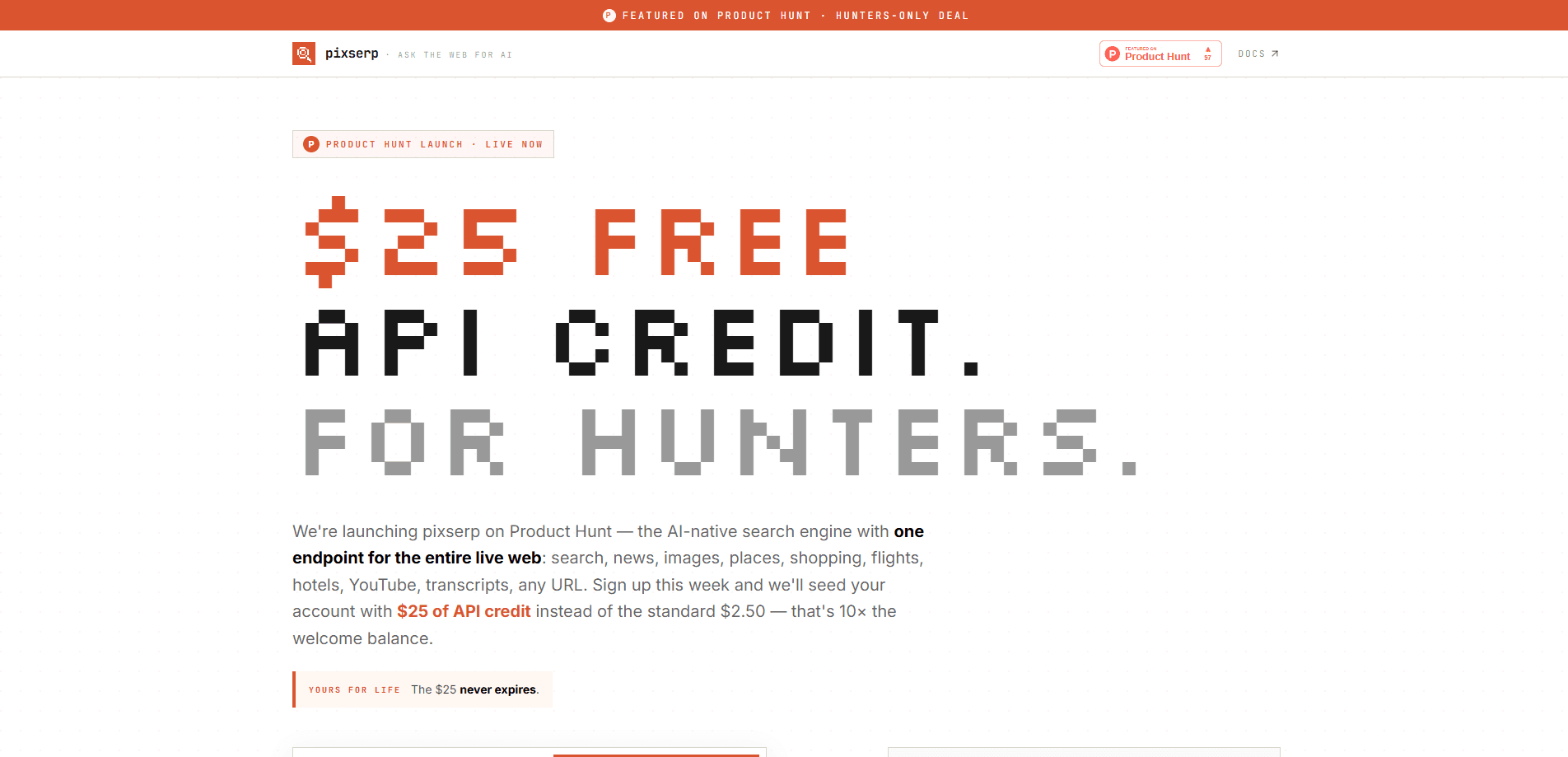
pixserp is an AI-native search engine API that gives developers and AI agents one OpenAI-compatible endpoint for querying the live web. Instead of wiring together a scraper, a reranker, and a cache layer, you send a plain-language ask and get back a cited answer, with structured rows for web pages, news, images, places, shopping, flights, hotels, YouTube videos, transcripts, and any URL. Need citations in your UI? They come back by default. It also supports JSON schema output and streaming.
About pixserp
What Is pixserp
pixserp is a cited search API built for teams shipping AI agents and retrieval-heavy apps. The pitch is simple: one endpoint replaces the usual retrieval stack. You ask a question in natural language, and pixserp finds the answer on the live web, then hands it back with the source URLs attached.
The appeal is the breadth behind a single call. The same flat price covers a cited article, a product listing, a flight, or a video transcript, so you don't juggle five providers and five bills. For developers, the OpenAI-compatible /v1/chat/completions shape means you can drop it into an existing prompt without rewriting your client code. Less glue. Fewer bills.
No consumer app exists. What you get is an API, not an end-user search product, so there's no dashboard to poke at. It's also pay-as-you-go with a top-up starting at $50 after your free balance runs out, which rules out casual one-off use.
Getting Started
- Sign in with a magic link at pixserp.com. No card is needed, and you start with a $2.50 free balance.
- Point your client at the OpenAI-compatible
/v1/chat/completionsendpoint and pass your key. - Send a plain-language ask, such as "best practices for Postgres index maintenance in 2026."
- Optionally pass a JSON schema to get structured output, or stream the response token by token.
- Read the cited answer plus the structured rows, then pass the source URLs straight into your UI.
Product Information
A quick look at pixserp's pricing, supported platforms, and performance.
Best for
The users, tasks, and scenarios where this tool fits best.
Users
- AI developers building agents that need live web facts
- RAG teams replacing a scraper-plus-reranker pipeline
- Product teams adding travel or shopping lookups
Tasks
- Asking the web a question and getting a cited answer
- Pulling a YouTube transcript or summarizing a specific video
- Extracting key claims from any URL
- Comparing prices or travel options
Scenarios
- Shipping a chatbot that answers with fresh sources instead of stale training data.
- Building a research agent that runs multi-step lookups and needs citations at each hop.
- Prototyping a travel or price comparison feature without standing up your own search stack.
Key features
One Endpoint for Ten Answer Shapes
pixserp covers web, news, images, places and maps, shopping, flights, hotels, YouTube videos, transcripts, and any URL behind a single call. You ask in plain language and the same flat rate applies no matter which shape comes back. That range is the biggest reason to pick it over a web-only search API.
Cited by Default
Every claim comes back with the source URL it came from, so you can pass citations straight into your UI or an evaluator without a separate retrieval round-trip. This matters for trust. Your users can check where an answer came from instead of taking it on faith.
Structured Output via JSON Schema
Pass a schema and pixserp returns JSON filled with web-grounded facts, so you get products, flights, hotels, places, and videos as structured rows rather than loose text. No regex over prose. That saves you from parsing text that was never meant to be parsed.
Streaming Responses
The API supports SSE streaming, delivering the answer token by token with live progress events. Fast first token matters. If your interface needs one, streaming keeps the wait feeling short even when a multi-step lookup takes a moment.
Drop-in OpenAI Compatibility
Because the endpoint follows the /v1/chat/completions shape, you can swap it into an existing prompt with minimal changes. Teams already using OpenAI-style clients don't have to learn a new SDK to get going. That's the whole point.
Flat, Predictable Pricing
pixserp charges a flat $1.50 per 1,000 requests with search and scrape included, and it doesn't add a token bill on top. The official comparison puts that against $5, $9, and $19 per 1k for similar ask-style endpoints, so the cost gap is the headline. Same rate at any volume, with top-ups from $50 to $50,000.
Pros and cons
Pros
- Ten answer shapes, from web pages to flights and YouTube transcripts, behind one endpoint and one bill.
- Citations come back by default, so source URLs are ready for your UI or your evaluator.
- Flat $1.50 per 1k requests with search and scrape included, versus $5 to $19 per 1k for comparable endpoints (vendor-published list prices).
- OpenAI-compatible request shape and JSON schema output keep integration work small.
- Fast cited answers, with the vendor citing roughly 0.5 to 1.5 seconds for pixserp-fast.
Cons
- It's API-only, so there's no consumer app or dashboard for non-developers to try.
- The free balance is $2.50 and top-ups start at $50, which makes it a poor fit for occasional, low-volume use.
- Coverage and speed figures come from the vendor's own pages and haven't been independently benchmarked, so treat them as claims rather than verified results.
Frequently asked questions
It's a search API for AI agents and apps that need live web answers with citations. You send a plain-language ask and get back an answer plus source URLs, along with structured rows when a schema is passed.
Related content
Explore related tools, skills, and articles for pixserp.
pixserp Alternatives
Forefront
Forefront · CodingForefront is a web platform for building with open-source AI. It lets you fine-tune leading open-source language models on your own data, evaluate how they perform, and run them through an API or export them to host yourself. Developers who want the convenience of a closed-source platform but insist on owning their models and data are the target audience here.

Startkit
StartKit.AI · CodingStartkit is a boilerplate for building AI SaaS and AI wrapper products. Think of it as an AI startup boilerplate with the boring parts already wired up: authentication, Stripe and Lemon Squeezy payments, usage limits, transactional email, and an AI API starter that talks to OpenAI, Anthropic, Groq, or Llama. You clone the repo, set your price, and start on the part of your product that people actually pay for. It's Next.js under React and Tailwind, so most of the boilerplate code already feels familiar.
Testim
Tricentis · CodingTestim is an AI-powered test automation platform for building and running end-to-end tests across web, mobile, and Salesforce applications. It leans on machine learning to keep tests stable when an interface changes, so teams spend less time fixing broken selectors. Not bad for an automated testing tool you can start using today. You create tests by recording actions in a browser, then optionally add JavaScript when you need more control. It's a solid pick for busy QA teams.