

Pollinations
Pollinations · Coding · Business
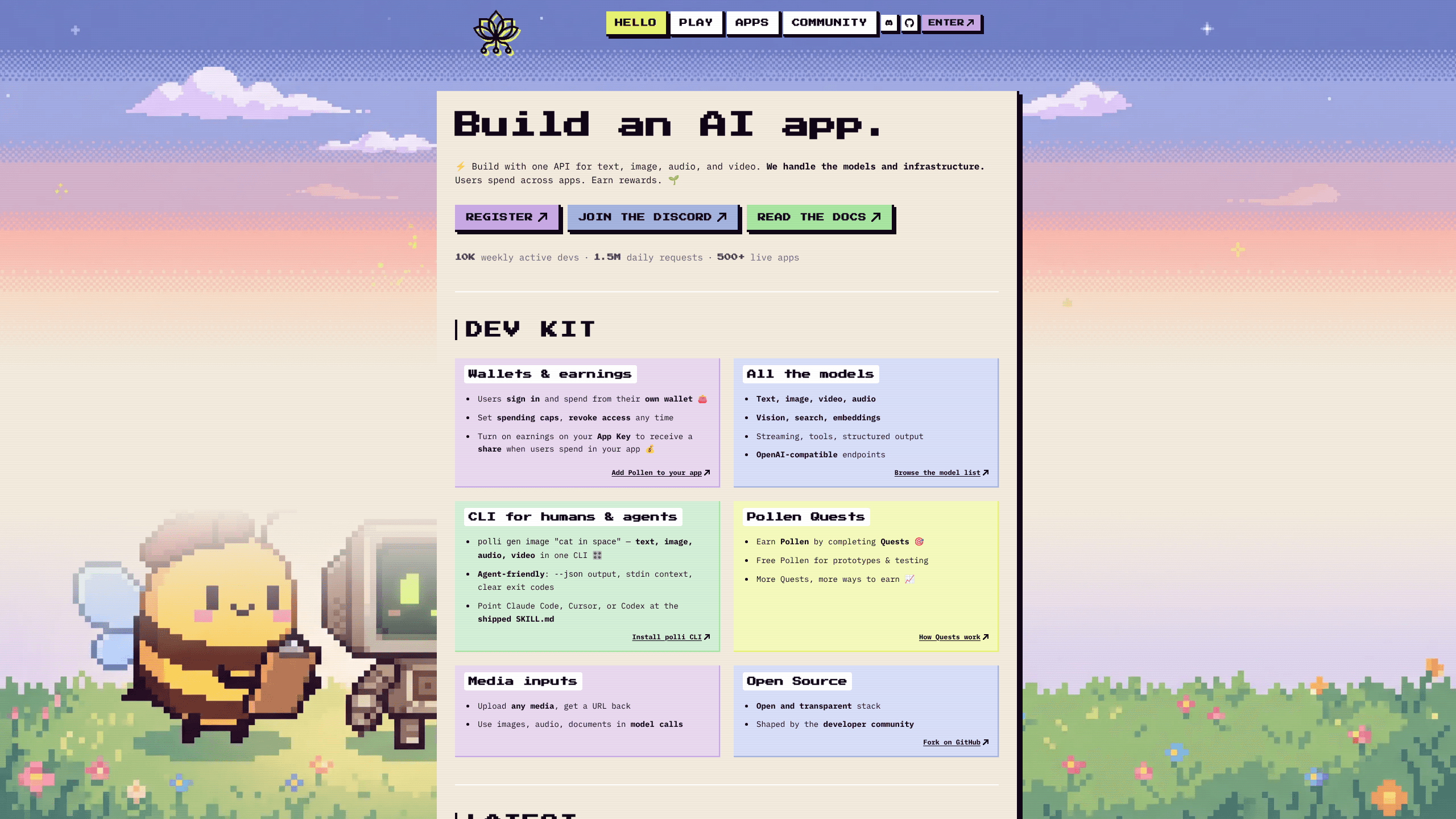
Pollinations is an open-source generative AI API that gives developers one key for text, image, video, audio, and voice models. It's OpenAI-compatible. Point any OpenAI SDK at its base URL and keep your existing code. The free tier makes it a common starting point for indie builders, hobby projects, and small apps that need generation without a billing setup on day one.
About Pollinations
What Is Pollinations
Pollinations is a generative AI platform and API built for people who ship things. It gives you one service that routes requests to a catalog of text, image, video, audio, and embedding models. No separate account with every provider. The API follows the OpenAI format, so any library you already use for GPT-style calls works after a base URL swap.
The problem it solves is sprawl. A single small app often needs an image endpoint, a chat endpoint, maybe speech-to-text. Each one wants its own key, its own limits, and its own invoice. Pollinations puts those behind one account and one key. It then layers a user-wallet system on top, so you can pass generation costs to your own users rather than absorbing them.
The main limit is control. The catalog is community-driven and shared, so model availability shifts, and you're building on someone else's routing rather than a dedicated deployment. If you need guaranteed throughput or private models, look at a paid first-party provider. Does it keep your data private? According to the project it stays privacy-minded, but I'd verify current data handling on the dashboard before putting anything sensitive through it.
Getting Started
- Create an account and generate an API key on the Pollinations dashboard. Use a secret key for backend calls and an app key for browser or mobile clients.
- Send the key in the
Authorizationheader, or as akeyquery parameter on GET endpoints. - Pick an endpoint from the docs, text, image, video, audio, embeddings, or realtime, and call it with your existing OpenAI SDK by changing the base URL.
- For apps with their own users, wire up the "bring your own Pollinations" sign-in so each user authorizes your app and pays with their own wallet.
- Ship it, then watch usage and earnings from the dashboard.
Product Information
A quick look at Pollinations's pricing, supported platforms, and performance.
Best for
The users, tasks, and scenarios where this tool fits best.
Users
- Indie developers
- App builders shipping to end users
- Hobbyists and students
Tasks
- Generating images from text prompts
- Adding chat and text generation
- Speech and audio work
- Model comparison on a budget
Scenarios
- Prototyping a new AI feature before you commit to a vendor
- Building a small web app that generates images on demand
- Running a community or classroom project
Key features
One Key, Many Modalities
A single Pollinations key reaches text, image, video, audio, realtime voice, and embedding endpoints. That range matters. Build a note app that summarizes text, reads it aloud, and illustrates it. Now you're not juggling three providers to make one feature work. According to the project, newer endpoints and models land in the same catalog over time.
OpenAI-Compatible by Design
The API mirrors the OpenAI format, so an existing client library works after a base URL change. That turns a vendor migration from a rewrite into a config edit. Streaming works too. So do vision inputs, where you pass images into a chat call.
Bring Your Own Pollinations Wallets
This is the feature that separates Pollinations from a plain API reseller. Your users sign in with their own Pollinations account through OAuth, and their usage draws on their own balance instead of yours. For a consumer app with unpredictable traffic, that changes everything. It's the difference between a capped hobby project and something you can leave running.
Developer Earnings
If you publish an app, model, or agent on the platform, the earnings system pays you based on the usage you drive. It's an unusual arrangement for an API service. It's aimed at the people building on top rather than only the people calling the endpoints. Check the current terms, since payout rules can shift. Read them first.
A Community Model Catalog
Model IDs follow a publisher/model convention, and the catalog is open to community contributions. You can browse aliases and swap models without changing your integration. The trade-off is volume. Popular models come and go, so pin the IDs you depend on.
MCP Servers and CLI
Pollinations ships MCP servers and a command-line tool alongside the HTTP API. If you work with agents or automate from a terminal, you can call the same models without hand-rolling request code. Small thing. It still saves the boilerplate that usually sits between "idea" and "first request."
Pros and cons
Pros
- One API key covers text, image, video, audio, and embeddings, which cuts the number of providers a small app has to manage.
- OpenAI compatibility means existing SDK code usually works after a base URL change.
- A genuine free tier makes it viable for prototypes, students, and side projects.
- The wallet system lets end users pay for their own usage, keeping costs off the developer's card.
- Open-source under the MIT license, with a public catalog you can inspect.
- Developer earnings let builders earn from apps they publish.
Cons
- Model availability shifts with the community catalog. A model you rely on can change or disappear, so pin IDs and handle fallbacks.
- Routing is shared. Throughput and latency aren't guaranteed the way a dedicated first-party deployment would be.
- Pricing is usage-based rather than a flat subscription. Costs scale with traffic and are harder to predict up front.
- Documentation lags behind the larger commercial providers, which matters if you need enterprise guarantees.
Frequently asked questions
Pollinations is used to add generative AI to apps without managing multiple provider accounts. You send prompts to one API for text, images, audio, video, or embeddings, and get results back through an OpenAI-style interface.
Related content
Explore related tools, skills, and articles for Pollinations.
Pollinations Alternatives
Forefront
Forefront · CodingForefront is a web platform for building with open-source AI. It lets you fine-tune leading open-source language models on your own data, evaluate how they perform, and run them through an API or export them to host yourself. Developers who want the convenience of a closed-source platform but insist on owning their models and data are the target audience here.

Startkit
StartKit.AI · CodingStartkit is a boilerplate for building AI SaaS and AI wrapper products. Think of it as an AI startup boilerplate with the boring parts already wired up: authentication, Stripe and Lemon Squeezy payments, usage limits, transactional email, and an AI API starter that talks to OpenAI, Anthropic, Groq, or Llama. You clone the repo, set your price, and start on the part of your product that people actually pay for. It's Next.js under React and Tailwind, so most of the boilerplate code already feels familiar.
Testim
Tricentis · CodingTestim is an AI-powered test automation platform for building and running end-to-end tests across web, mobile, and Salesforce applications. It leans on machine learning to keep tests stable when an interface changes, so teams spend less time fixing broken selectors. Not bad for an automated testing tool you can start using today. You create tests by recording actions in a browser, then optionally add JavaScript when you need more control. It's a solid pick for busy QA teams.