

Privent
Privent Technologies, Inc. · Coding
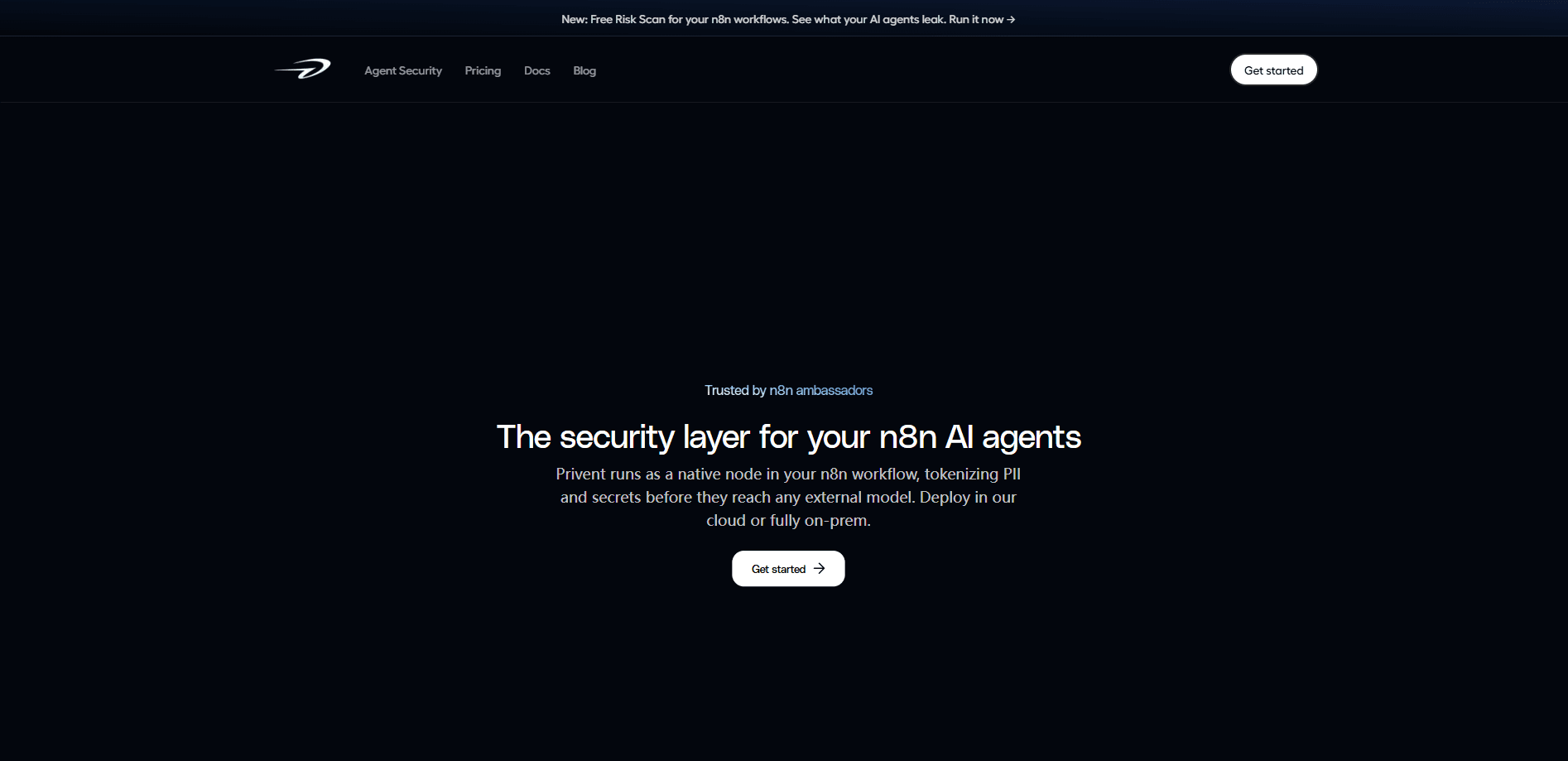
Privent is a runtime security layer built for n8n AI agents. It installs as a native workflow node and inspects the data your agent is about to send out, catching PII, PHI, and secrets before they reach an external LLM. Sensitive values get transformed into reversible tokens, risky runs get scored, and every decision lands in an audit log. Think of it as AI agent data control at the point where it matters. You can run it in Privent's cloud, in your own n8n engine, or fully on-prem.
About Privent
What Is Privent
Privent sits between your AI agent and the outside world. That gap is where most data leaks happen. An agent pulls a customer record, builds a prompt, and ships the whole thing to a third-party model without anyone checking what went along for the ride.
The product's answer is a control layer that reads the payload at runtime. It detects personal and financial data, plus credentials and source code, then replaces the sensitive parts with tokens the agent can still work with. Detokenization happens on the way back. Your workflow logic barely changes. The whole point is that your prompts never leave the detection pipeline as plaintext.
There are real limits to keep in mind. Privent is purpose-built for n8n today, with LangGraph, CrewAI, MCP, and a standalone SDK listed as coming soon. Teams running other agent frameworks can't adopt it yet. Detection is also a pipeline you have to deploy and maintain, not a toggle you flip once. And if you want the strongest guarantees, on-prem is where the value is, which means someone on your side has to own the install.
Getting Started
- In n8n, open Settings and go to Community Nodes, then install the
n8n-nodes-priventpackage. - Add a PriventApi credential with your API key and base URL.
- Drop the Session, Tokenize, and Detokenize nodes onto your workflow canvas where data enters and exits the agent.
- Run a test execution and check the dashboard for detection events, risk scores, and the access trail.
Product Information
A quick look at Privent's pricing, supported platforms, and performance.
Best for
The users, tasks, and scenarios where this tool fits best.
Users
- Security and platform engineers running n8n in production
- Compliance teams in regulated industries
- Small agencies building agent workflows for clients
Tasks
- Scrubbing customer records before an agent calls a hosted LLM
- Processing documents at scale
- Proving what an agent did and why
Scenarios
- A support agent that reads tickets and drafts replies
- A finance workflow that summarizes transactions
- An air-gapped deployment in a bank or hospital
Key features
Runtime Interceptor for n8n
The core node watches data as it moves through your agent, before it crosses into an external model. In practice, that's what n8n agent security comes down to: seeing the real payload, not just the connection. It scores each one and decides whether to allow, warn on, or block the action. Because it runs inside the runtime rather than at the network edge, it sees the actual content the agent is about to use.
Reversible Tokenization
Detected values are swapped for [KIND_NNN] style tokens that keep their type and position. PII detection happens first, then the swap. The agent can keep reasoning over the record, and Detokenize restores the real values on the way back. You get usable outputs without ever putting plaintext on the wire.
Risk Scoring and Category Breakdown
Every scoring request produces a composite risk score plus a per-signal breakdown. Categories cover PII, financial data, source code, legal, and strategic content. You can tune policy per data type instead of treating everything as equally dangerous.
Audit Logs and Access Trails
The system records the decision outcome, the stages applied, timestamps, the deployment group, and the execution graph node that triggered it. For document jobs, every download of a tokenized result is also logged. Nothing stores the raw text. Prompt content is processed in memory and discarded.
Document Processing Pipeline
Whole files go through the same tokenization as text, via an async jobs API. A job moves through four stages: Queued, Extracting, Scoring, and Tokenizing. Then it lands on one of three terminal states, including a distinct "completed with warnings" result that never collapses into plain success or failure. Scanned PDFs use OCR through an opt-in build with models mounted locally, and stored artifacts expire after 24 hours by default.
Cloud, Self-Hosted, or Fully On-Prem
You choose where the pipeline lives. On-prem AI security is the real selling point here. Installs include the full stack with ML inference, so even the ephemeral in-memory processing stays inside your network. The document engine boots fail-closed. A production deployment refuses to start rather than silently skipping scans.
Monitoring Extension
A separate browser extension for AI monitoring rolls out through MDM, such as Google Workspace or Intune. Once configured with an API key and deployment group key, detection events show up in the dashboard in real time.
Pros and cons
Pros
- Works as a native n8n node, so existing workflows need only a few new steps dropped onto the canvas rather than a full rebuild.
- Tokenization is reversible, which means the agent's output stays correct while the model itself never handles raw sensitive data at any point.
- Strong on-prem story: the entire stack, ML inference included, can run air-gapped with zero outbound calls.
- Transparent, public pricing starting from a free tier, with no separate enterprise tier hiding the real costs.
- Clear data policy: prompt text is processed in memory and never written to disk, indexed, or used for training.
Cons
- n8n is the only fully supported framework right now; LangGraph, CrewAI, MCP, and the SDK are still preview or coming soon, so broader teams have to wait.
- Fixing the framework gap means maintaining a detection pipeline yourself once you move on-prem, which adds operational work.
- Document job artifacts expire after 24 hours by default, so any long-term retention is something your storage layer has to handle.
Frequently asked questions
It inspects data moving through your n8n AI agents and catches sensitive content before it reaches an external LLM. Sensitive values become reversible tokens, and each run gets a risk score along with a full audit entry you can review later.
Related content
Explore related tools, skills, and articles for Privent.
Privent Alternatives
Forefront
Forefront · CodingForefront is a web platform for building with open-source AI. It lets you fine-tune leading open-source language models on your own data, evaluate how they perform, and run them through an API or export them to host yourself. Developers who want the convenience of a closed-source platform but insist on owning their models and data are the target audience here.

Startkit
StartKit.AI · CodingStartkit is a boilerplate for building AI SaaS and AI wrapper products. Think of it as an AI startup boilerplate with the boring parts already wired up: authentication, Stripe and Lemon Squeezy payments, usage limits, transactional email, and an AI API starter that talks to OpenAI, Anthropic, Groq, or Llama. You clone the repo, set your price, and start on the part of your product that people actually pay for. It's Next.js under React and Tailwind, so most of the boilerplate code already feels familiar.
Testim
Tricentis · CodingTestim is an AI-powered test automation platform for building and running end-to-end tests across web, mobile, and Salesforce applications. It leans on machine learning to keep tests stable when an interface changes, so teams spend less time fixing broken selectors. Not bad for an automated testing tool you can start using today. You create tests by recording actions in a browser, then optionally add JavaScript when you need more control. It's a solid pick for busy QA teams.