

Pulp Sense
PulpSense · Coding · Marketing · Business
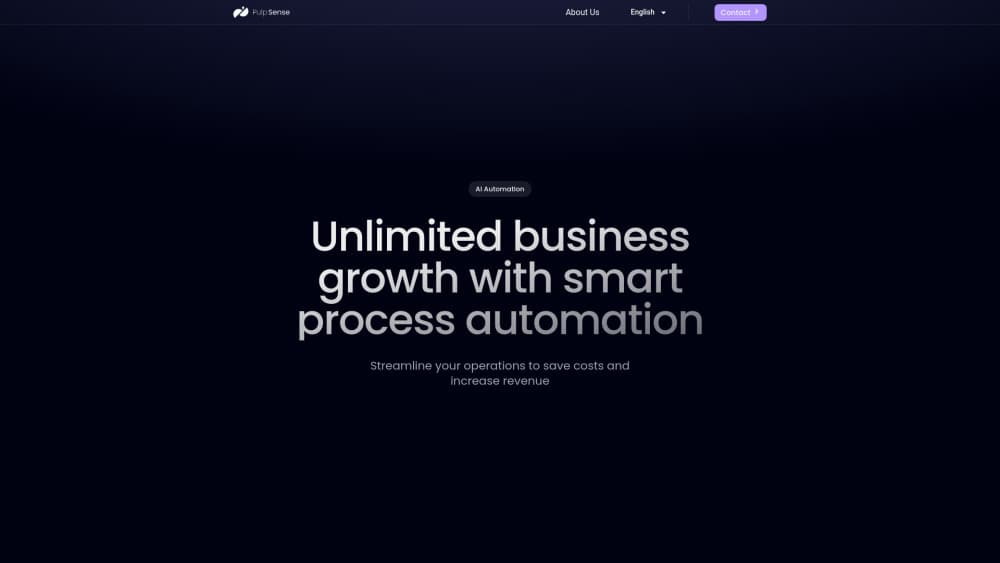
Pulp Sense is an AI automation agency that builds custom agents, CRM hubs, onboarding flows, content engines and dashboards for growing businesses.
About Pulp Sense
What Is Pulp Sense
Pulp Sense (also written PulpSense) is an automation agency that designs and builds AI systems for growth-stage companies. It works on the repetitive half of running a business: it captures leads, qualifies them, onboards clients, publishes content and reports on results. Instead of selling a single software product, the company builds custom automations on top of the tools a business already uses. That covers CRMs like HubSpot and Salesforce and work platforms like ClickUp, Monday.com and Slack. The founder is Santi Leoni, and the site lists an office phone in the United States.
The pitch is direct: grow revenue without growing payroll. That means automated lead nurturing that books calls, CRM workflows that remove manual data entry, and dashboards that update themselves. Automation runs as the core deliverable, and Pulp Sense works with 100+ tools plus a long list of CRMs and project management platforms. Clients range from agencies and content creators to executive search firms, law firms, e-commerce sellers and food trading companies.
Two things are worth knowing before you book a call. It's a services business rather than a self-serve app, so there is no signup page and no free tier. Pricing is quoted after a strategy call, and ongoing needs are handled through an Automation Club retainer. The results in the case studies come from real rollouts, not from a trial.
Getting Started
- Book a free strategy call and walk the team through your current operations and bottlenecks
- Review the custom plan, which lists the systems to build first, expected ROI and a timeline
- Approve the plan and let the team start implementation, which begins within 24 hours
- Attend the handover session with documentation and video walkthroughs, then adjust the systems during the 30-day window
Product Information
A quick look at Pulp Sense's pricing, supported platforms, and performance.
Best for
The users, tasks, and scenarios where this tool fits best.
Users
- Growth-stage founders
- Agency owners
- Operations and RevOps leads
- Creators and content brands
- Service businesses with steady onboarding
Tasks
- Process automation
- Lead capture and routing
- CRM builds and cleanup
- Client onboarding
- Content production
- Reporting and dashboards
- Consultation and training
Scenarios
- A recruiting firm loses a rep to manual coordination
- A trading desk tracks commodity prices by hand
- A content agency outgrows WhatsApp updates
- A law firm pays for billboard ads
- A sports agency reconciles ad leads by hand
Key features
AI Agents and Assistants
Pulp Sense builds agents that handle intake, scheduling, support and other recurring work. A booking agent qualifies leads and puts confirmed meetings on the calendar, a Slack assistant follows the team's SOPs, and a support bot reads context and routes requests to the right person. Another common build summarizes long documents and email threads so staff can skip the reading. The agents run inside the tools a team already uses, so adoption doesn't depend on learning a new app.
Central Operations Hub
The operations hub puts tasks plus sales plus hiring plus client delivery into one workspace. Pipelines track leads and deals, tasks carry an owner and a status, and hiring stages keep notes on each candidate. A client directory keeps records synced across the team. The goal is to stop the daily switching between Notion, Asana, HubSpot, Slack, spreadsheets and email just to move work forward.
Hands-off Client Onboarding
Onboarding runs from the moment a payment clears. A payment triggers the welcome sequence, smart emails lay out the next steps, and the system collects documents without manual follow-up. The CRM updates on its own and notifies the team, so a new client starts smoothly and nobody has to re-enter the same details in three places. It suits service businesses that add five or more clients a month.
AI Content Engines
The content engine covers ideas, production and distribution. AI drafts blogs, videos and images, and a human reviews each piece before it goes out. One original piece becomes material for ten or more platform formats, and the system schedules and publishes across channels. It fits creators and brands that publish weekly and spend hours cutting clips and writing posts by hand.
Real-Time Dashboards
Dashboards show sales plus hiring plus operations in one place, with live data instead of a spreadsheet rebuilt every week. Teams get Slack alerts when a key metric moves, unified reporting from several sources, and weekly performance summaries sent automatically. The intent is to answer "what's the status?" from the screen rather than by chasing colleagues.
Consultation and Training
For teams that want to own their systems, Pulp Sense offers one-on-one consulting, recorded walkthroughs and SOPs, plus technical vetting for operations hires. The service is built for founders who want control of their automations without spending six months figuring it out alone or staying dependent on an outside contractor.
Integrations Across 100+ Tools
Pulp Sense connects to the tools a business already runs, including major CRMs, project management platforms and communication apps. For custom or legacy systems, the team works through APIs or builds a workaround. The company states it has worked with more than 20 CRMs and 15 project management tools, so an unfamiliar stack is usually not a blocker.
Consultation-led Project Process
Every engagement follows four steps: a strategy call, a custom plan, a quick start and a scale-up phase. The plan lists which systems to build first, the expected return and a timeline for each automation. Implementation starts within 24 hours of approval, and each project includes 30 days of free adjustments after launch.
Pros and cons
Pros
- Custom builds sit on top of the tools a business already uses, so there is no forced migration
- Broad integration coverage, with stated experience across more than 20 CRMs and 15 project management platforms
- Fast start, with implementation beginning within 24 hours of plan approval
- 30 days of free post-launch adjustments, and clients own the systems with full documentation
- Case studies cover agencies, search firms, law firms, trading firms and sports marketing, with time-saved figures for each
Cons
- No self-serve product or free tier, since everything runs through a strategy call and a quote
- Pricing isn't published, so cost is only clear after a discovery call
- It's a services engagement rather than software, which suits teams ready to invest rather than those testing an idea
- Ongoing needs fall to the Automation Club retainer, which adds a recurring cost for teams with frequent requests
Related content
Explore related tools, skills, and articles for Pulp Sense.
Pulp Sense Alternatives
FastRouter.ai
FastRouter.ai · Coding · Productivity · BusinessFastRouter.ai is an LLM gateway that sends each request to the best of 200+ AI models through one OpenAI-compatible API, charging provider list price with no markup.

Rival Workshop
Rival · Coding · ProductivityRival Workshop is a local app that puts every skill and rule file in your repo on a shelf, so you can see what Claude Code, Codex or Cursor loads before each task.

Sente
teai.io · Voice & Language · Coding · ChatbotSente is an AI coding agent CLI from teai.io: one curl command installs it, it wraps OpenCode, and it reaches more than 380 models through one OpenAI-compatible endpoint.