
Rapid Muscle
Rapid Muscle · Leaning · AI Assistant
Rapid Muscle builds science-based hypertrophy workout splits around your lagging muscles, then logs your lifts so you can push progressive overload week after week.
About Rapid Muscle
What Is Rapid Muscle
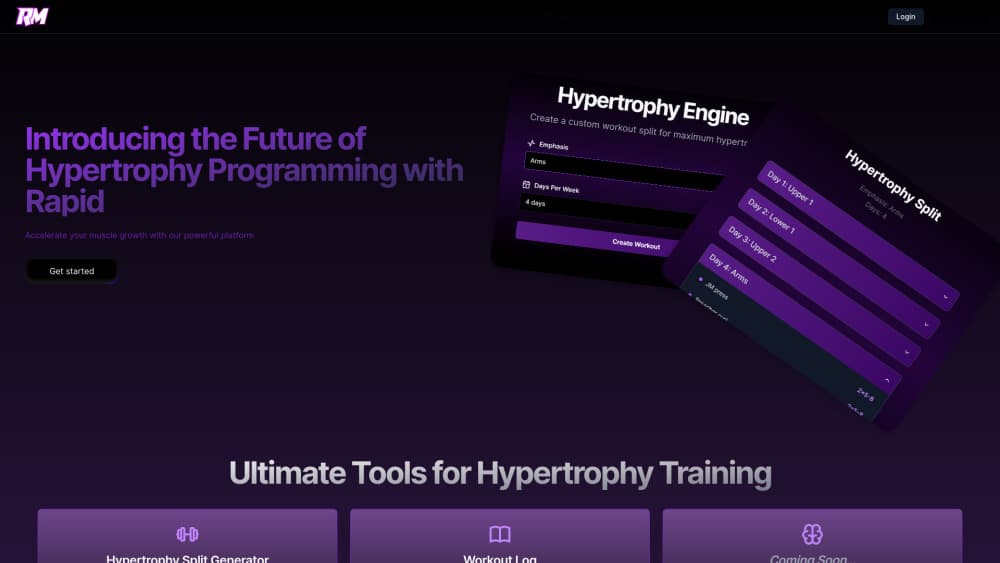
Rapid Muscle is a hypertrophy workout generator for lifters who want a training plan built from research instead of random influencer clips. You pick the muscle you want to bring up, set how many days you can train, and the generator returns a full split with exercise choices, order, volume and weekly frequency already worked out.
The problem it targets is decision fatigue. Most people can train hard. Fewer can sit down and design a balanced week that hits a weak point often enough without wrecking recovery. Rapid Muscle handles that planning layer, then gives you a log so the plan actually progresses instead of repeating the same weights for months.
The limits are worth stating up front. The company says it does not support powerlifting, calisthenics or home training, so this is a gym tool. The workout tracker holds two logged splits at a time, which pushes you toward one program rather than program hopping. The promised AI personal trainer is still listed as coming soon.
Getting Started
- Create an account on the Rapid Muscle site with an email address and password.
- Choose the muscle group you want to prioritize and the number of days you can train each week.
- Generate the split, then review the exercises, sets and rep targets before your first session.
- Log each workout in the tracker with the weights and reps you hit, and use that history to add load next time.
Product Information
A quick look at Rapid Muscle's pricing, supported platforms, and performance.
Best for
The users, tasks, and scenarios where this tool fits best.
Users
- Gym lifters with a lagging muscle
- Lifters who keep changing programs
- Self-directed trainees who want the reasoning
Tasks
- Building a weekly hypertrophy split from scratch
- Bringing up a specific body part
- Tracking progressive overload
- Comparing training ideas before committing
Scenarios
- A busy week with three gym days
- A plateau on one muscle group
- Returning to structured training after a layoff
Key features
Hypertrophy Split Generator
The core tool produces a science based workout split. It asks for a priority muscle and your available training days, then produces a complete split. It decides which exercises to use, how to sequence them and how much volume each muscle gets. The point is a coherent week, not a list of exercises.
Priority Muscle Programming
Your chosen muscle group gets trained first in the session and appears two to three times per week. Other muscle groups land at one to two sessions per week. That structure is meant to bring up a lagging body part while leaving enough recovery for everything else.
Exercise Selection and Sequencing
Rapid Muscle leans on machine based movements for stability, isolation and lower injury risk. Exercises are ordered so the priority muscle is trained fresh, with other muscle groups alternated in between to spread fatigue. You can still adjust the generated workout inside the tracker.
Workout Tracker
The workout tracker is where the plan meets reality. Log the weights and reps you complete, see your history over time, and use it to decide when to add load. It is built for consistent progressive overload, which matters more than any single exercise choice.
Science-Based Volume and Frequency
The company describes a moderate volume approach paired with high intensity, citing recent hypertrophy research. Frequency, exercise choice and weekly structure all follow that model. The site does not publish a full citation list, so treat the research claims as the developer's stated method.
AI Personal Trainer in Development
A chatbot coach is listed as coming soon, pitched as a specialist that answers training questions such as which squat variation hits the quads hardest. Until it ships, the generator and the log are the working parts of the product.
Pros and cons
Pros
- The generator returns a full weekly split, including exercise order and volume, so you are not assembling a plan from scattered advice.
- Priority muscle logic is explicit and easy to check against your own recovery.
- The workout tracker sits next to the plan, which makes progressive overload a habit rather than a separate spreadsheet.
- Pricing is simple: one monthly plan at €10.99 or a yearly plan at €49.99, both cancellable.
- It runs in the browser, so there is nothing to install before your first session.
Cons
- No support for powerlifting, calisthenics or home training, which rules out anyone without gym access.
- The tracker caps you at two logged splits, so lifters who like running several programs at once will hit the limit.
- The AI personal trainer is still marked coming soon, so you are paying for the generator and log today.
- There is no free tier. A one week free access exists only through an Instagram sharing promotion.
Frequently asked questions
It generates hypertrophy training splits and provides a log for tracking weights and reps. You choose a priority muscle and your weekly training days, and the app returns a structured plan you can follow in the gym.
Related content
Explore related tools, skills, and articles for Rapid Muscle.
Rapid Muscle Alternatives
Coddy
Coddy · Coding · LeaningCoddy is a gamified platform to learn to code through short interactive lessons in 20+ languages, with a browser editor, an AI tutor and free certificates.

Marv
Cameron (independent developer) · Coding · Productivity · LeaningMarv is an AI cursor companion for Windows and Mac. It sees your screen, answers out loud, and draws arrows and highlights that show you the next click.

Teachoo
iAsk AI · Leaning · ChatbotTeachoo is a free AI homework helper that walks students through math, science, writing and coding problems one step at a time, with photo input, hints and flashcards.