
Reach ATS
Reach ATS · Productivity · Business
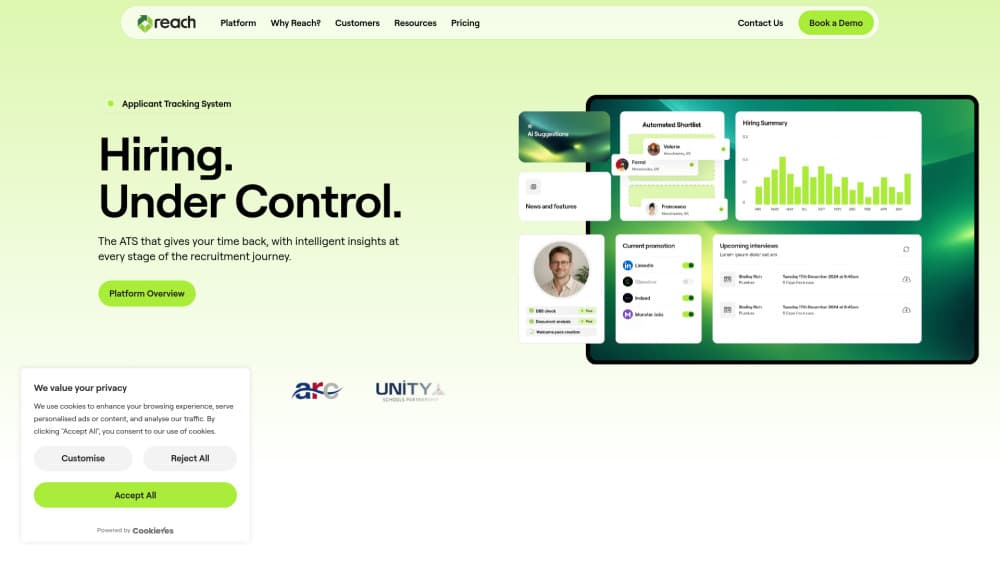
Reach ATS is a hiring platform, and it's built around configurable workflows rather than a fixed set of steps. It follows a role from candidate attraction through onboarding. You post to multiple job boards from one place, screen applicants with AI match scores, and push offers into branded onboarding. Candidates book their own interview slots along the way. Pricing isn't published, so you'll ask for a quote. It's AI recruiting software for teams that have outgrown spreadsheets but don't want an enterprise system they'll spend months configuring.
About Reach ATS
What Is Reach ATS
Reach ATS is an applicant tracking system, which is software that stores every application and moves candidates through defined stages of a hiring process. It's recruitment software that covers the full hiring process, from attraction to onboarding, so recruiters don't have to stitch together separate tools for posting, screening, interviews, and offers.
Three things stand out here. First, it's configurable: the vendor says workflows adapt as a team grows, so the same platform suits a small in-house team and a busier hiring function. Second, AI is applied at specific points, including screening criteria and match scores. The vendor frames it as help where it saves time, not a replacement for judgment. Third, it includes human support for attraction campaigns and expert guidance, which is unusual for software at this tier.
The main limitation is pricing transparency. Reach ATS doesn't publish a rate card, so you have to talk to sales before you know what a seat or an annual plan costs. Teams that need a concrete number before booking a demo should expect an extra step.
Getting Started
- Book a demo through the Reach ATS website and walk through your current hiring process with the team.
- Set up your account: company profile, hiring users, and the stages each role passes through.
- Connect your job boards and publish a vacancy, or build a branded careers page to collect applications directly.
- Turn on screening rules so incoming applicants get match scores and anonymised review before a recruiter opens them.
- Move shortlisted candidates into interviews, then into offers and onboarding once someone accepts.
Product Information
A quick look at Reach ATS's pricing, supported platforms, and performance.
Best for
The users, tasks, and scenarios where this tool fits best.
Users
- In-house recruiters and talent acquisition teams that handle several open roles at once and need candidates to move through one pipeline instead of scattered inboxes.
- Hiring managers who join late in the process
- Small HR teams without a dedicated recruiter
Tasks
- Multi-board job posting
- Screening large applicant pools
- Scheduling interviews
- Offer and onboarding handover
Scenarios
- A growing company that hires in bursts and needs to add stages or approvers without switching systems.
- A recruitment agency running campaigns for multiple clients, using the ad assistant and talent pool to reuse candidates for new roles.
- A team replacing a spreadsheet-and-email process where nobody can tell which candidate sits at which stage.
Key features
Multi-Board Job Posting With an Ad Assistant
Reach ATS posts a vacancy to several job boards in one action, so a recruiter isn't re-entering the same listing across five sites. The intelligent ad assistant helps shape the listing itself. For teams hiring in volume, that's the difference between a morning of admin and a few minutes.
AI Screening With Match Scores
The platform applies screening criteria to incoming applications and returns a match score for each candidate. Recruiters see a ranked view of who fits the role before reading a single resume. Does it replace a recruiter's judgment? No. The score still needs a human check. But it clears the obvious noise fast.
Anonymised Screening and Bias Detection
Applicants can be reviewed without identifying details shown at the first pass, and the platform flags detected bias. That matters if you hire across regions and want the shortlist to stand up to scrutiny. It's a review aid rather than a guarantee of fairness, since bias can sit in the criteria you set.
Self-Serve Interview Scheduling
Candidates pick their own interview slots instead of waiting for a recruiter to confirm times. Video interview options and assessment days are supported, so high-volume rounds don't collapse into a maze of calendar threads. That keeps momentum. Feedback stays attached to the candidate record.
Branded Careers Pages and Candidate Portal
You get a careers site that carries your branding, plus a portal where applicants can check status and handle documents. A decent candidate experience is one fewer reason for good people to drop out mid-process.
Offers and Onboarding in One Flow
Offer management, e-signatures, automated communications, and onboarding software all sit in the same system. Right to work, DBS, and reference checks are built in, so the handover between recruiter and hiring manager doesn't lose paperwork. No chasing. Day one starts with the admin already done.
Talent Pool and Automated Communications
Candidates who don't fit a current role stay in a searchable talent pool, and automated messages keep applicants updated from application to day one. Reusing past applicants is often cheaper than sourcing new ones. It's easy to forget them without a system.
Pros and cons
Pros
- One platform covers attraction, screening, interviews, offers, and onboarding, so there's no gap where a candidate falls out of view.
- Workflows are configurable, which means the system follows your hiring process instead of forcing you into a rigid default.
- AI screening and match scores cut the time spent on first-pass review of large applicant pools.
- Built-in right-to-work, DBS, and reference checks save chasing paperwork at the offer stage.
Cons
- No published pricing. You have to contact sales to learn what it costs, which slows down any comparison against other systems.
- It's a web platform with no mobile app, so recruiters mostly need a desktop browser to work in it.
- Setup is part of the value, so expect some effort to configure stages and screening criteria before the system runs the way you want.
Frequently asked questions
Reach ATS is a hiring platform that manages recruitment software duties from candidate attraction through onboarding. It bundles multi-board job posting, AI screening, interview scheduling, offers, and onboarding into one platform, so recruiters run the whole process in one place.
Related content
Explore related tools, skills, and articles for Reach ATS.
Reach ATS Alternatives

Swms
Swms AI · Writing · Productivity · BusinessSwms is an AI safety compliance tool that turns a plain description of a job into ready-to-use safety documents. Describe your project, trade, and known hazards, and it writes a safe work method statement, job hazard analysis, safe work procedure, RAMS, or safety data sheet in seconds. It also ships with Oscar, a chat assistant that answers workplace safety questions in any language. Teams in construction, mining, transport, and warehousing use it to cut the paperwork that usually eats into a workday.

Wordly AI Translation
Wordly · Voice & Language · ProductivityWordly AI Translation is a real-time AI translation and captioning platform built for meetings, conferences, and events. It delivers live translation, captions, transcripts, and summaries in more than 60 languages, and attendees join by scanning a QR code or opening a link instead of using dedicated headsets. The platform works with Zoom, Microsoft Teams, Google Meet, and Webex, and it's designed for organizations that want multilingual access without hiring human interpreters for every session. Simple as that.

Rows
Rows (Superhuman) · Productivity · BusinessRows is an AI spreadsheet and data analysis tool that imports live data from more than 50 sources, then lets you work with it using plain language instead of SQL queries or nested formulas. You can pull numbers out of PDFs, connect ad platforms, databases, and bank accounts, and ask the AI to build reports, merge datasets, or set up models that recalculate themselves. It runs in the browser, works like a spreadsheet, and now sits under the Superhuman umbrella.