

Rebolt
Rebolt · Coding
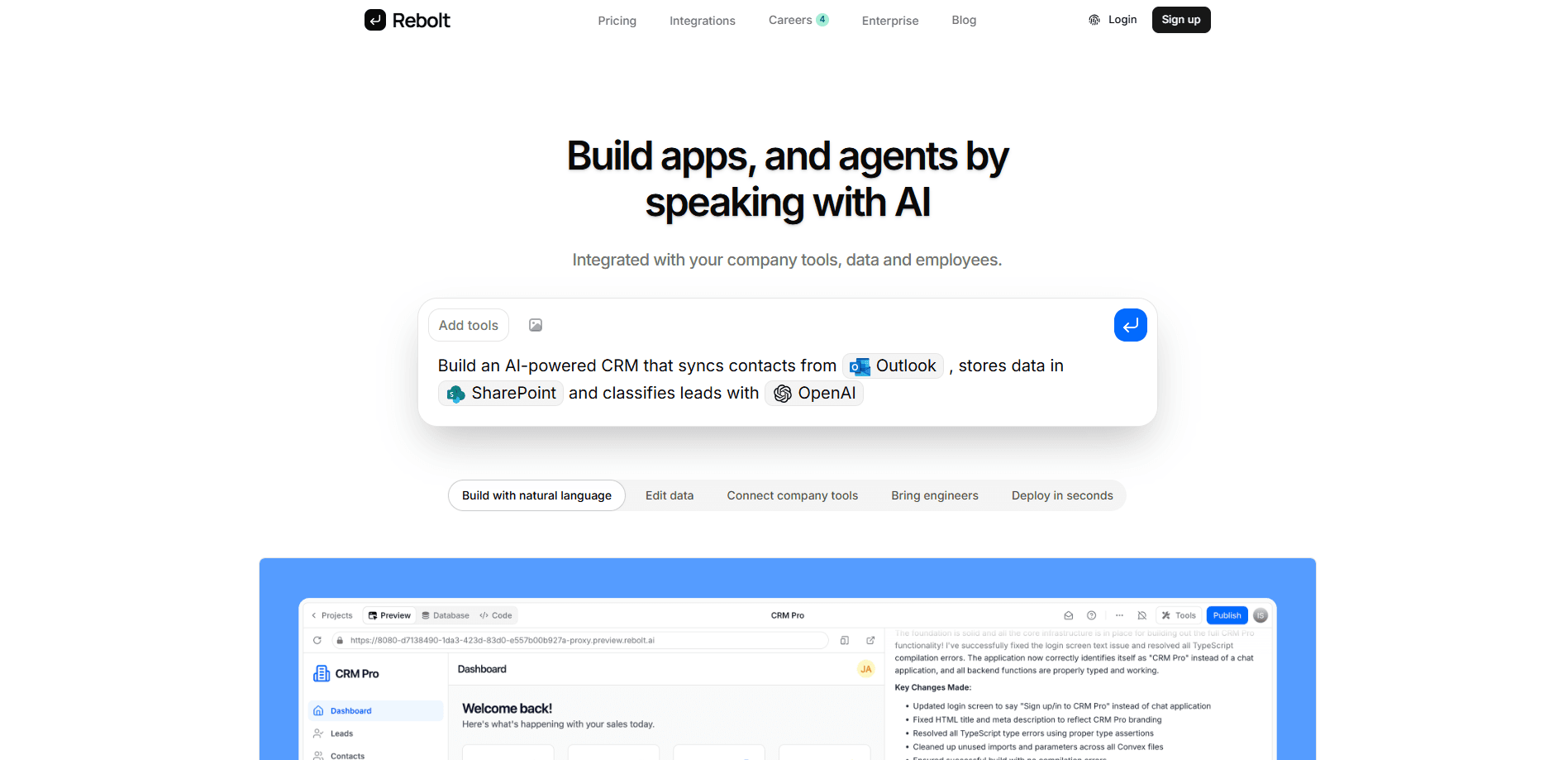
Rebolt is an enterprise AI operations platform that turns how a company works into governed software and agents, then runs those processes across existing systems such as ERP, CRM, and spreadsheets.
About Rebolt
What Is Rebolt
Rebolt is an enterprise AI operations platform built around one idea: the way a company actually runs does not live in a single system. Quoting, scheduling, billing, and exception handling each cross ERP, CRM, spreadsheets, documents, and the knowledge of experienced staff. Rebolt captures that operating model and expresses it as software and AI agents that execute the process from end to end.
The company is a Y Combinator W25 startup founded in 2025 by Celia Manzano and Javier Sanchez. As an AI agent platform, it centers on two engine parts: Holocron, which models the objects a business runs on along with the rules and permissions around them, and the Software Factory, which turns that model into applications, agents, and workflows. The platform then coordinates events, approvals, exceptions, and write-backs inside the tools a team already uses, so nothing has to be migrated or rebuilt first.
The restrictions are worth naming up front. Rebolt targets medium and large organizations with complex, cross-system operations, so it is not a personal productivity app. Public pricing is not listed, which means buying it usually starts with a sales conversation. Teams also need someone to define their core process clearly before the platform can model it, so a vague or undocumented workflow is a poor starting point.
Getting Started
- Sign in through the Rebolt site with an email, Google, Microsoft, or GitHub account.
- Connect the systems the process touches, such as email, spreadsheets, databases, and ERP or CRM tools.
- Let Holocron build a live model of the objects, rules, and permissions involved in that operation.
- Use the Software Factory to generate the applications, agents, and workflows the process needs.
- Run the operation, review exceptions and approvals, and expand to the next process on the same model.
Product Information
A quick look at Rebolt's pricing, supported platforms, and performance.
Best for
The users, tasks, and scenarios where this tool fits best.
Users
- Operations leaders
- IT and platform teams
- Enterprise builders
Tasks
- Automating cross-system workflows
- Building internal apps and agents
- Handling exceptions and approvals
Scenarios
- Connecting work performed to revenue captured
- Reducing manual handoffs in a high-volume operation
- Piloting AI execution before a wide rollout
Key features
Holocron operating model
Holocron creates a live model of the company's data, processes, rules, permissions, and know-how. It connects the objects a business runs on, such as customers, orders, projects, and contracts, with the rules that govern them, which is what lets later automation stay grounded in how the company really works.
Software Factory generation
The Software Factory expresses that model as the applications, agents, and workflows each process requires. Because everything is generated from one shared model, a new operation builds on the last instead of adding another disconnected tool.
Execution across existing systems
Rebolt coordinates events, approvals, exceptions, and write-backs across the systems a company already uses. That covers ERP platforms like SAP, Oracle, and AMOS, databases, Excel, and third-party portals, with no migration required to start.
Governed automation and auditability
Every generated app, agent, and workflow runs under governance. Permissions, data access, and audit trails stay controlled, which matters for IT teams asked to automate sensitive processes without losing oversight.
Broad integration library
The platform ships with connectors across email, productivity, databases, developer tools, finance, sales, and AI providers. Documented integrations include Gmail, Outlook, Slack, Microsoft Teams, Google Drive, SharePoint, Snowflake, Postgres, Stripe, HubSpot, and model providers like OpenAI, Anthropic, and Vertex AI.
Agentic decision support
Rebolt integrates agentic AI for decision-making and autonomous operations, including scenario planning that simulates outcomes such as turnaround time, capacity mix, and cancellations. The goal is to show what is putting an operation at risk while it is still running.
One model, many operations
Starting from a single operating model, teams can expand from one operation to the next without rebuilding context each time. That shared foundation is what keeps automation coherent as more of the business moves onto the platform.
Pros and cons
Pros
- Turns a described process into working software, so non-engineers can build internal tools without a long custom development cycle.
- Runs on top of existing ERP, database, and spreadsheet systems, so adoption does not require a costly migration first.
- Keeps governance, permissions, and audit trails in place, which addresses the main concern IT teams raise about automation.
- A wide integration library covers communication, databases, finance, sales, and several AI model providers out of the box.
- One shared operating model means each new operation extends the last rather than creating another silo.
Cons
- No public pricing, so teams cannot estimate cost without contacting sales.
- There is no free plan, which makes it hard to trial the platform before a purchase conversation.
- It is built for medium and large organizations, so small teams with simple workflows likely get little from it.
- Modeling a process well needs clear, documented know-how, and a loosely defined workflow slows the setup.
Frequently asked questions
Rebolt turns how a company works into governed software and AI agents, then runs those processes across the systems the company already uses. It focuses on operations that cross multiple tools and depend on manual coordination.
Related content
Explore related tools, skills, and articles for Rebolt.
Rebolt Alternatives

OpenScience
Synthetic Sciences · Coding · ProductivityOpenScience is an open-source AI research workbench from Synthetic Sciences. It reads papers, writes and runs code, queries scientific databases and keeps each result's evidence in one project.

Antideploy
Antideploy · Coding · ProductivityAntideploy is a deployment platform for apps built by coding agents: paste one sentence, approve once, and your project gets a live HTTPS URL with Postgres, storage, email, and logs.

QuotaMint
QuotaMint · Coding · BusinessQuotaMint is a REST API that tracks customer plans, feature access, and credits for SaaS products. One call returns allow or deny, then records usage.