

Redacto
Redacto · Productivity
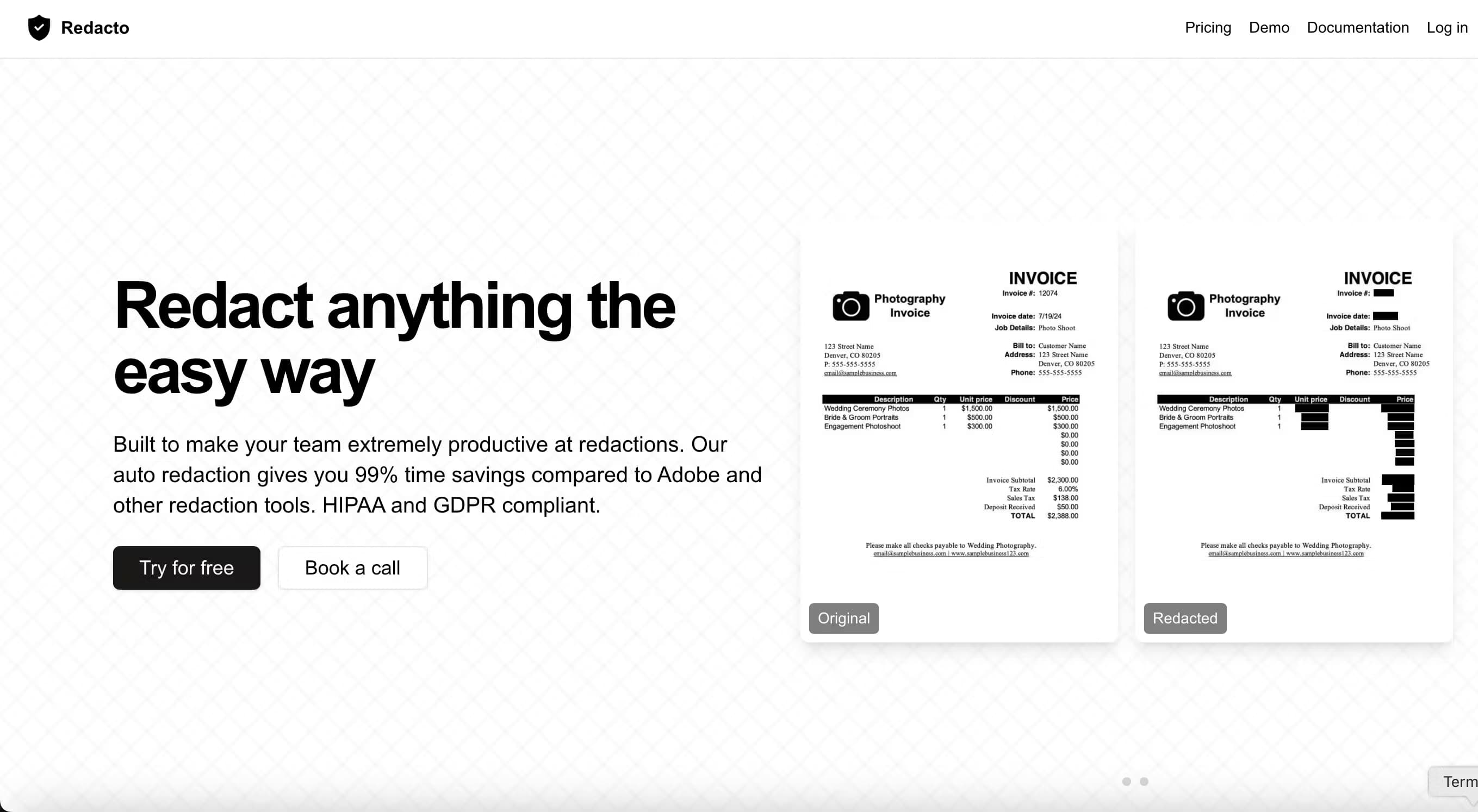
Redacto is an AI redaction tool for legal, medical, and financial documents. It parses files, detects sensitive information like client PII, and applies redactions automatically.
About Redacto
What Is Redacto
Redacto is web-based software that finds and removes sensitive information from documents before they leave your hands. You upload a file, the parser reads it the way a person would, and it flags the details your policy says must go: names, client identifiers, trade secrets, medical records, financial data. Then it applies the redactions.
The work it replaces is slow and repetitive. Teams that redact case files, medical records, or disclosure packets by hand burn hours per batch, and every missed field is a compliance risk. Redacto targets both problems at once, and the company estimates the automation saves 99% of the time a manual tool like Adobe Acrobat takes on the same job. It's aimed at legal teams doing M&A and mass tort work, healthcare groups handling patient records, and finance shops managing disclosures.
The limits are worth naming. Redacto doesn't decide what the law or your policy requires you to remove. It proposes a fast first pass, and an authorized person still reviews every release decision before anything goes out. Pricing sits behind a sales conversation, so you can't self-serve a plan from the site. Independent accuracy on messy scans isn't published, and the company's claims come from its own evaluations.
Getting Started
- Open getredacto.com or book a call with the team to get an account and a trial.
- Upload the documents you need to redact, or connect the API to your own workflow.
- Set the redaction schema, either from a preset like medical or financial records, or through a prompt.
- Run the pass and review the detected items before they're applied.
- Download the redacted files and confirm the redactions are burned in, not just covered.
Product Information
A quick look at Redacto's pricing, supported platforms, and performance.
Best for
The users, tasks, and scenarios where this tool fits best.
Users
- Legal teams working M&A and mass tort cases
- Healthcare staff preparing records for disclosure
- Finance and compliance officers
- Legal tech developers
Tasks
- Cleaning client information out of case files
- Redacting medical records before a demand packet
- Removing metadata before sharing
- Handling documents in more than one language
- Checking that redactions actually applied
Scenarios
- A tight-turnaround disclosure deadline
- Recurring redaction queues
- Onboarding a document-heavy matter
- Auditing a release before it goes out
Key features
Automated PII detection and redaction
The core job is finding sensitive information and removing it. Redacto's parser reads a document like a person would, taking in layout, structure, and meaning rather than matching keywords. That matters when the same name appears in a header, a signature block, and a table, or when a document uses shorthand only someone reading the full page would catch. It detects client PII and other identifiers, then applies redactions across the file.
Document parsing that follows structure
Most redaction tools match strings. Redacto reads the document first, capturing how it's laid out and what the sections mean, then works from that understanding. The payoff shows up on long, messy files where the same detail takes a different form in each section. Parsing across 100+ languages and mixed-language documents means a file with Spanish and English clauses doesn't need splitting before it runs.
Prompt-based redaction for custom schemas
Not every job fits a preset. Redacto supports prompt-based redaction, so you describe what you need removed, such as financial fields or a specific medical schema, in plain terms. That covers the long tail of requests a fixed list of entity types misses. Teams can build a schema once and reuse it on every batch that follows.
OCR for scans, faxes, and handwriting
Plenty of records arrive as images, not clean text. Redacto runs OCR over scanned pages, faxes, and handwritten content, and the company says it holds up on low-quality sources. Without it, redaction stops at the first scan. With it, the same pass covers a folder that mixes digital PDFs and paper that went through a scanner.
Metadata removal
A black box over a name doesn't erase the name hiding in the file's metadata. Redacto strips sensitive metadata, including author names and creation dates, so the details don't travel with the document. Anyone who releases files outside their organization needs this. A visual check won't catch it.
File type and API coverage
Redacto handles PDFs, Word documents, images, spreadsheets, and more, and every plan includes full API access. That combination lets a team embed redaction in its own pipeline rather than dragging files through a separate app. Batch processing over hundreds of documents in minutes is the headline use case the company sells.
Pros and cons
Pros
- Parses documents by structure and meaning, so it catches identifiers that string matching misses.
- Covers 100+ languages and mixed-language files without splitting them first.
- OCR extends redaction to scans, faxes, and handwriting, which many tools skip.
- Removes metadata along with visible content. That closes a common leak most tools leave open.
- Full API access on every plan makes it usable inside existing workflows.
Cons
- Pricing is quote-based, so teams can't size a plan from the site before talking to sales.
- It doesn't decide what your policy or law requires, so a person still reviews every release, which keeps a manual step in the loop.
- Accuracy figures come from the company's own evaluations, and independent results on poor-quality scans aren't published.
Frequently asked questions
Redacto removes sensitive information from documents automatically. Legal, medical, and financial teams use it to redact client PII, records, and confidential details from case files, disclosure packets, and reports across hundreds of documents in one pass.
Related content
Explore related tools, skills, and articles for Redacto.
Redacto Alternatives

Swms
Swms AI · Writing · Productivity · BusinessSwms is an AI safety compliance tool that turns a plain description of a job into ready-to-use safety documents. Describe your project, trade, and known hazards, and it writes a safe work method statement, job hazard analysis, safe work procedure, RAMS, or safety data sheet in seconds. It also ships with Oscar, a chat assistant that answers workplace safety questions in any language. Teams in construction, mining, transport, and warehousing use it to cut the paperwork that usually eats into a workday.

Wordly AI Translation
Wordly · Voice & Language · ProductivityWordly AI Translation is a real-time AI translation and captioning platform built for meetings, conferences, and events. It delivers live translation, captions, transcripts, and summaries in more than 60 languages, and attendees join by scanning a QR code or opening a link instead of using dedicated headsets. The platform works with Zoom, Microsoft Teams, Google Meet, and Webex, and it's designed for organizations that want multilingual access without hiring human interpreters for every session. Simple as that.

Rows
Rows (Superhuman) · Productivity · BusinessRows is an AI spreadsheet and data analysis tool that imports live data from more than 50 sources, then lets you work with it using plain language instead of SQL queries or nested formulas. You can pull numbers out of PDFs, connect ad platforms, databases, and bank accounts, and ask the AI to build reports, merge datasets, or set up models that recalculate themselves. It runs in the browser, works like a spreadsheet, and now sits under the Superhuman umbrella.