

Relace Repos
Relace · Coding
Relace Repos is a git-compatible source control system built for AI coding agents rather than human developers. It gives you hosted repositories for your applications, built-in codebase retrieval that stays fast on large projects, and rate limits designed for high-throughput automation. Teams building text-to-app platforms or autonomous coding agents use it to store, version, and search code without the ceiling that a service like GitHub eventually hits.
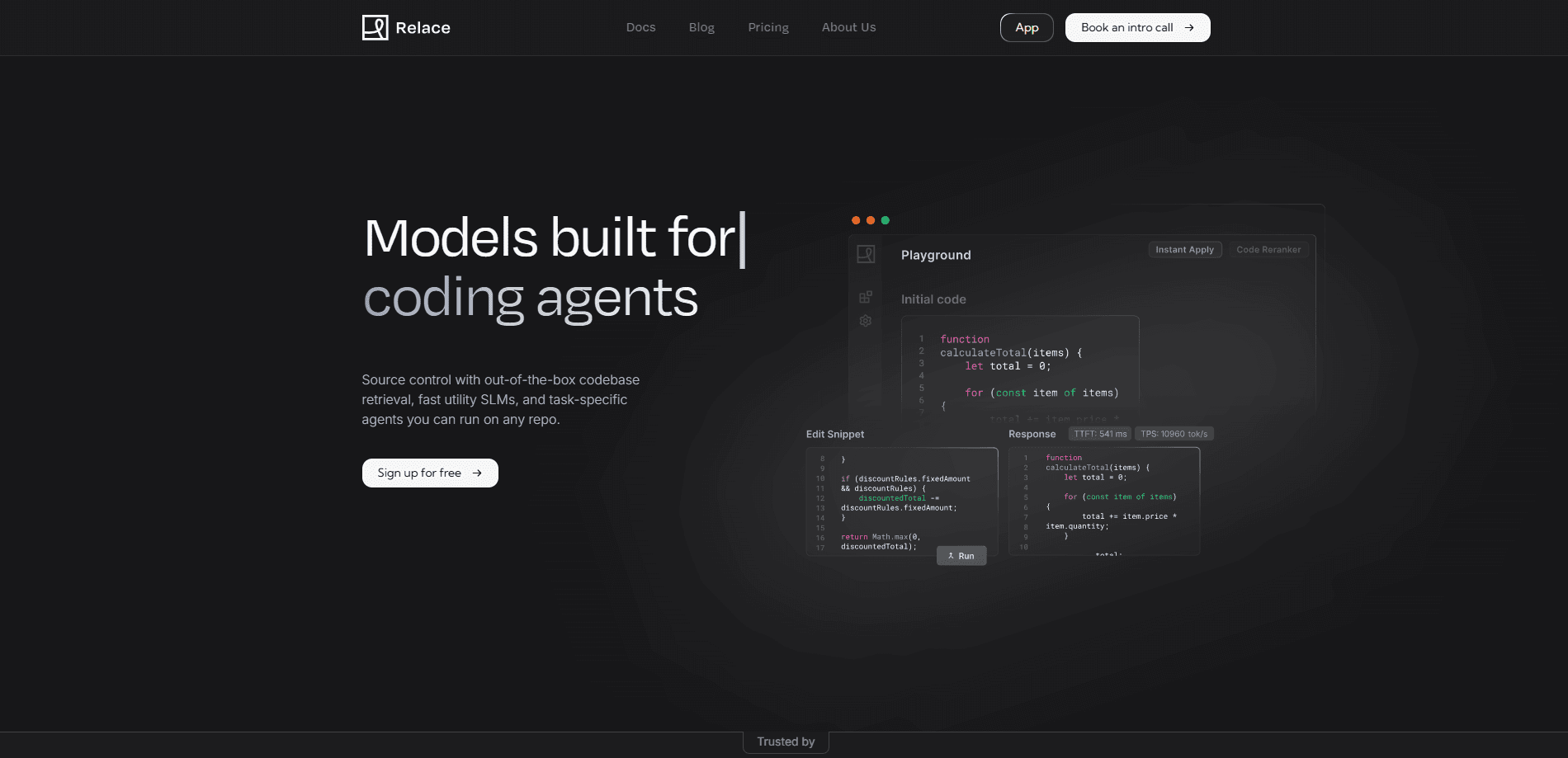
About Relace Repos
What Is Relace Repos
Relace Repos is a fully managed version control system that Relace built specifically for AI applications. If you're shipping a product where an agent writes and edits code on behalf of your users, you run into a problem that regular git hosts never planned for: thousands of small repositories, each touched by automation instead of a person at a keyboard. Relace Repos is designed for exactly that shape of workload. It's a different beast.
The product pairs durable source storage with agentic search, so an agent can find the relevant files in a large codebase in seconds instead of pulling everything into context. It keeps full git compatibility, which means standard git operations work and human developers can still collaborate on the same code. It also supports multi-tenancy that scales to millions of repositories across thousands of users, with rate limits that let many repos run at once.
The most important limitation is audience. This isn't a place to keep your personal side projects, and it isn't a replacement for GitHub in a normal human-driven workflow. It's infrastructure you integrate into an AI product, so the value only shows up once you have an agent that needs to read, write, and search code at scale. There's also no free stand-alone tier in the classical sense; access runs through the Relace platform and its token-based pricing.
Getting Started
- Create an account at app.relace.ai and confirm access to the Relace platform.
- Generate a repo token, the credential your backend or agent uses to read and write to Relace repos securely.
- Create a repository, either empty or from a Relace template that gives new repos a starting point.
- Push and pull using standard git commands, or wire the lightweight read/write operations directly into your backend.
- Turn on agentic search and import a GitHub project if you want retrieval over an existing codebase.
Product Information
A quick look at Relace Repos's pricing, supported platforms, and performance.
Best for
The users, tasks, and scenarios where this tool fits best.
Users
- AI product teams
- Platform engineers
- Enterprise developers
Tasks
- Hosting a repo per user application
- Running codebase retrieval for agents
- Versioning agent-made edits
- Integrating with GitHub for human review
- Testing repositories in isolation
Scenarios
- Scaling an AI code editor to many concurrent users
- Spawning subagents on branches
- Onboarding an existing project into agent workflows
- Cutting token costs on long agent sessions
Key features
Git-compatible repository hosting
Relace Repos keeps full git compatibility, so standard git operations work and you can interact from the git CLI on any file system. That matters because your engineers don't have to learn a new workflow, and existing tooling keeps working. Human developers can still review and collaborate on the same code an agent is writing.
Built-in agentic search
Agentic search explores large codebases in parallel and answers in seconds, keeping latency low even as a project grows. Instead of retrieving full source every time an agent spins up, it pulls only the files relevant to the request. For teams whose cold-start latency was dominated by cloning, this is the feature that changes the math.
Multi-tenancy at scale
The platform scales to millions of repositories across thousands of users, a design point driven by the way text-to-app systems treat each user application as its own repo. A single account doesn't hit a hard repository ceiling the way it can on a human-first host.
Permissive rate limits
Rate limits are set for high-throughput automation rather than occasional manual pushes. If a single AI edit needs at least two API calls, GitHub's hourly request ceiling caps you at roughly two requests per second; Relace Repos is built so that many repos can push and pull simultaneously without that bottleneck. That's the whole point.
Lightweight push/pull operations
Read and write operations are lightweight and designed to be called from sandboxes and serverless environments. That removes the local clone, edit, stage, commit, push chain that a standard git host assumes. Fewer steps means less overhead per agent action.
Relace templates
Templates give new repositories a starting point, so you're not configuring every repo from scratch. Once a template exists, every new repo spun up by your application can inherit the same baseline. Setup gets easier fast.
Repo tokens
Repo tokens are the credential layer for accessing your Relace repos securely. They let your backend or agent authenticate per repo without handing out broader account access. Keep them tight. Managing them cleanly is part of how you keep an automated system safe.
GitHub integration
You can integrate Relace Repos with your GitHub account or app, which lets human developers keep working in GitHub while agents operate on Relace repos. It's the bridge that makes AI-written changes reviewable by the team.
Pros and cons
Pros
- Built specifically for AI agent workloads, so repository limits and rate limits don't cap you the way human-first git hosts do.
- Agentic search returns relevant files in seconds and keeps latency low on large codebases.
- Full git compatibility means existing CLI workflows and human collaboration keep working.
- Multi-tenancy scales to millions of repos, which fits the one-repo-per-app model of text-to-app platforms.
- Integrates with the rest of Relace, including Compact for cutting token costs and specialized agents you can run on any repo.
Cons
- There's no free stand-alone plan, so you pay per token rather than getting a free tier to experiment with.
- It's infrastructure for developers, not a consumer product, and it assumes you already have an agent or backend to connect. Non-technical users won't get anything out of it.
- You can't use it as a drop-in personal GitHub replacement; the value only appears at real automation scale.
Frequently asked questions
It's a version control system for AI applications. You use it to store, version, and search the source code your coding agents read and write, generally with one repository per user application. It handles the repo and request volumes that human-first git hosts struggle with.
Related content
Explore related tools, skills, and articles for Relace Repos.
Relace Repos Alternatives
Forefront
Forefront · CodingForefront is a web platform for building with open-source AI. It lets you fine-tune leading open-source language models on your own data, evaluate how they perform, and run them through an API or export them to host yourself. Developers who want the convenience of a closed-source platform but insist on owning their models and data are the target audience here.

Startkit
StartKit.AI · CodingStartkit is a boilerplate for building AI SaaS and AI wrapper products. Think of it as an AI startup boilerplate with the boring parts already wired up: authentication, Stripe and Lemon Squeezy payments, usage limits, transactional email, and an AI API starter that talks to OpenAI, Anthropic, Groq, or Llama. You clone the repo, set your price, and start on the part of your product that people actually pay for. It's Next.js under React and Tailwind, so most of the boilerplate code already feels familiar.
Testim
Tricentis · CodingTestim is an AI-powered test automation platform for building and running end-to-end tests across web, mobile, and Salesforce applications. It leans on machine learning to keep tests stable when an interface changes, so teams spend less time fixing broken selectors. Not bad for an automated testing tool you can start using today. You create tests by recording actions in a browser, then optionally add JavaScript when you need more control. It's a solid pick for busy QA teams.