
Research Topics Generator
Research Topics Generator · Writing · Business
Research Topics Generator is a free AI tool that turns your interests into workable research topics and questions for student and academic projects.
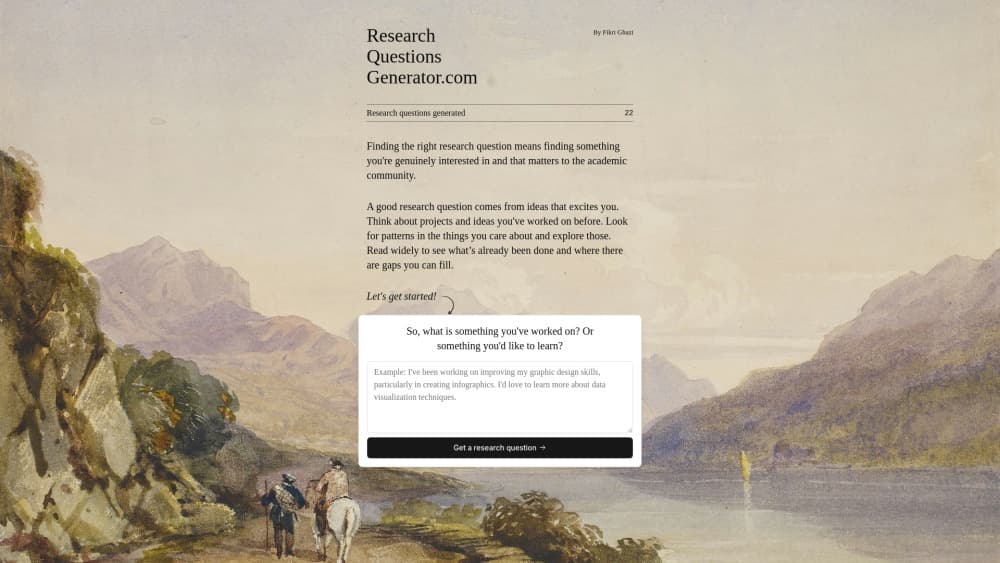
About Research Topics Generator
What Is Research Topics Generator
Research Topics Generator is a free web tool that helps students and early-career researchers turn a vague area of curiosity into concrete research topic ideas. You type in what you're interested in, add context like scope and complexity, and the tool suggests possible research directions you can build on. It's built by an independent team and runs entirely in your browser, so there's nothing to install.
As an AI topic generator, the tool uses generative AI to produce suggestions, which sets clear expectations. It isn't a literature review. It won't tell you whether your idea is original. The site says outright that suggestions shouldn't be treated as proof of originality, and that you're still responsible for checking the literature, ethics, data access, and methodological fit. That honesty is the point. Think of it as an academic topic generator, not an answer key. If you treat it as a starting point rather than a finished answer, it saves you the blank-page problem.
It's aimed at the exploratory stage, before a supervisor or a proper literature search narrows things down. Where does that leave you? With a shortlist to react to instead of an empty page. The subject pages add worked examples that show what a focused topic looks like: a defined population or system, a bounded context, and an observable relationship you can actually investigate.
Getting Started
- Open the tool at researchtopicsgenerator.com and enter the subject area you want to explore.
- Add context such as your scope and the complexity level you're aiming for.
- Generate several topic ideas, then run them again with different wording to widen the pool.
- Pick the directions that fit your time, data, and skills.
- Refine the strongest one with a supervisor and a search of recent scholarly literature.
Product Information
A quick look at Research Topics Generator's pricing, supported platforms, and performance.
Best for
The users, tasks, and scenarios where this tool fits best.
Users
- Students
- Early-career researchers
- Teachers and advisors
Tasks
- Finding a research topic
- Drafting research questions
- Breaking a blank page
Scenarios
- Starting a dissertation
- Choosing a course project
- Exploring an unfamiliar field
Key features
Interest-to-Topic Generation
You describe what you're curious about, and the tool returns possible research directions. Context like scope and complexity shapes what you get back, so a narrow prompt gives tighter suggestions than a one-word subject.
Research Question Suggestions
Beyond broad topics, it acts as a research question generator. It produces question-style prompts. These map more closely to what a proposal or abstract needs. They're easier to hand to a supervisor than a vague theme.
Subject Guides With Worked Examples
The subject pages go past raw output and show how a focused topic is structured. Each example points to a defined population, a bounded context, and an observable relationship. Reading a few of these teaches the pattern faster than trial and error.
Fully Browser-Based
There's no account to create. Nothing to download. The whole tool runs in the browser, which keeps the barrier low when you just want to test an idea. Open it, type, and go.
Free to Use
The tool carries no price tag and no visible paid tier. That's rare. For students on a budget, it matters, and it means you can generate as many candidate topics as you need.
Pros and cons
Pros
- Free with no signup, so you can test it in seconds.
- Handles the blank-page problem well by producing multiple starting angles.
- Subject guides explain the structure of a focused topic, not just the idea.
- Honest about limits, stating plainly that it doesn't verify originality or replace supervision.
Cons
- It won't check whether a topic is already covered, so you still need a real literature search.
- No API, so you can't fold it into your own scripts or workflow.
- Suggestions vary run to run, which means you may need several passes to find a direction you like.
Frequently asked questions
Yes. The tool is free to use and there's no paid plan or account requirement listed on the site.
Related content
Explore related tools, skills, and articles for Research Topics Generator.
Research Topics Generator Alternatives

Lattice
Lattice · Writing · Voice & LanguageLattice is a free AI humanizer that rewrites stiff or template-sounding text by routing it through other languages and back, so the result reads like a person wrote it.

Superhuman Go
Superhuman · Writing · Productivity · BusinessSuperhuman Go is an AI assistant from the team behind Grammarly. It works in your browser, desktop apps, and Slack, offering proactive writing help and custom agents grounded in your work context.

GoodSocials
Pavel Kucherbaev · Writing · Productivity · MarketingGoodSocials is an AI social media manager for LinkedIn that drafts weekday posts from market research or your own Stripe, GitHub and PostHog numbers, then waits for approval.