

Revelion AI
Revelion Limited · Coding
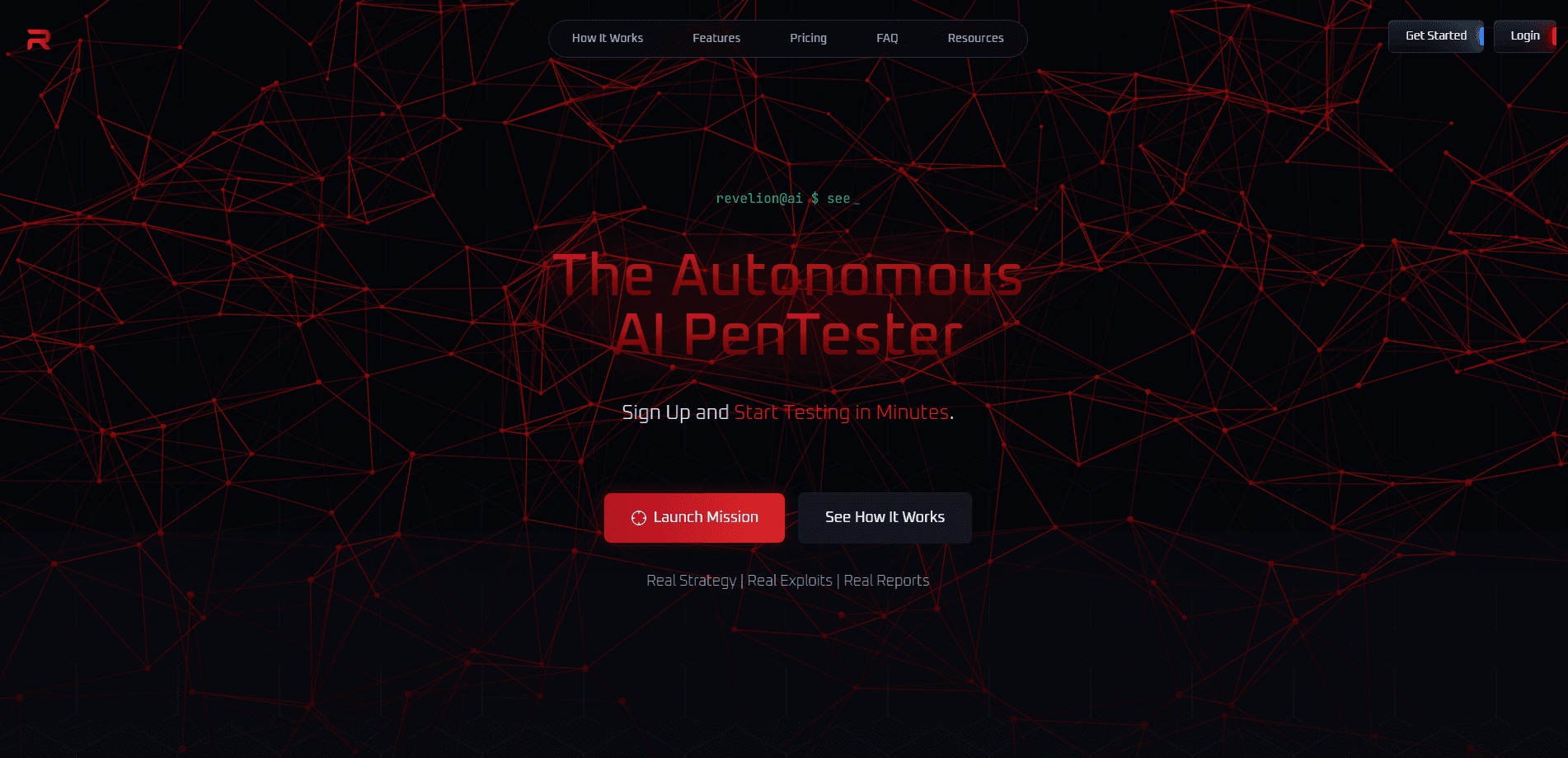
Revelion AI is an autonomous penetration testing platform built by Revelion Limited in the United Kingdom. It runs a full offensive engagement against an authorized estate, moving through reconnaissance, enumeration, exploitation, validation, and reporting without a human operating the keyboard. What sets it apart is the reporting standard. It only lists findings it actually demonstrated, each one attached to reproduction steps and evidence rather than a theoretical severity score. Revelion only reports what it proved. That's the promise. A typical mission costs roughly 30,000 credits, and the entry plan sits at £99 per month. Both numbers are published. The platform's audience is narrow on purpose. MSPs test many clients at once, and enterprise teams retest their own systems as they ship.
About Revelion AI
What Is Revelion AI
Revelion AI is an autonomous AI pentester delivered as a service. You point it at an estate you own or are authorized to test. Then it runs the same phases a human penetration tester would. Recon first. Then a written report. No keyboard operator needed. The difference is that it runs on demand, so you can test every time you deploy instead of waiting for the next annual engagement.
The platform is honest about its own limits. Access isn't self-serve, and that's deliberate. You request access, someone reviews the request, and only then does testing get scheduled. It also won't touch anything outside a declared scope. The safety guardrails live in the engine itself at the code level, not in a policy document. Can you test without that review? No. Not yet.
For security teams, the practical value is frequency and evidence. A traditional pentest gives you a snapshot once a year. An autonomous pentesting platform lets you validate the same estate continuously and hand auditors findings that were actually reproduced. That matters when you're answering for SOC 2 or ISO 27001 controls.
Getting Started
- Request access at the Revelion website and wait for the review to complete, since onboarding isn't instant.
- Define the scope you want tested and supply the guardrails and context the engine should respect.
- Provide credentials and any authorized access the mission needs to move past the perimeter.
- Launch a mission and let the autonomous AI pentester work through recon, exploitation, and validation.
- Review the report, then retest the closed findings in a later run.
Product Information
A quick look at Revelion AI's pricing, supported platforms, and performance.
Best for
The users, tasks, and scenarios where this tool fits best.
Users
- Managed service providers
- MSSPs and enterprise security teams
- Compliance teams
- Internal IT teams without a dedicated security function
Tasks
- Continuous security testing
- Validated finding summaries
- Multi-client reporting for MSPs
- Pre-audit evidence gathering
Scenarios
- You just shipped a new release and want to know whether the changes opened anything up.
- A client signed on and you need a baseline assessment without booking a human team weeks out.
- An auditor asks how you know a reported vulnerability was fixed, and you want proof rather than a scan result.
- Your internal app has authentication and business-logic flows that scanners keep flagging as false positives.
Key features
Autonomous Mission Execution
Revelion takes an engagement from reconnaissance through exploitation, validation, and reporting on its own. You define the scope, the AI pentester runs the phases, and you get a report at the end. That's the whole pitch. It's also what lets automated security testing happen as often as you deploy rather than once a year.
Evidence-Based Findings
Every finding in a Revelion report was demonstrated during the mission. You get reproduction steps and attached evidence, not a long list of theoretical vulnerabilities ranked by a score that may or may not reflect real risk. For teams drowning in scanner output, that's a meaningful filter. It saves hours.
Declared Scope and Code-Level Guardrails
Testing only runs inside a scope you declare, and the guardrails are enforced in the engine at the code level. Customers can add further guardrails and context on top. The platform also expects a documented Letter of Authorisation. That keeps the whole process inside a sanctioned testing boundary.
Integrations with Slack, MCP, and API
Revelion connects to Slack, exposes an MCP server, and offers an API. That means findings and mission status can flow into the tools a security team already uses, and the MCP server lets compatible agent setups pull Revelion data programmatically. The API availability puts it in reach of teams building their own dashboards.
Coverage Across Common Attack Surfaces
The platform targets network infrastructure, web applications and portals, REST and GraphQL APIs, cloud environments, Active Directory identity paths, and IoT or embedded devices. That spread matters for MSPs running assessments across very different client environments, where a single-scope tool would leave whole categories untested. Coverage is broad. Client estates rarely look alike.
Credit-Based Pricing with a Low Entry Point
Pricing starts at the MSP Basic plan at £99 per month and runs on credits. A typical mission costs roughly 30,000 credits, so you can estimate cost per engagement instead of paying a flat retainer whether you test or not. If you're comparing Revelion pricing against a fixed annual pentest budget, the credit model rewards teams that test in bursts and penalizes teams that test constantly.
Pros and cons
Pros
- Runs on demand, so testing frequency can match your deployment cadence.
- Reports only demonstrated findings with reproduction steps, cutting false positives.
- Guardrails enforced in the engine at code level, not just in policy.
- Entry pricing at £99 per month with credit-based usage fits MSP budgets.
- Slack, MCP, and API integrations slot into existing workflows.
Cons
- Access is granted only after a review, so you can't test today and no free trial exists.
- Pricing is credit-based, which makes per-mission cost less predictable than a flat fee.
- Aimed at MSPs and enterprise teams, so an individual developer has no realistic path in.
- The full platform depth isn't visible before onboarding, making pre-purchase evaluation hard.
Frequently asked questions
It performs autonomous penetration tests against an estate you're authorized to test. The platform runs reconnaissance, enumeration, exploitation, and validation, then delivers a report of findings it demonstrated with evidence and reproduction steps.
Related content
Explore related tools, skills, and articles for Revelion AI.
Revelion AI Alternatives
Forefront
Forefront · CodingForefront is a web platform for building with open-source AI. It lets you fine-tune leading open-source language models on your own data, evaluate how they perform, and run them through an API or export them to host yourself. Developers who want the convenience of a closed-source platform but insist on owning their models and data are the target audience here.

Startkit
StartKit.AI · CodingStartkit is a boilerplate for building AI SaaS and AI wrapper products. Think of it as an AI startup boilerplate with the boring parts already wired up: authentication, Stripe and Lemon Squeezy payments, usage limits, transactional email, and an AI API starter that talks to OpenAI, Anthropic, Groq, or Llama. You clone the repo, set your price, and start on the part of your product that people actually pay for. It's Next.js under React and Tailwind, so most of the boilerplate code already feels familiar.
Testim
Tricentis · CodingTestim is an AI-powered test automation platform for building and running end-to-end tests across web, mobile, and Salesforce applications. It leans on machine learning to keep tests stable when an interface changes, so teams spend less time fixing broken selectors. Not bad for an automated testing tool you can start using today. You create tests by recording actions in a browser, then optionally add JavaScript when you need more control. It's a solid pick for busy QA teams.