

Revolte
Revolte · Coding
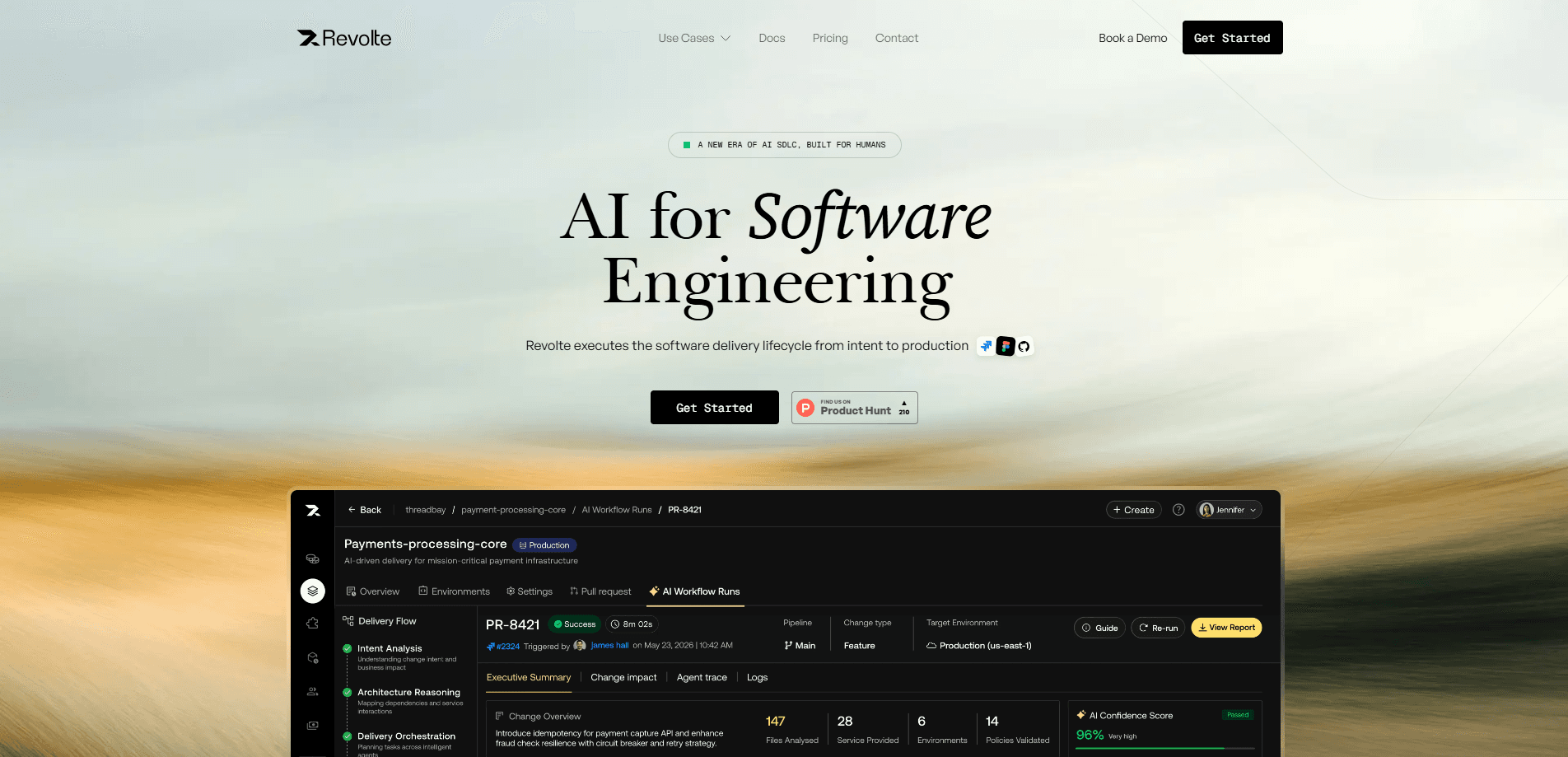
Revolte is an AI software delivery platform that runs development, testing, deployment, and production operations end to end. You hand it intent, a feature to build or a ticket to execute, and its agents read your codebase, plan the work, and wait for your approval before they ship anything. It's built for engineering teams that want agent speed without giving up control, since every agent action stays visible and auditable before it lands in production.
About Revolte
What Is Revolte
Revolte isn't a coding assistant bolted onto your editor. It's an AI-native software delivery platform built around what the team calls agentic delivery, where AI agents own the full software delivery lifecycle from intent to shipped code while engineers direct the system and approve outcomes. That covers application development, automated quality engineering, security and performance checks, production reliability, data migration, and application modernization.
The core idea is that autonomy should be auditable. Agents ask before they act, and every consequential decision surfaces to the right person at the right time. You set approval thresholds per workflow, team, or risk level. Because Revolte plugs into your existing environments, pipelines, and infrastructure rather than replacing them, it fits teams that already have a stack they trust. Think of it as AI DevOps with a review gate at every step.
The main limitation is scope. Revolte is aimed at engineering organizations running production software, so it's not a fit for solo tinkering beyond the free tier or for teams without any CI/CD setup to connect to. It also won't replace engineering judgment. You still own what ships. Some capabilities, like automated quality engineering and security and performance monitoring, are still marked as coming soon on the site. So not everything in the pitch is live today.
So who should actually sign up? Teams running production services, mostly. Not hobbyists.
Getting Started
- Sign up at the Revolte console and create a project for the services you want managed.
- Connect your repository and infrastructure so agents can read your codebase and context.
- Define requirements for a task, whether that's a feature, a bug fix, or a ticket, and let Revolte build a plan.
- Review and approve the plan and any consequential agent actions at the approval thresholds you set.
- Let agents write the code, run tests, and open the pull request, then confirm what goes to production.
Product Information
A quick look at Revolte's pricing, supported platforms, and performance.
Best for
The users, tasks, and scenarios where this tool fits best.
Users
- Engineering teams shipping production software
- Platform and DevOps engineers
- Solo builders and indie devs on a budget
Tasks
- Turning specifications into deployable code
- Scaling test coverage
- Data migration and validation
- Modernizing legacy systems
Scenarios
- A team that wants AI to handle routine PRs and boilerplate
- An org under compliance pressure
- Rolling out agents across a large engineering org
Key features
The Agentic Delivery Loop
Revolte's agents run development, testing, deployment, and production operations end to end, not just code generation. Engineers define requirements and approve outcomes while agents execute across the lifecycle. Every step is visible before you commit. That's the difference between plain automated software delivery and a governed delivery loop, and it's why the platform pitches AI agents for software development rather than another autocomplete tool.
Sandboxed Execution Environment
Every agent runs inside a dedicated execution environment that's sandboxed, permissioned, and scoped to exactly what a task needs and nothing more. That scoping is what keeps an agent from touching parts of your system it has no business changing.
Context Management
Agents stay grounded in your actual codebase, architecture decisions, and prior work. Every task starts with real context instead of a blank prompt, so output reflects how your system is actually built rather than generic patterns. No blank slate.
Revolte IDP & Platform
This is the internal developer platform layer that connects agent output to your existing environments, pipelines, and infrastructure. Revolte plugs into what you've already built, so you don't rip out your toolchain to adopt it. Keep your stack.
Delivery Intelligence
Delivery Intelligence tracks what agents did, why, and what happened after, and it's the data layer behind every audit trail. Enterprise teams use it to track DORA and FLOW metrics, AI ROI, quality trends, and release readiness instead of counting tokens consumed. For anyone weighing AI code delivery, it's the piece that answers "why did this ship" after the fact.
Control & Governance
Agents ask before they act, and every consequential decision surfaces to the right person at the right time. You set approval thresholds per workflow, team, or risk level, so autonomy scales with your risk appetite rather than being all-or-nothing. Set the rules once. The agents follow them.
Outcome-Based Pricing
Revolte is priced per service rather than per user, so unlimited users can work on a plan. Plans run from a free tier with 20 credits up to a $199 Growth plan with 500 credits. Extra credits are pay-as-you-go. Cloud usage always bills separately, which keeps the meters predictable. No per-seat math.
Pros and cons
Pros
- Agents cover the full delivery lifecycle, not just code generation, so development, testing, deployment, and production operations line up under one system.
- Governance is built in: approval thresholds and audit trails mean agents ask before acting and every action is inspectable.
- Pricing is per service with unlimited users, which avoids per-seat cost creep as your team grows.
- It connects to existing pipelines and infrastructure instead of forcing a toolchain rebuild.
- A free tier and a $20 Starter plan let small teams test it before committing.
Cons
- Some advertised capabilities, including automated quality engineering and security and performance monitoring, are still marked coming soon, so the current feature set is narrower than the marketing.
- It's built for production engineering teams. Hobbyists and teams without CI/CD pipelines won't get much from the governed workflows.
- Cloud usage bills separately from credits, which means the real monthly cost can run higher than the plan price suggests.
Frequently asked questions
Revolte runs the software delivery lifecycle with AI agents, covering application development, testing, deployment, and production operations. Engineers define requirements and approve outcomes while the agents do the execution work across the lifecycle.
Related content
Explore related tools, skills, and articles for Revolte.
Revolte Alternatives
Forefront
Forefront · CodingForefront is a web platform for building with open-source AI. It lets you fine-tune leading open-source language models on your own data, evaluate how they perform, and run them through an API or export them to host yourself. Developers who want the convenience of a closed-source platform but insist on owning their models and data are the target audience here.

Startkit
StartKit.AI · CodingStartkit is a boilerplate for building AI SaaS and AI wrapper products. Think of it as an AI startup boilerplate with the boring parts already wired up: authentication, Stripe and Lemon Squeezy payments, usage limits, transactional email, and an AI API starter that talks to OpenAI, Anthropic, Groq, or Llama. You clone the repo, set your price, and start on the part of your product that people actually pay for. It's Next.js under React and Tailwind, so most of the boilerplate code already feels familiar.
Testim
Tricentis · CodingTestim is an AI-powered test automation platform for building and running end-to-end tests across web, mobile, and Salesforce applications. It leans on machine learning to keep tests stable when an interface changes, so teams spend less time fixing broken selectors. Not bad for an automated testing tool you can start using today. You create tests by recording actions in a browser, then optionally add JavaScript when you need more control. It's a solid pick for busy QA teams.