

Roadway
Roadway · Marketing
Roadway is an autonomous advertising system that runs paid and organic campaigns with purpose-built AI agents, full-funnel measurement and approval-gated workflows.
About Roadway
What Is Roadway
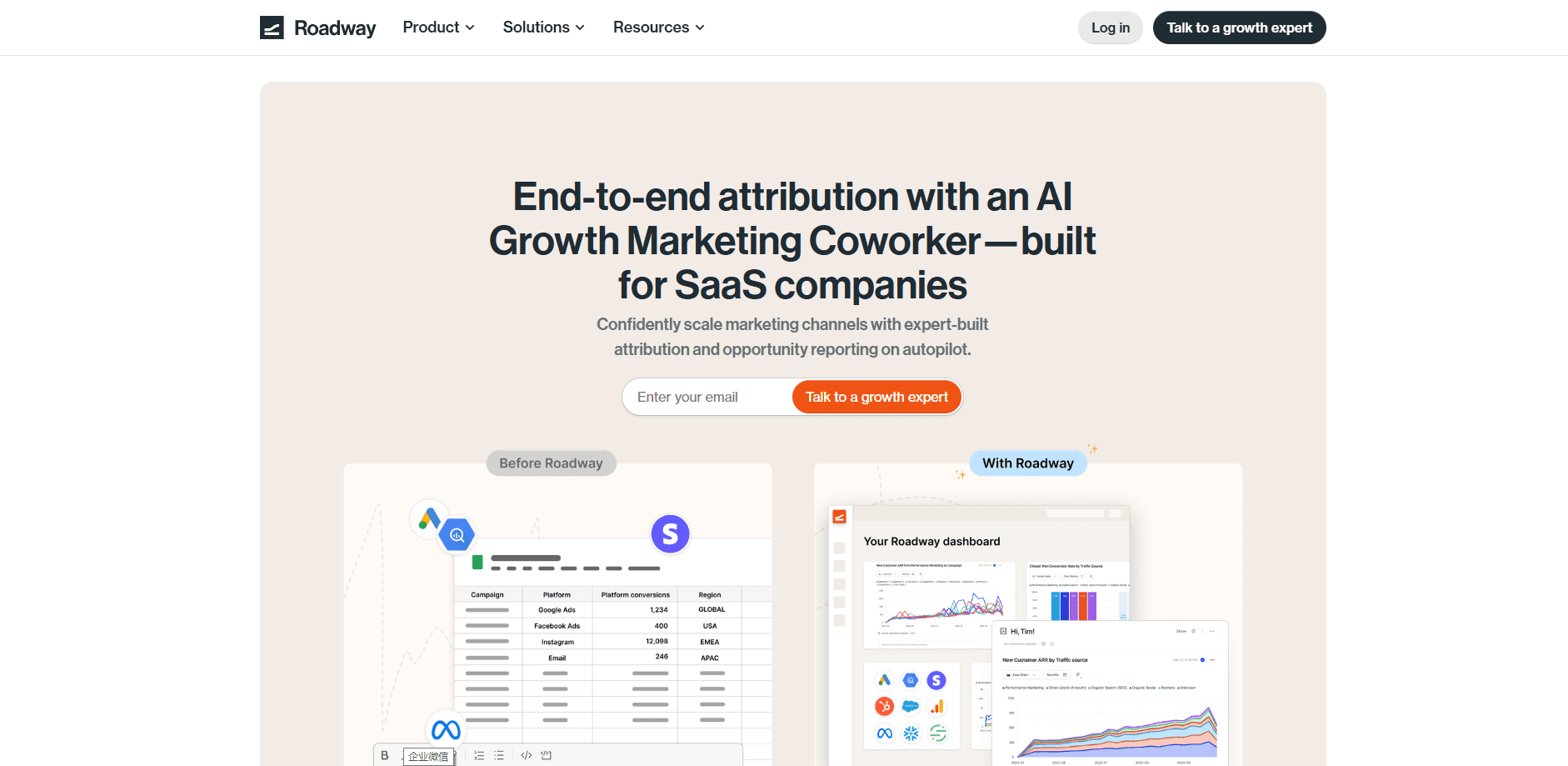
Roadway is an autonomous advertising system for performance marketing teams. Instead of adding one more dashboard, it puts AI agents it calls Coworkers to work inside your ad channels, planning changes and waiting for a human to approve them before anything spends money.
The pitch rests on a simple split. Most ad automation tools read the numbers each platform reports and shuffle budgets from there. Roadway builds a measurement layer first, mapping full-funnel spend to real revenue and payback, then lets its agents act against those numbers rather than platform-reported ones. That difference matters when a channel looks cheap on its own dashboard but expensive once you trace it to closed deals.
The way it runs is deliberately narrow. Each Coworker knows your goals, funnel and guardrails for one channel, such as paid search. It reviews search terms, flags ones drifting above your target CAC and proposes pausing them or mirroring winners from Google onto Bing. You approve, it executes, and it remembers what the change did. Workflows sit on top and handle reporting, optimization, scaling and budget shifts on a schedule or a trigger.
The company also offers a forward-deployed service. A growth engineer connects your data, sets up the first agents and tunes the system with you over monthly calls. That model fits teams with real ad spend, not someone testing ads for the first time. There is no public price list, so the cost conversation starts with a demo.
Getting Started
- Book a demo and connect your ad accounts so Roadway can read your current spend and performance.
- Have the team map your measurement, tying channel data to revenue and payback rather than platform-reported conversions.
- Set goals and guardrails per channel, including your target CAC and spending caps.
- Let the first Coworker plan a change, review the proposal, then approve or reject it.
- Expand into scheduled Workflows as the system proves what it can handle safely.
Product Information
A quick look at Roadway's pricing, supported platforms, and performance.
Best for
The users, tasks, and scenarios where this tool fits best.
Users
- Performance marketing teams at funded startups
- Growth leads who own ad spend
- Agencies managing client spend
Tasks
- Paid search automation
- Cross-channel budget shifts
- Channel expansion
- Scheduled reporting
Scenarios
- Spend that keeps drifting above target
- Teams that cannot watch dashboards daily
- Scaling a channel that already works
Key features
AI Coworkers
Workers are purpose-built agents that each learn one channel, its tools and its goals. They plan an action, show it to you for approval, then execute and remember the result. The design keeps a person in the loop, since the agent proposes but does not fire on its own.
Full-funnel measurement
The measurement layer ties paid and organic channel data to real revenue and payback, not the conversions each platform reports on its own. Roadway can pull from direct connectors or a warehouse-native setup, so the numbers your agents act on trace back to closed deals.
Autonomous workflows
Workflows run reporting, optimization, experimentation and scaling on a schedule or a trigger. Budget caps and guardrails hold across the whole system, so a single workflow cannot blow past the limits set for it. Each one can auto-approve within bounds or queue for review.
Task history and audit trail
Every action and its impact is recorded in a task history. You can see what an agent did, what it changed and whether it worked, which makes the system easier to trust and to tune over time. This trail is what lets a team loosen the approval rules safely.
Custom tools over MCP
Custom tools let Roadway coworkers reach anything with a hosted MCP server, added by URL. That chains data, creative, research and action into workflows grounded in your measurement, goals, funnel, guardrails and memory. It is how teams stretch the system past the built-in channels.
Forward-deployed setup
A growth engineer connects your data, maps measurement to revenue and stands up the first agents. The promise is a working system rather than another tool to implement, and monthly calls with an expert advisor expand what the system runs and how much it can approve.
Guardrails and approvals
Goals, funnel and guardrail metrics are set per channel, and every action queues for approval by default. Auto-approve is opt-in only, which means a team can widen what runs automatically as it builds confidence, without handing over the ad account on day one.
Pros and cons
Pros
- Acts on real revenue and payback, so budget moves follow closed deals rather than platform-reported numbers that flatter a channel.
- The approve-first design keeps a person in control, which lowers the risk of an agent spending on its own.
- Purpose-built agents that learn one channel do a narrower job than a general assistant, and that focus shows in the plans they propose.
- Custom tools over MCP let a team connect data and creative systems without waiting for a native integration.
Cons
- No free plan or self-serve trial. You start with a demo and a forward-deployed setup, so you cannot test it alone first.
- There is no published price list, so it is hard to budget for Roadway before talking to sales.
- The value depends on clean measurement. If your channels are not wired to revenue and payback, the agents work from a weak foundation.
- It fits ongoing ad spend. A small or one-off campaign will not earn back the setup effort.
Frequently asked questions
Roadway automates ad campaign management for performance marketers. Its AI agents plan and run changes across channels like Google, Bing, Meta and LinkedIn, and its workflows handle reporting, optimization and scaling once you approve them.
Related content
Explore related tools, skills, and articles for Roadway.
Roadway Alternatives

Tractionwave
TractionWave · Image · MarketingTractionWave is an AI attention heatmap tool for static ads. Upload a PNG or JPG and it returns predicted attention, ranked hotspots, and fixes before you spend budget.

OpenSEO - AI Visibility
EveryApp · Coding · Marketing · BusinessOpenSEO is an open source SEO platform for keyword research, backlinks, rank tracking, site audits, and AI visibility, with usage-based pricing and MCP access for AI agents.

Plugins Radar
Plugins Radar · Marketing · BusinessPlugins Radar tracks where your ChatGPT plugin ranks in directory and in-chat search, which competitors outrank it and what changed, with hourly checks on 9,885 listings.