

Runner AI
Runner AI · Coding · Business
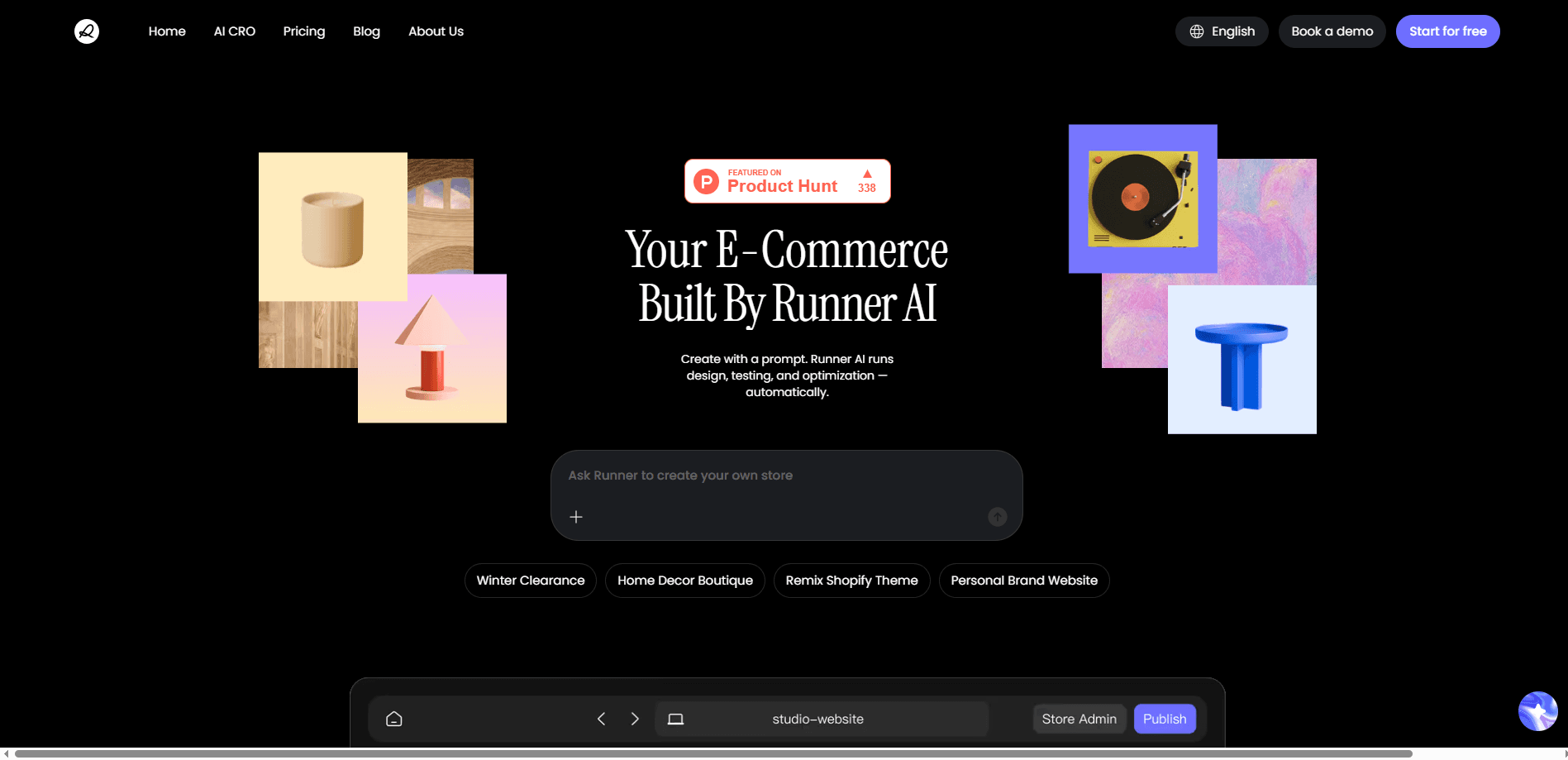
Runner AI is an AI ecommerce platform that builds an automated online store from a one-sentence description and then hands day-to-day operations to a team of autonomous agents. You describe what you want to sell, and Runner generates a storefront, sources products, writes listings, and runs experiments on pricing and layout. The store backend is built to match what Shopify offers. The running of it is handled by software, not a person. It suits solo founders and small teams who want a live store without hiring an agency.
About Runner AI
What Is Runner AI
Runner AI is a commerce platform built around the idea that a store should run itself. Instead of asking you to drag blocks into a template, it takes a plain-language brief and turns it into a working store with products, images, and a live checkout. Ten AI specialists then take over the routine work that usually eats an owner's week.
The problem it targets is the stack most sellers end up paying for. A typical online store leans on a payment tool, an email tool, a review app, an analytics dashboard, and an agency to hold it together. That adds up fast. Runner folds those into one system where an agent can see the whole picture and act on it, rather than waiting for you to connect the dots. Founder Weizhi Li spent five years at Google and DeepMind working on data infrastructure and Gemini, and the pitch grows out of that background.
The limits matter as much as the pitch. Runner is a hosted platform, so you trade some control for the automation. The pricing model includes a per-sale Runner fee on top of standard payment processor costs, which scales with your volume. And because so much of the value comes from agents making judgment calls, the output still needs a human eye on brand and positioning.
Getting Started
- Sign up at runnerai.com and pick the free plan to try the builder without a card.
- Describe your business in a sentence, or clone an existing store template and adjust it with a follow-up prompt.
- Let Runner generate the storefront, product catalog, and images, then review the draft before it goes live.
- Connect a payment provider so the live checkout can accept real orders.
- Switch on the store-ops agents you want, such as abandoned-cart recovery or weekly performance reports, and check the dashboard as results come in.
Product Information
A quick look at Runner AI's pricing, supported platforms, and performance.
Best for
The users, tasks, and scenarios where this tool fits best.
Users
- Solo founders who want a store running without hiring staff, and are comfortable reviewing AI-generated copy and pricing before launch
- Small ecommerce teams juggling several sales channels who need automation for carts, stock alerts, and reporting
- Dropshipping sellers who move fast between product ideas and need listings written for them
Tasks
- Turning a product idea into a live storefront
- Running A/B and multivariate tests on layout and pricing
- Recovering abandoned carts and replying to reviews
Scenarios
- Launching a first store as a side project, where the free plan covers up to 20 products before you commit to a paid tier
- Running several brands from one account, which the higher paid tiers support
- Testing a niche before investing in inventory, using the clone-a-store route to start from a working layout
Key features
Store Building From a Sentence
You describe the business and Runner AI assembles the storefront, product pages, and imagery in one pass. There's no drag-and-drop editor or plugin hunt. If a detail is off, you click the part of the store you want changed and tell Runner what to adjust in plain language. The template library lets you start from a store that already works and rewrite it in a line. Simple as that.
AI Product Sourcing and Listing Generation
Runner sources products and images for the catalog and writes the listing copy. This is the part that usually eats a weekend of photo editing and keyword work. On the free plan the catalog caps at 20 products, so the sourcing engine is more of a trial run than a production tool until you upgrade. Paid tiers lift that ceiling. The Pro and Max plans allow unlimited products.
A Team of Store-Ops Agents
Rather than one chatbot, Runner runs specialists that each own a function: cart recovery, low-stock alerts, review requests and auto-replies, and a weekly performance report. The agents act on what they see in your store data, not on a script you maintain. That's the shift. Store-ops automation is a preview feature on lower tiers and opens up on the higher plans.
Experimentation and Simulation
Runner AI lets you see how shoppers would react before you publish a change, then runs A/B and multivariate tests on the live store. Ad spend shifts itself toward whatever is converting. Manual budget-tweaking goes away. These testing features start as previews and become full features as you move up the plans.
Unified Data Behind the Agents
The platform keeps store data in one place so the agents can see the full picture, which is the core argument for building commerce this way. When orders, traffic, and campaign results sit in the same system, an agent can connect a traffic spike to a stock problem without you linking tools. Why does that matter? Because the agents get sharper as the store collects history.
Creative Studio and Ads
Runner includes a Creative Studio for image and video assets tied to ad campaigns, including TikTok creative. You get generation tools for both stills and video without leaving the platform. The free tier only previews this. Paid tiers open up the full studio alongside the analytics dashboard.
Chat on Every Platform
You can talk to Runner on the web, or through the iOS, Android, and desktop apps. The assistant remembers your store between conversations. It can also search the web when a request needs outside information. That continuity is what makes conversational store management workable rather than a novelty.
Pros and cons
Pros
- Builds a store from a text description, so you don't need to learn a page builder or assemble a plugin stack
- Agents handle recurring chores like cart recovery, review requests, and weekly reporting on their own
- Free plan lets you build and preview up to 20 products with no card required
- Higher tiers cut the Runner fee per sale from 3.5% down to 1%, which matters as volume grows
- Chat works across web, iOS, Android, and desktop, and the assistant remembers your store between sessions
Cons
- The per-sale Runner fee sits on top of payment processor costs of 2.9% plus 30 cents, so total take rate is higher than a flat subscription competitor
- Store-ops automation and the testing features are only previews on the lower plans, so the biggest selling points need a paid tier
- Product sourcing caps at 20 items on free and 100 on the Plus plan, which limits a real catalog until you reach Pro
- As a hosted platform, you give up control over the underlying build compared with a self-managed store
Frequently asked questions
Runner AI builds an online store from a one-sentence description and then runs it with autonomous agents. The storefront, product catalog, and listings come out of a text brief, and the agents handle ongoing tasks like cart recovery, stock alerts, and ad optimization. You review and steer rather than build page by page.
Related content
Explore related tools, skills, and articles for Runner AI.
Runner AI Alternatives
Forefront
Forefront · CodingForefront is a web platform for building with open-source AI. It lets you fine-tune leading open-source language models on your own data, evaluate how they perform, and run them through an API or export them to host yourself. Developers who want the convenience of a closed-source platform but insist on owning their models and data are the target audience here.

Startkit
StartKit.AI · CodingStartkit is a boilerplate for building AI SaaS and AI wrapper products. Think of it as an AI startup boilerplate with the boring parts already wired up: authentication, Stripe and Lemon Squeezy payments, usage limits, transactional email, and an AI API starter that talks to OpenAI, Anthropic, Groq, or Llama. You clone the repo, set your price, and start on the part of your product that people actually pay for. It's Next.js under React and Tailwind, so most of the boilerplate code already feels familiar.
Testim
Tricentis · CodingTestim is an AI-powered test automation platform for building and running end-to-end tests across web, mobile, and Salesforce applications. It leans on machine learning to keep tests stable when an interface changes, so teams spend less time fixing broken selectors. Not bad for an automated testing tool you can start using today. You create tests by recording actions in a browser, then optionally add JavaScript when you need more control. It's a solid pick for busy QA teams.