

DataFuel.dev
DataFuel.dev · Coding
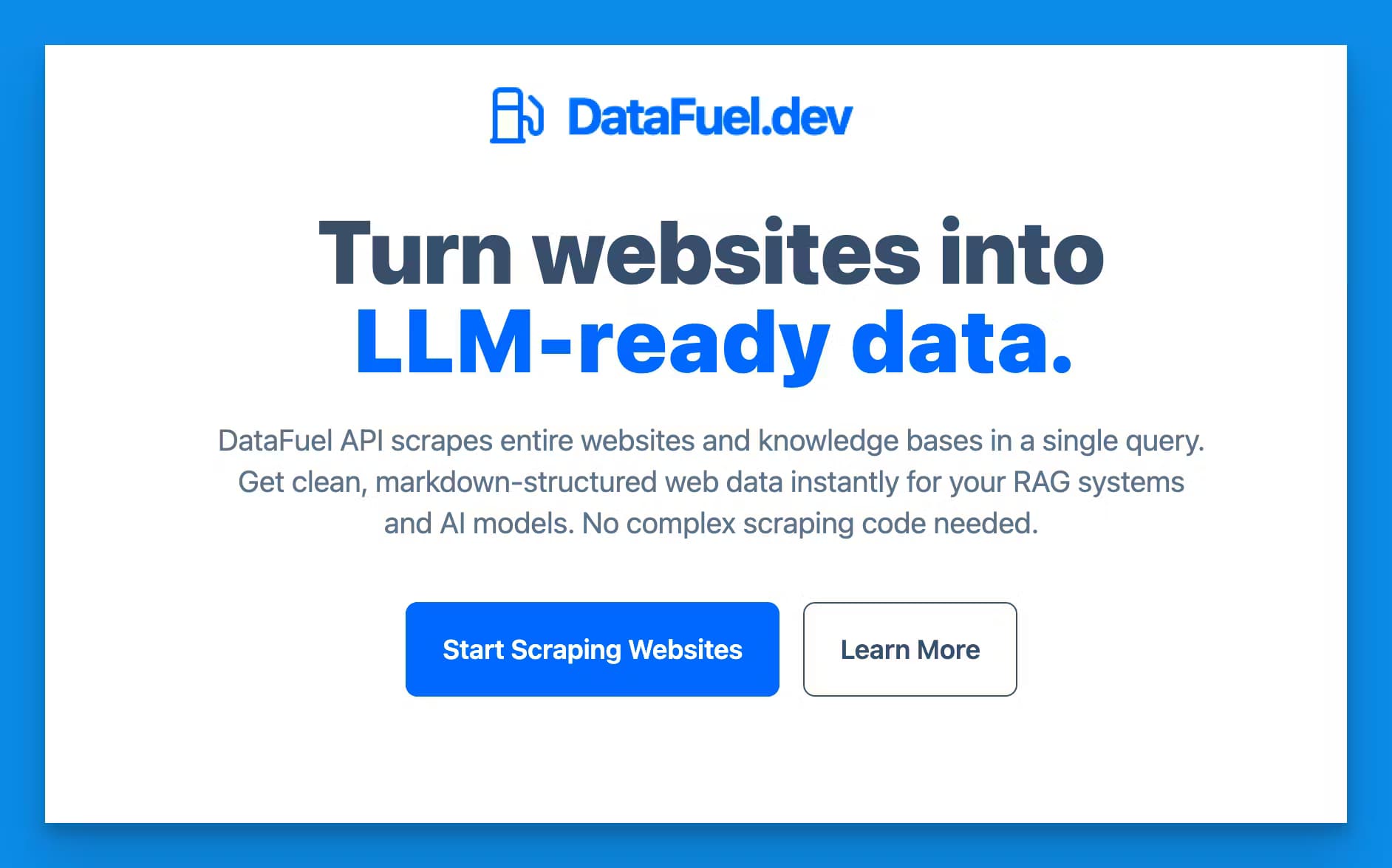
DataFuel.dev is a web scraping API that turns full websites into clean, markdown-ready data for RAG pipelines and AI model training.
About DataFuel.dev
What Is DataFuel.dev
DataFuel.dev is a web scraping platform built for people who need training and retrieval data, not another browser automation toy. It takes a site or a knowledge base and returns markdown-structured content your LLM stack can actually use. One API call handles the crawl, the cleanup, and the format conversion.
The pitch is narrow on purpose. Plenty of scrapers give you raw HTML. They leave you to strip navigation, ads, and boilerplate yourself. DataFuel skips that step entirely, and the result lands in a vector database with no extra parsing work when you're feeding a retrieval generation (RAG) system that needs structured input at scale.
The catch is the credit model. Every URL costs one credit. AI-powered scraping and AI JSON schema generation burn 15 credits per URL because they run through GPT-4o. Scraping a few thousand pages with AI extraction gets expensive fast when every single page carries that 15x multiplier. Know your volume before you commit. It's the difference between a cheap pipeline and a bill that stings.
Getting Started
- Sign up at the DataFuel website to grab an API key and start the 3-day free trial.
- Paste a URL into the browser demo if you want to preview the markdown output before writing any code.
- Point the API at a single page or hand it a whole site so the crawler walks the domain for you.
- Add login credentials if the target lives behind authentication, then pick your output format (markdown, JSON, or TXT).
- Pull the results into your RAG pipeline, vector store, or fine-tuning dataset.
Product Information
A quick look at DataFuel.dev's pricing, supported platforms, and performance.
Best for
The users, tasks, and scenarios where this tool fits best.
Users
- ML and LLM engineers
- RAG developers
- Data teams at small companies
- Indie builders
Tasks
- Turning documentation sites into RAG-ready datasets
- Extracting structured JSON with a custom schema
- Scraping gated content
- Building training data pipelines
Scenarios
- Preparing a knowledge base for a customer support chatbot
- Tracking AI news and research papers
- Benchmarking an LLM on real-world text
- Migrating content off a legacy CMS
Key features
Single-Query Site Scraping
One query covers a whole website or knowledge base. DataFuel's crawler follows links on its own. You don't hand-build a list of URLs for a docs site or wiki. This is the core of any RAG data pipeline that needs fresh pages on a schedule. The output arrives as clean markdown, already stripped of the navigation and ad clutter that pollutes raw HTML. For RAG work, that's the difference between usable chunks and a cleaning project.
Markdown-Optimized Output for RAG
The default format is markdown tuned for retrieval pipelines and vector databases. This website to markdown conversion preserves headings, lists, and links. That gives your chunking strategy real structure to work with. You can also export JSON for AI-filtered values or plain TXT when you just need the text. Picking the right format up front saves a conversion step later, and markdown is the one most RAG stacks want.
Access to Gated and Authenticated Content
You can point DataFuel at pages that sit behind a login. Send credentials with the request and the API handles authentication to reach private documentation, internal wikis, and gated knowledge bases. Credentials are encrypted at rest and in transit, according to DataFuel, and that matters if you're scraping internal sources rather than public pages. Not all scrapers do this, which is a real gap when your best data sits behind a login.
GPT-4o Powered JSON Extraction
Define a custom JSON schema and the API uses GPT-4o to pull structured values from each page. DataFuel claims 100% structured extraction accuracy for fields like emails and other well-defined data. The tradeoff is cost. AI extraction runs 15 credits per URL instead of one. Use it when the payoff in clean structured data outweighs the 15x credit burn. Not ideal for a million-page crawl, perfect for a few hundred high-value pages.
Crawler with Automatic Retries
The built-in crawler walks large sites and retries failed requests without you writing error handling. For big domains, that reliability is the difference between a complete dataset and one full of holes. Concurrency scales with your plan, from a single request on Freelancer up to 50 at once on Ultimate, so a slow crawl on the entry tier becomes much faster the higher you go.
No-Code Builder Integrations
DataFuel connects to Zapier and Make, so you can trigger a scrape from a no-code workflow instead of a script. Native n8n support is listed as coming soon. If your team leans on automation tools rather than a codebase, this keeps data prep inside the tools you already use. No glue code required.
Pros and cons
Pros
- Output is LLM-ready markdown out of the box, so there's no cleanup step before a RAG pipeline can use it.
- One API request scrapes an entire site, which removes the need to maintain your own crawler.
- Handles authenticated and gated content, opening up private docs and internal knowledge bases.
- Works with custom JSON schemas through GPT-4o for structured extraction like emails and prices.
- Integrates with Zapier and Make, and n8n support is on the way.
Cons
- AI-powered scraping and JSON schema generation cost 15 credits per URL, so large AI-extraction jobs drain credits quickly.
- Published plan prices weren't visible on the public site, which makes budgeting harder before you sign up.
- The free tier is only a 3-day trial rather than an ongoing free plan, so long-term testing means paying.
- As a newer platform, community documentation is thin, so you're more reliant on official support for edge cases.
Frequently asked questions
It scrapes websites and knowledge bases and returns the content as clean, markdown-structured data. The goal is to skip the manual cleanup that usually sits between raw HTML and an LLM-ready dataset. Think of it as a website to markdown converter that runs at API scale.
Related content
Explore related tools, skills, and articles for DataFuel.dev.
DataFuel.dev Alternatives
Forefront
Forefront · CodingForefront is a web platform for building with open-source AI. It lets you fine-tune leading open-source language models on your own data, evaluate how they perform, and run them through an API or export them to host yourself. Developers who want the convenience of a closed-source platform but insist on owning their models and data are the target audience here.

Startkit
StartKit.AI · CodingStartkit is a boilerplate for building AI SaaS and AI wrapper products. Think of it as an AI startup boilerplate with the boring parts already wired up: authentication, Stripe and Lemon Squeezy payments, usage limits, transactional email, and an AI API starter that talks to OpenAI, Anthropic, Groq, or Llama. You clone the repo, set your price, and start on the part of your product that people actually pay for. It's Next.js under React and Tailwind, so most of the boilerplate code already feels familiar.
Testim
Tricentis · CodingTestim is an AI-powered test automation platform for building and running end-to-end tests across web, mobile, and Salesforce applications. It leans on machine learning to keep tests stable when an interface changes, so teams spend less time fixing broken selectors. Not bad for an automated testing tool you can start using today. You create tests by recording actions in a browser, then optionally add JavaScript when you need more control. It's a solid pick for busy QA teams.