

SearchZ.ai
SearchZ.AI · Coding
SearchZ.ai is an AI-powered search engine that ranks web results by quality, relevance, and authority instead of raw keyword matching. It runs a neural ranking model, filters out spam, and keeps the whole experience free of signups, trackers, and targeted ads. If you want clean results and don't feel like handing over your data to get them, that's the pitch.
About SearchZ.ai
What Is SearchZ.ai
SearchZ.ai is a web search engine built around artificial intelligence rather than ad placement. Its neural ranking algorithm scores each result for quality, relevance, and authority, then pushes the most useful pages to the top. A separate AI classifier sorts your query into a category and leans on sources like .gov, .edu, and established publications when the topic calls for it.
The company pitches it as a bridge between AI chatbots and traditional search engines. You're not chatting with an assistant that writes you an answer. You get a list of ranked links, just cleaner than what most engines hand you, and the sorting is done by machine learning instead of bidding. It's also a web search without trackers, which is the other half of the sell.
The biggest limits are worth stating up front. There's no public pricing page, no documented API, and no Google Play app, so it's a browser-only tool. Because searches aren't stored and there's no account, you also can't sync history or save queries across devices.
Getting Started
- Open a browser and go to searchz.ai. No account, email, or download is needed.
- Type your query into the search bar and press Enter.
- Scan the ranked results, which the AI classifier has already sorted and de-spammed.
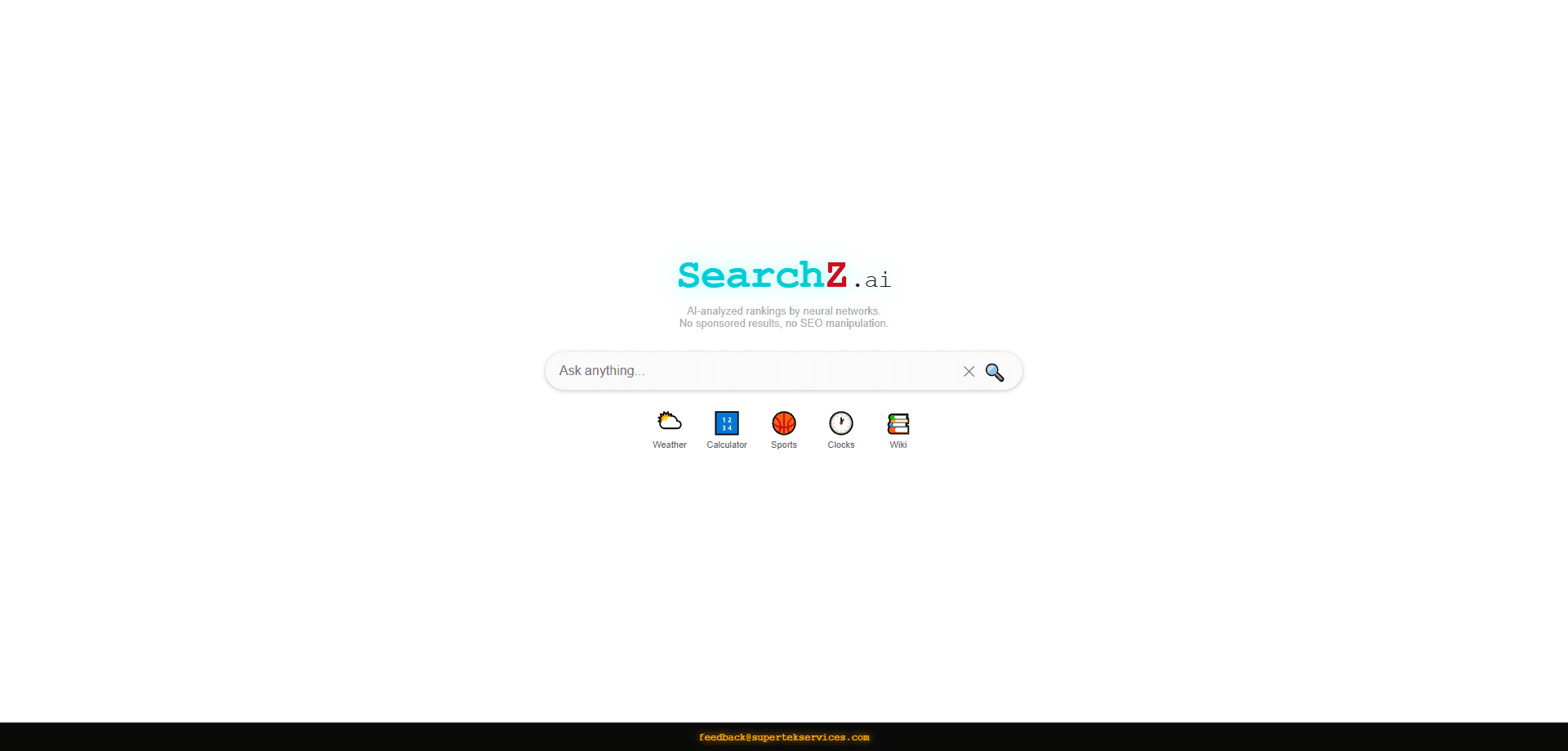
- Use built-in smart features like the calculator, weather, sports scores, or Wikipedia lookup when your query matches those intents.
- Refine your wording if the top results miss the mark, since SearchZ.ai doesn't store past searches to learn from.
Product Information
A quick look at SearchZ.ai's pricing, supported platforms, and performance.
Best for
The users, tasks, and scenarios where this tool fits best.
Users
- Privacy-conscious searchers
- Students and researchers
- Casual web searchers
Tasks
- Finding credible sources on a topic
- Cutting through spam
- Quick everyday lookups
Scenarios
- Researching a medical or legal question
- Searching on a shared or work computer
- Drowning in ads on mainstream engines
Key features
Neural Ranking by Quality, Relevance, and Authority
SearchZ.ai sorts every result with what it calls a neural-powered ranking algorithm. Instead of counting keyword matches, the model scores pages on real quality, on relevance to your query, and on source trustworthiness. High-authority pages surface first. So you spend less time clicking through dead ends.
AI Query Classification
An AI classifier reads your query and routes it into a category before ranking results. On topics where credibility matters, it deliberately favors sources like government, educational, and established news domains. This is the feature that separates it from a plain keyword index, and it's why reference searches feel different here. It's a small change. It matters.
Spam Filtering
The engine is marketed on being spam-free, and it filters out the low-quality results that clutter mainstream search. Fewer scraper sites and thin content pages land on page one. For anyone who's tired of scrolling past content farms, this is the core draw. It's a simple idea, and it works.
Source Diversity
Results are drawn from multiple authoritative domains rather than stacking one site repeatedly. That gives you a more balanced picture of a topic instead of a single source dominating the top of the results. Good for cross-checking a claim.
Privacy-First Design
Searches aren't stored, there are no signups, no trackers, and no targeted ads. Just a private search engine with nothing to configure. The site states this plainly, and it's the reason the tool needs no account to use. For a shared computer or a sensitive query, that's the whole point.
Built-In Smart Features
Beyond web links, SearchZ.ai handles several everyday intents directly: a calculator, weather, live sports scores, and Wikipedia search. You get quick answers without bouncing to another tab, which keeps short lookups fast. No extra app required.
Pros and cons
Pros
- No signup, no download, and no login, so it works the moment you open the page
- Neural ranking and an AI classifier push authoritative sources such as .gov and .edu higher
- Spam filtering keeps content farms and thin pages off the first page of results
- Searches aren't stored, and there are no trackers or targeted ads
- Built-in calculator, weather, sports scores, and Wikipedia search cover quick questions
Cons
- No public API, so you can't plug it into your own apps or workflows
- Browser-only with no mobile app, which limits offline or on-the-go use
- Because nothing is stored and there's no account, you can't save or sync search history across devices
- No paid tier or documented roadmap, so advanced or enterprise features aren't available
Frequently asked questions
Yes. SearchZ.ai has no pricing page and no paid tier, so every feature runs at no cost. If you were hoping for a private search engine without a paywall, this is it. There's no upsell either, and the lack of targeted ads is part of the product's stated design rather than a temporary promotion.
Related content
Explore related tools, skills, and articles for SearchZ.ai.
SearchZ.ai Alternatives
Forefront
Forefront · CodingForefront is a web platform for building with open-source AI. It lets you fine-tune leading open-source language models on your own data, evaluate how they perform, and run them through an API or export them to host yourself. Developers who want the convenience of a closed-source platform but insist on owning their models and data are the target audience here.

Startkit
StartKit.AI · CodingStartkit is a boilerplate for building AI SaaS and AI wrapper products. Think of it as an AI startup boilerplate with the boring parts already wired up: authentication, Stripe and Lemon Squeezy payments, usage limits, transactional email, and an AI API starter that talks to OpenAI, Anthropic, Groq, or Llama. You clone the repo, set your price, and start on the part of your product that people actually pay for. It's Next.js under React and Tailwind, so most of the boilerplate code already feels familiar.
Testim
Tricentis · CodingTestim is an AI-powered test automation platform for building and running end-to-end tests across web, mobile, and Salesforce applications. It leans on machine learning to keep tests stable when an interface changes, so teams spend less time fixing broken selectors. Not bad for an automated testing tool you can start using today. You create tests by recording actions in a browser, then optionally add JavaScript when you need more control. It's a solid pick for busy QA teams.