

SelectPrism
SelectPrism · Business
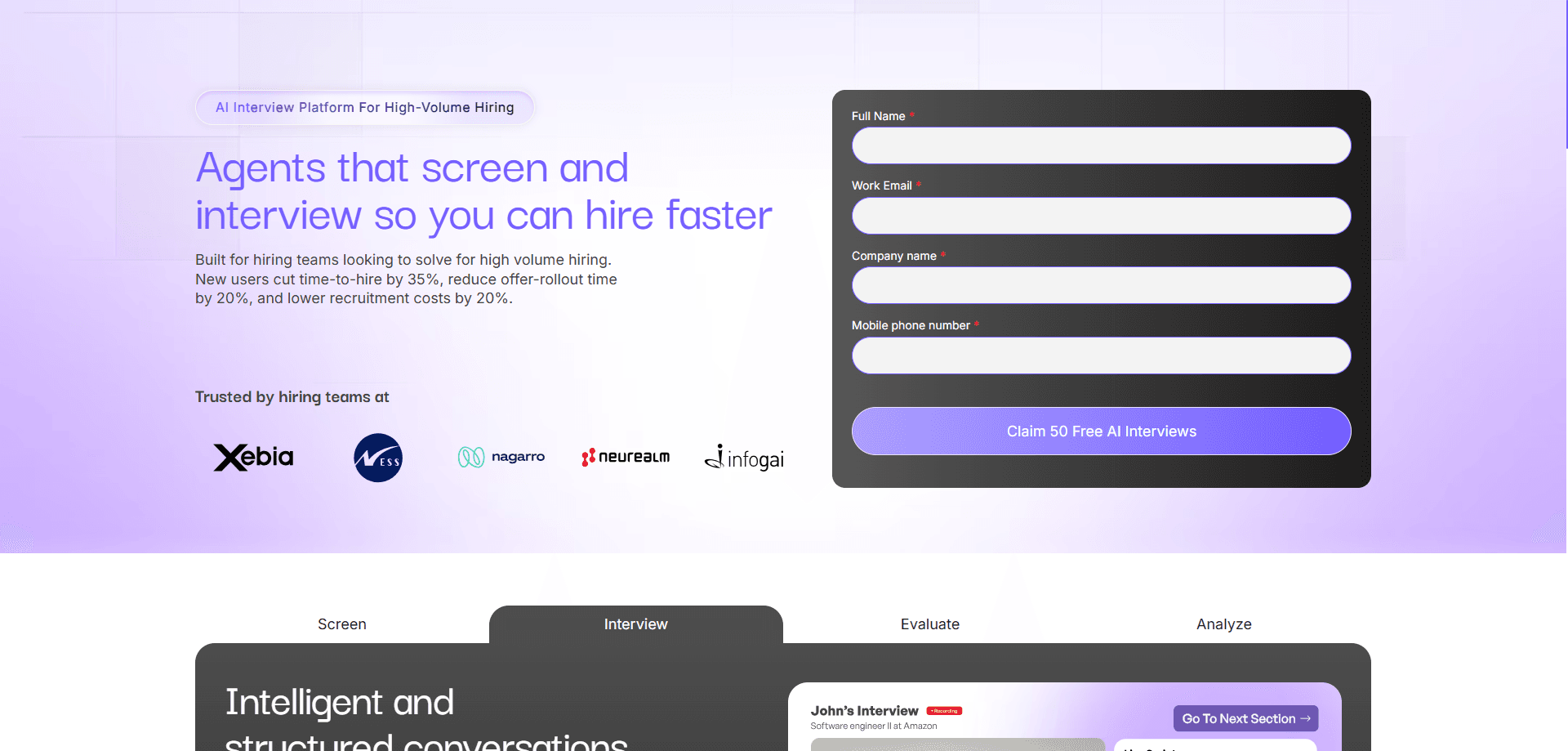
SelectPrism is an enterprise-grade agentic AI interview and hiring platform that runs screening, scheduling, and first-round interviews for recruiting teams. It scores candidates against role-specific skills rubrics, flags fraud during video conversations, and hands shortlists off to your ATS. It's aimed at companies that hire in volume and want faster decisions without adding recruiters. Simple promise. Big funnel.
About SelectPrism
What Is SelectPrism
SelectPrism is hiring software that automates the earliest stages of recruitment: resume screening, phone screening, and first-round interviews. It positions itself as agentic, which here means AI agents handle the repetitive work while recruiters keep the final call on who advances. The target buyer is an enterprise, a staffing agency, or a fast-growing company that interviews hundreds of candidates for a single role, and anyone who has run that kind of hiring push knows how quickly the calendar fills with calls that go nowhere. That's a lot of first-round calls. Most of them don't need a human.
The platform maps over 60,000 skills and about half a million connections between them, trained on what the company describes as years of proprietary hiring data. Instead of matching resumes to keywords, it tries to match people to skills, which is a meaningfully different signal when you're screening hundreds of applicants and every resume has been polished to hit the same buzzwords. That's the difference between finding someone who wrote "Python" on a CV and finding someone who can actually build with it. Every score comes with an explanation, so hiring managers can see why a candidate landed where they did. No black box.
The biggest limitation is scope. SelectPrism is built for teams that already have volume and an ATS workflow. A small business hiring two people a year would get little from the automation, and several of the more advanced pieces, including talent rediscovery and the Interview Copilot, are still labeled beta. Pricing runs on a per-candidate basis, so costs scale with your funnel rather than a flat seat fee.
Getting Started
- Book a demo through the official SelectPrism site and set up an account with your company details.
- Connect your existing ATS, HRIS, CRM, and calendar so shortlists and invites flow both ways.
- Create a role, upload the job description, and let the platform build an evaluation rubric from the required skills.
- Invite candidates to the automated phone screen or AI-led video interview and review the scored reports.
- Compare the stack-ranked shortlist and send your picks to the next round.
Product Information
A quick look at SelectPrism's pricing, supported platforms, and performance.
Best for
The users, tasks, and scenarios where this tool fits best.
Users
- Enterprise recruiting teams
- Staffing agencies
- Hiring managers
- CHROs and TA leaders
Tasks
- First-round screening
- Resume ranking
- Interview scheduling
- Post-interview review
- Candidate comparison
Scenarios
- Scaling a hiring push
- Reconnecting with past candidates
- Technical and coding assessments
- Compliance-sensitive hiring
Key features
Adaptive AI-led L1 Interviews
The platform runs first-round video interviews on its own, adjusting question difficulty to match how each candidate answers. Integrity checks run during the conversation rather than after, so suspicious sessions get flagged in the moment. Recruiters get a scored report instead of a recording to sit through. That last part saves real time.
Skills Intelligence Engine
SelectPrism matches people to skills, not resumes to keywords. Its engine maps over 60,000 skills and about half a million connections between them, trained on what the company describes as years of proprietary hiring data. In practice, a shortlist reflects what a candidate can do, not just the words on their CV, which is a meaningfully different signal when you're screening at volume. The model also improves as it runs more interviews, so early results may be rougher than later ones.
Fraud Detection and Integrity Checks
Continuous AI oversight watches every interview for fraud signals. This matters most in remote and high-volume hiring, where impersonation and AI-assisted cheating are real and growing risks that quietly corrupt your shortlist. The checks are built into the interview flow, so they don't add a separate verification step. No extra tool. No extra logins.
Explainable Scoring and Rubrics
Every candidate gets a rubric-based score with the reasoning behind it. Hiring managers can see strengths, risks, and overall fit in a single report, which cuts down on the "why is this person on the list" conversation. Consistent rubrics also reduce the drift that creeps in when different interviewers score the same role. Same role, same yardstick.
Multi-modal Evaluation
The platform adapts across technical, coding, and problem-solving assessments, not just open conversation, which matters because a chat-only screen tells you almost nothing about how someone writes code under pressure. Thinking signals capture snapshots of a candidate's reasoning along the way. Why does that matter? Because how someone works through a problem often says more than whether they got the right answer.
Interview Copilot for Hiring Managers
During later-stage rounds, the Copilot offers smart suggestions, follow-up prompts, and guidance based on your evaluation rubric. It's still in beta, but the idea is to give managers live support rather than a post-hoc summary. Consider it a pilot feature for now. Don't build a process around it yet.
ATS and Workflow Integrations
SelectPrism connects with your ATS, HRIS, CRM, and calendars, and hands off shortlists for next-round scheduling. Talent rediscovery and HR connect scheduling are also in beta. The end-to-end handoff is the part most teams feel first, since it removes manual data re-entry between tools and keeps one record of every candidate instead of three scattered across inboxes.
Pros and cons
Pros
- Skills-based matching goes beyond keyword screening, so shortlists reflect real ability rather than whichever candidates happened to phrase their resume the way the job ad did.
- Explainable scoring means every recommendation comes with a reason a hiring manager can actually check rather than trust on faith.
- Per-candidate pricing around $10 to $12 is far below the roughly $60 to $80 per hour recruiters report spending on manual interviews.
- Built-in integrity checks handle fraud risk without adding a separate verification tool.
- Integrates with existing ATS, HRIS, CRM, and calendar systems, so it fits current workflows.
Cons
- No free plan, so you need a demo and a paid commitment before testing it properly.
- Several headline features, including talent rediscovery and the Interview Copilot, are still in beta and may change.
- Pricing scales per candidate, which gets expensive fast for very large funnels.
- API availability isn't clearly documented, which leaves developers guessing about custom integrations.
Frequently asked questions
SelectPrism automates the early stages of hiring: resume screening, phone and video screening, interview scheduling, and first-round evaluation. Recruiters use it to cut the manual work before humans make the final call. The point is to shrink the funnel before it reaches your team.
Related content
Explore related tools, skills, and articles for SelectPrism.
SelectPrism Alternatives

Would you pay?
Mustafa Ergisi · Marketing · BusinessWould you pay? turns indie startups into a swipe deck. Strangers swipe right only if they'd pay, and makers see the yes rate before they build more.

Timeless Code
Timeless · Coding · Productivity · BusinessTimeless Code is an AI meeting notetaker that installs inside Claude Code, records calls on a Mac, and lets you ask about any transcript without leaving the terminal.

Hopscotch AI
Hopscotch Labs · Coding · Productivity · BusinessHopscotch AI is an OpenAI-compatible LLM router. One key reaches 500+ models across providers at list price, with no token markup, spend limits and per-request cost logs.