

Skills for Agents
MindPal · Coding · Leaning
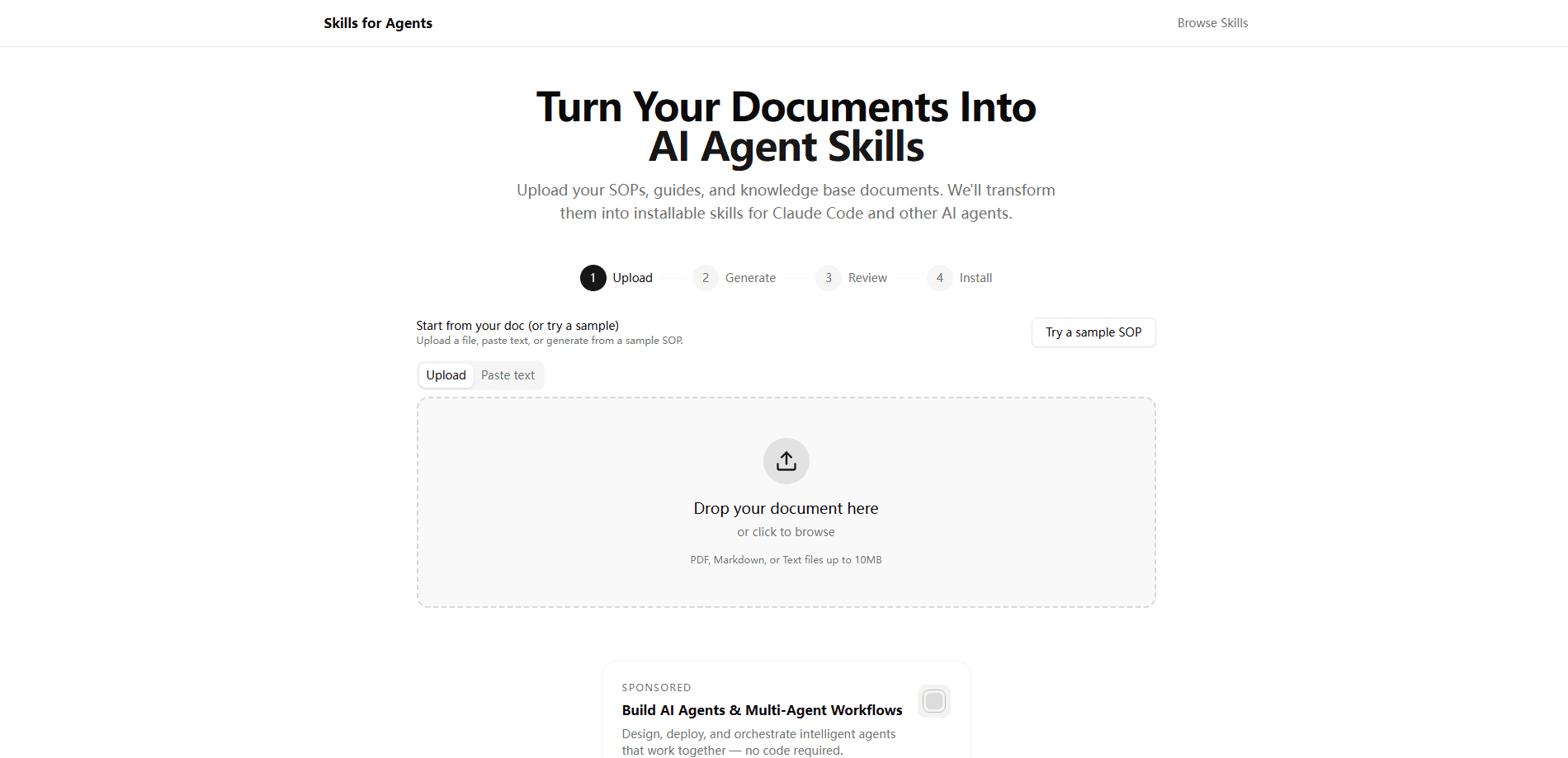
Skills for Agents is a web platform that transforms documents like SOPs, guides, and knowledge bases into installable skills for Claude Code and other AI agents. You upload a file, paste text, or start from a sample, and the tool packages that content into a structured skill your agent can load on demand. It targets people who already have written procedures and want their AI agents to follow them without re-pasting instructions every session.
About Skills for Agents
What Is Skills for Agents
Skills for Agents is a document-to-skill converter built by the team behind MindPal. The idea is simple: most teams already wrote down how their work gets done, in SOPs, onboarding guides, or internal knowledge bases. Those documents sit in a folder while the AI agent doing the task never sees them.
The platform closes that gap. It reads your document and turns it into a modular skill, a folder with a SKILL.md file plus any supporting references, that an agent loads only when a task calls for it. Claude Code is the primary target, and the format follows the open Agent Skills standard that Cursor, Codex, and others now read too.
The main limitation is scope. This is a packaging tool, not an agent runtime. It doesn't execute your workflow for you or host the agent. You still install the resulting skill into your own tools, and quality depends heavily on how clear your source document is. Feed it a vague guide and you get a vague skill.
Getting Started
- Open skills.mindpal.space and go to the generator from the home page.
- Upload a PDF, Markdown, or text file up to 10MB, or paste your text directly into the editor.
- Review the parsed content and adjust the skill name and description so the agent knows when to trigger it.
- Generate the skill and download the package.
- Install the folder into your agent's skills directory, such as .claude/skills, and test it with a real task.
Product Information
A quick look at Skills for Agents's pricing, supported platforms, and performance.
Best for
The users, tasks, and scenarios where this tool fits best.
Users
- Operations and support teams
- Solo developers running Claude Code
- Technical writers and knowledge managers
Tasks
- Converting an onboarding guide into a repeatable skill
- Turning a coding standard or style guide into a skill
- Packing a support playbook into a loadable module
Scenarios
- Onboarding a new AI agent to an existing workflow
- Standardizing tool use across a small team
- Keeping process knowledge in one place
Key features
Document-to-Skill Conversion
The core function takes a document you already have and turns it into a structured skill. It accepts PDF, Markdown, and plain text files up to 10MB, so most SOPs and guides fit without reformatting. The output follows the folder-plus-SKILL.md layout that agent platforms expect.
Sample SOPs to Start From
If you don't have a document ready, you can generate a skill from a built-in sample SOP and edit it afterward. That's a quick way to see what a finished skill looks like before committing your own content. It also helps you judge how detailed your real document needs to be.
On-Demand Loading Through Skills
Skills only load when the agent decides a task matches, which keeps context clean. Instead of front-loading every instruction into a system prompt, the agent pulls the skill in when it's relevant. That means longer, more detailed procedures don't eat your context window on unrelated tasks.
Claude Code and Cross-Tool Support
Claude Code is the main target, and the format lines up with the open Agent Skills standard. Tools like Cursor and Codex read the same structure, so a skill you package here usually works across several agents. That reduces lock-in if you switch tools later.
Skill Descriptions That Drive Triggering
The generator helps you write the name and description metadata that agents scan first. A weak description is the most common reason a skill never fires, so this part matters more than it looks. You can edit it before generating the package.
Lightweight Web Workflow
There's nothing to install to build a skill. You work in the browser, generate the package, and download it. The whole loop from upload to install usually takes a few minutes.
Pros and cons
Pros
- Turns existing documents into agent skills without manual prompt writing
- Follows the open Agent Skills format, so output works across Claude Code, Cursor, and similar tools
- Supports PDF, Markdown, and text files up to 10MB
- Sample SOPs let you try the workflow before using your own content
- No software to install just to generate a skill
Cons
- It's a packaging tool, not an agent host, so you still install and run skills in your own setup
- Output quality depends on the source document, and thin input produces thin skills
- No public API, which limits automated or batch use for larger teams
Frequently asked questions
It converts your documents into installable skills for AI agents. You upload or paste content, and it packages that material into a skill folder your agent can load when a task matches.
Related content
Explore related tools, skills, and articles for Skills for Agents.
Skills for Agents Alternatives
Forefront
Forefront · CodingForefront is a web platform for building with open-source AI. It lets you fine-tune leading open-source language models on your own data, evaluate how they perform, and run them through an API or export them to host yourself. Developers who want the convenience of a closed-source platform but insist on owning their models and data are the target audience here.

Startkit
StartKit.AI · CodingStartkit is a boilerplate for building AI SaaS and AI wrapper products. Think of it as an AI startup boilerplate with the boring parts already wired up: authentication, Stripe and Lemon Squeezy payments, usage limits, transactional email, and an AI API starter that talks to OpenAI, Anthropic, Groq, or Llama. You clone the repo, set your price, and start on the part of your product that people actually pay for. It's Next.js under React and Tailwind, so most of the boilerplate code already feels familiar.
Testim
Tricentis · CodingTestim is an AI-powered test automation platform for building and running end-to-end tests across web, mobile, and Salesforce applications. It leans on machine learning to keep tests stable when an interface changes, so teams spend less time fixing broken selectors. Not bad for an automated testing tool you can start using today. You create tests by recording actions in a browser, then optionally add JavaScript when you need more control. It's a solid pick for busy QA teams.