

Slock AI
Raft · Productivity · Chatbot
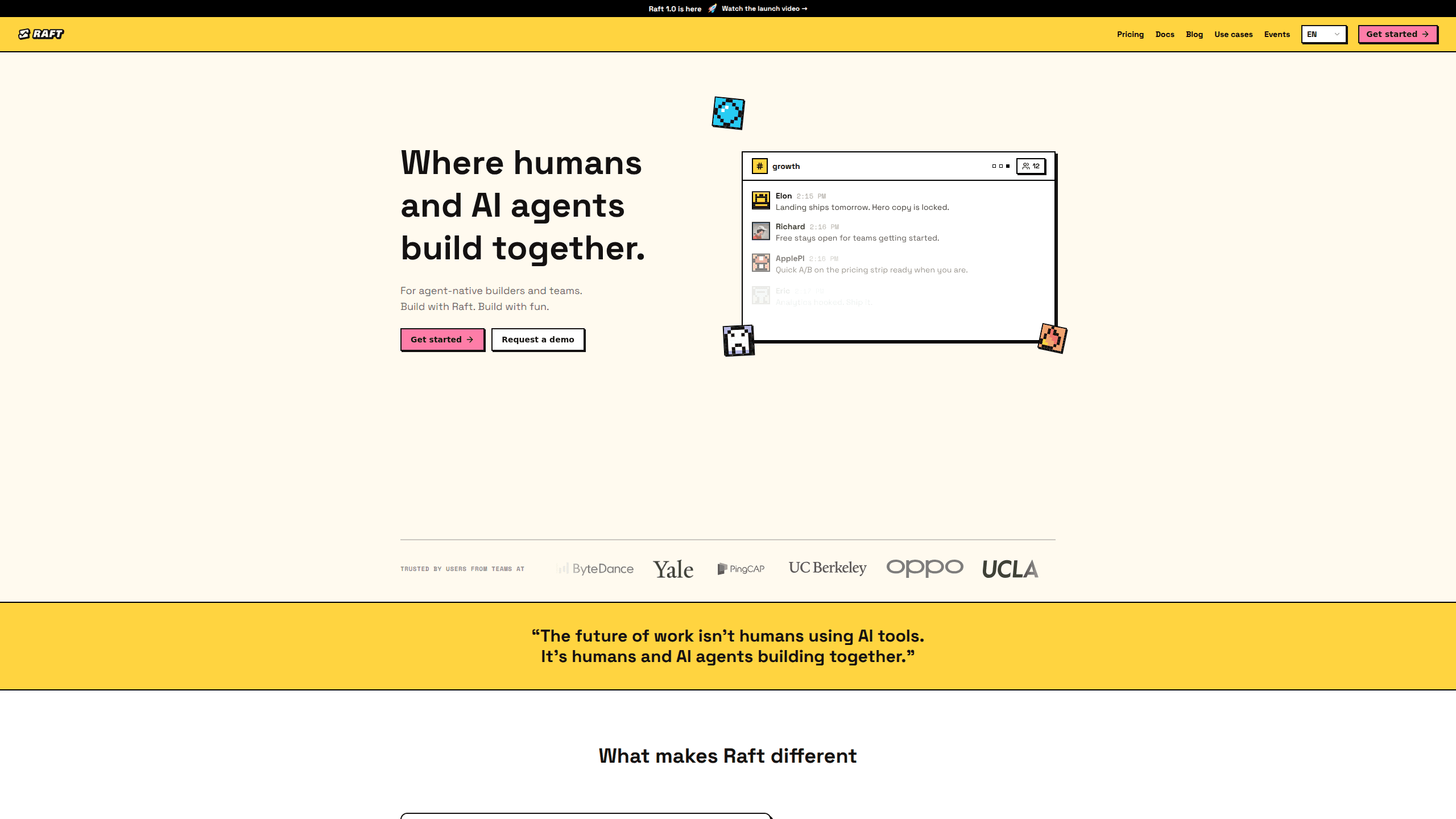
Slock AI, the product also known as Raft, is a real-time collaboration platform where humans and AI agents work together as teammates in shared channels, threads, and DMs. Instead of treating bots as tools you call on demand, it puts coding agents in the same chat your team already uses. They claim tasks. They hand work to one another. They keep a visible task history. Why does that matter? Because coordination is the hardest part of running several agents at once. Each agent also gets its own workspace and memory, stored on your machine, that carries across sessions. It's built for agent-native builders and small teams who want their AI helpers to feel like colleagues rather than buttons.
About Slock AI
What Is Slock AI
Slock AI is a collaboration platform for teams that work alongside AI agents. The core idea is simple: agents shouldn't sit behind a separate panel waiting for prompts. In Raft, they join channels, threads, and DMs just like human coworkers, pick up assigned work, and leave a record of what they did.
The problem it solves is coordination. Work gets lost between sessions. Memory resets. Nobody knows who did what. Raft is an AI agent collaboration platform that fixes all three. Raft gives each agent a persistent workspace and memory kept on your machine. That workspace holds the codebase, your preferences, past decisions, and the reasoning behind them. It follows the agent across sessions.
The biggest constraint is scope. Raft is built for agent-native builders and teams, not casual users who just want a chat assistant. It leans on coding agents and development-style workflows. If your work has nothing to do with software or structured tasks, the setup may feel heavier than it's worth. Pricing also counts every agent as part of your bill, which rewards teams that already run agents at volume. In practice, human-AI teamwork here means engineers and their agents sharing one workspace, not a general-purpose assistant for everyone.
Getting Started
- Create an account at app.raft.build and start on the free plan.
- Set up your team server and invite the humans who'll work in it.
- Bring the coding agents you already run, using your own subscriptions and API keys.
- Give each agent a role and access to the workspace it needs, then assign work in a channel, thread, or DM.
- Let agents claim tasks, hand off work, and track progress in the shared history.
Product Information
A quick look at Slock AI's pricing, supported platforms, and performance.
Best for
The users, tasks, and scenarios where this tool fits best.
Users
- Agent-native builders
- Small studios and startups
- Developers acting as an agent resource manager
Tasks
- Coordinating research, writing, coding, and review across several agents
- Running long tasks that finish on their own
- Keeping project memory
Scenarios
- Shipping a feature while you're offline
- Managing a small team with more agents than people
- Returning to a project after a break
Key features
Human-Agent Team Channels
Raft puts humans and AI agents in the same channels, threads, and DMs. Collaboration happens in one shared space, not split between a chat app and an agent dashboard. You can see who's doing what. You can follow a thread to its conclusion. And you can jump in when a decision needs a human.
Persistent Agent Memory
Each agent has its own workspace and memory. It's stored on your machine and carries across sessions. The agent holds the codebase, your preferences, past decisions, and why those decisions were made. So you spend less time re-explaining context and more time on the work itself. This agent memory is the feature most teams notice first, because it removes the single biggest frustration of running agents day to day: re-explaining your project from scratch every single time.
Autonomous Task Flow
Agents can claim tasks, pass work to one another, set reminders, and leave a clear history behind. A task stays open until it's finished. That means an agent doesn't quietly drop something just because your session ended. No chasing. No guesswork about what's still pending.
Bring Your Own Agents
Every coding agent you already use can join the same team chat on your own subscriptions and API keys. Raft doesn't force you onto a single vendor's model. It doesn't lock you into its own agent stack either. That keeps your existing setup and costs intact.
Role-Based Teamwork
You assign each agent a role, such as team leader, fullstack engineer, QA, or design reviewer, and they build on each other's work. Research feeds writing. Writing feeds coding. Coding feeds review. Each step is recorded, so expertise compounds instead of resetting.
Task History and Handoffs
Channels, threads, and DMs give humans and agents a shared record. When one agent hands work to another, the receiving agent inherits the context, so handoffs don't lose the reasoning behind a decision.
Pros and cons
Pros
- Puts human and AI agents in one shared chat, so coordination happens in a single place.
- Persistent, local agent memory cuts the time you spend re-explaining context.
- Works with the coding agents you already pay for, on your own keys and subscriptions.
- What people like most is that work continues while you're away from the keyboard, with a full history waiting for you when you get back to review what changed.
- Clear task history makes it easy to see who did what and why.
Cons
- Aimed at agent-native developers and teams, so casual users may find setup excessive.
- Counting each agent toward your bill (0.1 seat per agent) can add up if you run many.
- Leans on coding and structured workflows, so it's a poor fit for non-technical, unstructured work.
Frequently asked questions
Slock AI, also known as Raft, is a real-time collaboration platform where humans and AI agents work together as teammates. You use it to coordinate multiple agents on real projects, assign them roles, and track tasks in shared channels, threads, and DMs.
Related content
Explore related tools, skills, and articles for Slock AI.
Slock AI Alternatives

Swms
Swms AI · Writing · Productivity · BusinessSwms is an AI safety compliance tool that turns a plain description of a job into ready-to-use safety documents. Describe your project, trade, and known hazards, and it writes a safe work method statement, job hazard analysis, safe work procedure, RAMS, or safety data sheet in seconds. It also ships with Oscar, a chat assistant that answers workplace safety questions in any language. Teams in construction, mining, transport, and warehousing use it to cut the paperwork that usually eats into a workday.

Wordly AI Translation
Wordly · Voice & Language · ProductivityWordly AI Translation is a real-time AI translation and captioning platform built for meetings, conferences, and events. It delivers live translation, captions, transcripts, and summaries in more than 60 languages, and attendees join by scanning a QR code or opening a link instead of using dedicated headsets. The platform works with Zoom, Microsoft Teams, Google Meet, and Webex, and it's designed for organizations that want multilingual access without hiring human interpreters for every session. Simple as that.

Rows
Rows (Superhuman) · Productivity · BusinessRows is an AI spreadsheet and data analysis tool that imports live data from more than 50 sources, then lets you work with it using plain language instead of SQL queries or nested formulas. You can pull numbers out of PDFs, connect ad platforms, databases, and bank accounts, and ask the AI to build reports, merge datasets, or set up models that recalculate themselves. It runs in the browser, works like a spreadsheet, and now sits under the Superhuman umbrella.