

Solarch
Solarch · Coding
Solarch is an architecture-first backend tool built around diagram to code generation. You draw your backend as a node-and-edge graph, a strict Rules Engine checks every connection, and a hybrid compiler writes the code. It's built for developers who want the diagram and the codebase to stay in sync instead of slowly drifting apart. Think of it as type-safe code generation driven by the picture, not the other way around.
About Solarch
What Is Solarch
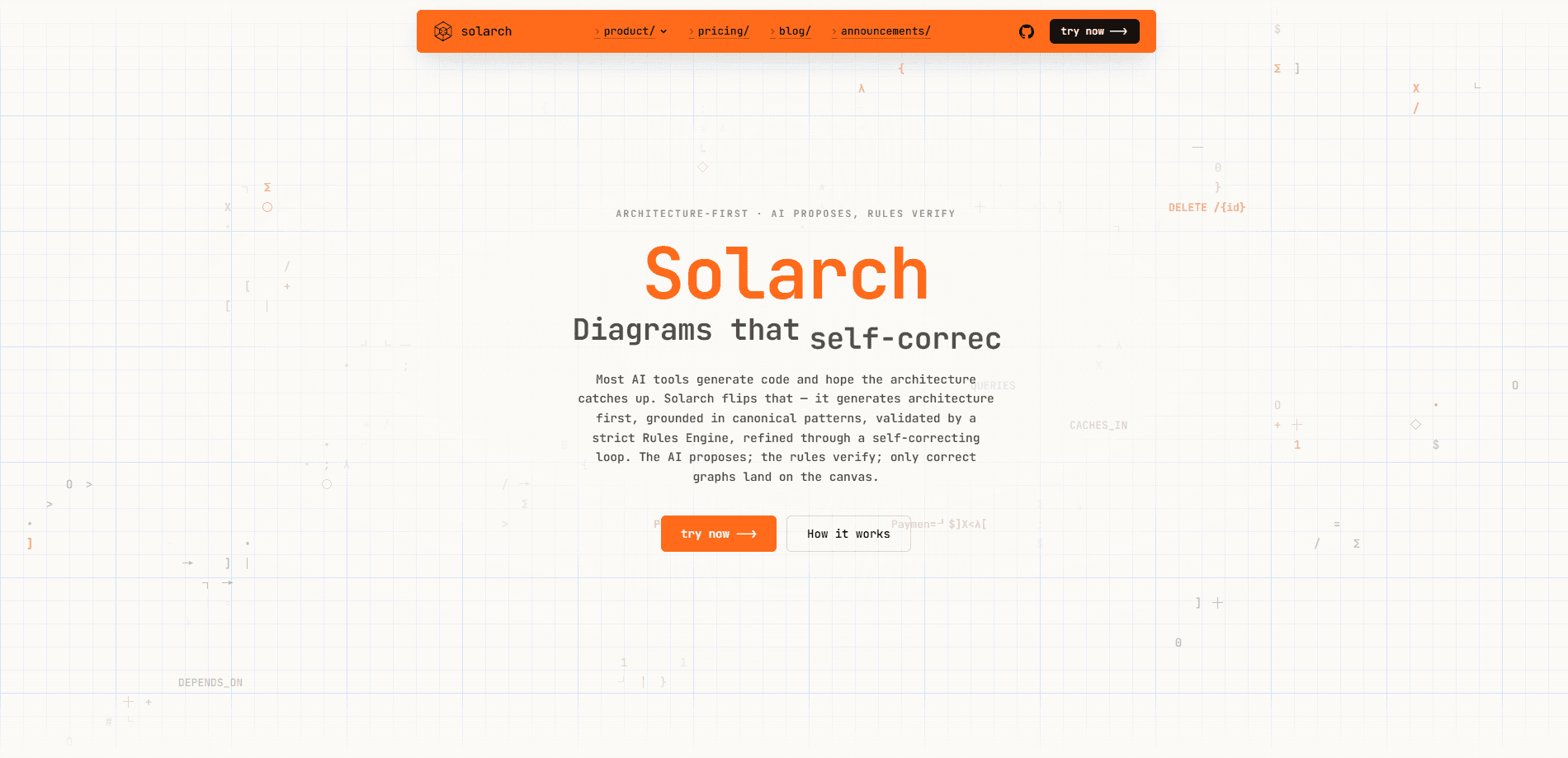
Solarch is a backend architecture tool that starts from the picture, not the code. You sketch controllers, services, repositories, tables, DTOs, and queues on one canvas, and a default-deny Rules Engine validates each connection as you draw it. A controller can't reach a table directly; it has to go through a service or repository. Illegal edges get rejected on the spot, not three commits later.
The pitch is blunt. Most AI coding tools write code first and hope the architecture keeps up. Solarch flips the order: architecture-first development means the AI proposes a structure grounded in canonical patterns, the rules verify it, and only a correct graph ever becomes code. So what does diagram to code actually buy you? A single source of truth, checked by rules, that both your editor and your AI agent can read from. That's type-safe code generation with the guarantee built in.
The main limit is scope. Solarch handles backend structure, so frontend work, deployment, and infrastructure are outside what it draws. It also won't invent your business logic for you. About 80% of a project ships as backend scaffolding; the algorithmic parts stay yours to write.
Getting Started
- Sign up at app.solarch.dev and open a blank project canvas.
- Draw your system as nodes and edges, or let the AI architect propose a starting graph you can edit.
- As you connect nodes, watch the Rules Engine flag illegal edges and fix them before moving on.
- Run the hybrid compiler: stage one builds a token-free skeleton, stage two fills the empty function bodies.
- Export the result as code, a Mermaid diagram, an API contract, or AI-readable vector memory.
Product Information
A quick look at Solarch's pricing, supported platforms, and performance.
Best for
The users, tasks, and scenarios where this tool fits best.
Users
- Backend developers who think in diagrams and want the code to match what they drew.
- Solo builders who want scaffolding done fast but plan to keep control of the tricky logic.
- Small teams that need shared projects with a single source of truth for the architecture.
Tasks
- Turning a system sketch into a type-safe code skeleton without hand-writing DTOs and entities.
- Catching architectural mistakes early, before a controller ends up talking straight to a database table.
- Keeping a diagram, an editor, and an AI agent reading from the same validated graph.
Scenarios
- Starting a new backend and wanting a clean structure from day one instead of refactoring later.
- Auditing an existing design where the diagram and the codebase have quietly gone out of sync.
- Handing a project to another developer and giving them a graph they can actually read.
Key features
Rules Engine Validation
Every edge you draw gets checked against a default-deny Rules Engine, which means anything not explicitly whitelisted is forbidden before it ever reaches your codebase. It enforces 7 anti-patterns and 3 conditional checks. Bad connections get caught while you're still thinking about them. That's far cheaper than fixing them after they're in the code.
Hybrid Compiler
Solarch splits generation into two stages. First, a deterministic compiler turns the graph into a skeleton with zero tokens, building DTOs, entities, and constructor injection straight from the edges without invoking a model at all. Then a surgical AI fills only the empty function bodies at roughly 300 tokens per function. The split keeps costs down, and it keeps the structural work fully predictable. Structure is free. Logic costs a little.
Architecture-First AI
The AI proposes an architecture grounded in canonical patterns, and the Rules Engine verifies it before anything lands on the canvas, so an incorrect graph never survives to the next step. You stay in charge of the design while the tool handles the tedious drafting. It's the reverse of the usual code-first workflow, and it's the reason drift stays at zero. Nothing lands unless the rules allow it.
Multi-Target Export
A validated graph exports as several things at once, so you can pull out source code, a Mermaid diagram, an API contract, or AI-readable vector memory from the same source of truth. You can pull out source code, a Mermaid diagram, an API contract, or AI-readable vector memory. That last option means Cursor and Claude can read your architecture as context, so your agent works from the same map you do. One graph, many outputs.
Editor, CI, and Agent Sync
Solarch lives where you work. The architecture runs through your editor, your CI pipeline, and your AI agent with one shared diff engine, so all three always agree on what the current version actually is. Whatever change you ship, all three see the same version, which removes the classic problem of a stale diagram nobody trusts. No more guessing which copy is current.
Shared Team Projects
The Team plan adds shared projects with single-home nodes and ghost references across the organization, which means one node has exactly one owner no matter how many projects point at it. One node has one owner, and other projects point back to it instead of copying it. For teams, that ends the argument over which version of the architecture is the real one. Language support is still thin, and Solarch hasn't published which stacks it covers, so you should verify your own before a paid plan.
Bring-Your-Own Stack
Solarch isn't a closed platform you have to move into. You bring the graph to your existing stack and keep your editor, your pipeline, and your agent. The generated code is meant to fit into what you already run, not replace it.
Pros and cons
Pros
- Catches illegal backend connections at draw time, so architectural mistakes never reach the codebase.
- The two-stage compiler keeps AI token costs low by reserving the model for function bodies only.
- Export options cover code, diagrams, contracts, and agent memory from a single validated graph.
- Shared team projects with single-home nodes stop version confusion across a larger org.
- A 7-day trial on paid plans lets you test the AI scaffolding before committing.
Cons
- Scope stops at backend structure, so frontend, deployment, and infrastructure still need their own tools.
- The two lower tiers are drawing and scaffolding only; full codebase generation starts at the $100/mo Code plan.
- There's no published public API, so teams that need to script around it will have to wait or ask.
Frequently asked questions
Solarch is a backend architecture tool. You draw your system as a node-and-edge graph, and it generates code that matches the architecture exactly. The point is to stop the design and the codebase from drifting apart. Draw first. Code second.
Related content
Explore related tools, skills, and articles for Solarch.
Solarch Alternatives
Forefront
Forefront · CodingForefront is a web platform for building with open-source AI. It lets you fine-tune leading open-source language models on your own data, evaluate how they perform, and run them through an API or export them to host yourself. Developers who want the convenience of a closed-source platform but insist on owning their models and data are the target audience here.

Startkit
StartKit.AI · CodingStartkit is a boilerplate for building AI SaaS and AI wrapper products. Think of it as an AI startup boilerplate with the boring parts already wired up: authentication, Stripe and Lemon Squeezy payments, usage limits, transactional email, and an AI API starter that talks to OpenAI, Anthropic, Groq, or Llama. You clone the repo, set your price, and start on the part of your product that people actually pay for. It's Next.js under React and Tailwind, so most of the boilerplate code already feels familiar.
Testim
Tricentis · CodingTestim is an AI-powered test automation platform for building and running end-to-end tests across web, mobile, and Salesforce applications. It leans on machine learning to keep tests stable when an interface changes, so teams spend less time fixing broken selectors. Not bad for an automated testing tool you can start using today. You create tests by recording actions in a browser, then optionally add JavaScript when you need more control. It's a solid pick for busy QA teams.