

Sonarly
Sonarly, Inc. · Coding
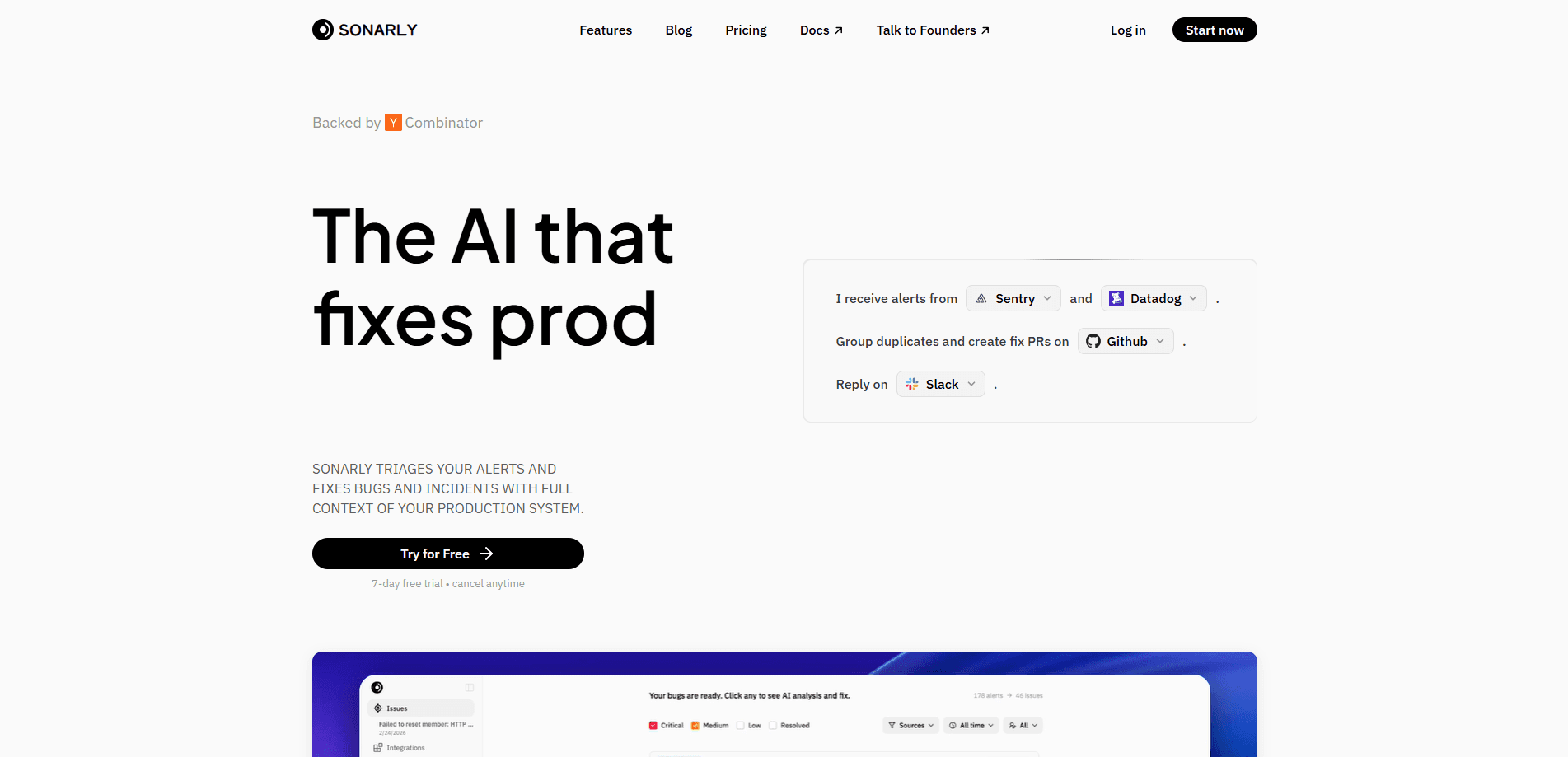
Sonarly is an autonomous monitoring platform that reads your production alerts, groups the duplicates, and opens pull requests to fix the bugs behind them. It plugs into tools like Sentry, Datadog, Grafana, GitHub, and Slack, then replies in the same channel where your team already talks so nobody has to switch tabs. The pitch is simple. Cut resolution time by 10x without hiring another on-call engineer. So what's the actual problem here? Most teams drown in noise. As an AI alert triage tool, production alert monitoring stops being a full-time job once the duplicates are gone.
About Sonarly
What Is Sonarly
Sonarly is an AI SRE tool built for teams that run software in production. It's also, more plainly, an AI bug fixing layer that sits on top of the monitoring you already pay for. It connects to your observability stack, watches the alerts coming in, and does the first pass of triage that usually eats a chunk of every engineer's week: sorting severity, assigning blame, and clustering duplicate reports into one incident.
The real differentiator is what happens after triage. Sonarly reads your codebase, queries your logs, traces a root cause across services, and then opens a pull request on GitHub with a proposed fix. According to Sonarly, its root-cause accuracy sits at 84%, which the company says is the best on the market. That's a vendor claim, so treat it as a target, not a guarantee.
The catch is availability. Sonarly's site now states it's no longer taking new users, so you'll need to talk to the founders directly before you can sign up. It's also a heavyweight tool: it wants read access to your code and production telemetry, which is a real security conversation for any team handling sensitive data. If your alerts already run clean and your team is small, the setup overhead might outweigh the payoff.
Getting Started
- Talk to the founders to get access, since Sonarly has paused open signups.
- Connect your alert sources and code host from the dashboard, such as Sentry, Datadog, and GitHub.
- Point Sonarly at the Slack or Discord channel where your team handles incidents.
- Let it ingest alerts for a few days so it can learn your duplicate patterns and service layout.
- Review the pull requests it opens and merge the fixes that hold up.
Product Information
A quick look at Sonarly's pricing, supported platforms, and performance.
Best for
The users, tasks, and scenarios where this tool fits best.
Users
- On-call engineers buried in alert noise
- Small SRE and platform teams
- Startup engineering leads
Tasks
- Grouping duplicate alerts
- Tracing a root cause across services
- Drafting a fix pull request
Scenarios
- Monday morning alert cleanup
- A post-deploy spike in errors
- Handing off an incident
Key features
Alert Triage and Deduplication
Sonarly assigns blame, rates severity, and collapses duplicate alerts into single incidents. Sonarly says about 50% of its customers' alerts are duplicates. That's roughly half the noise gone before a human looks. For teams that get paged on the same bug repeatedly, this feature pays for itself first.
Root Cause Analysis
The platform investigates your codebase and queries your logs to trace a bug across services, backing each conclusion with evidence instead of a guess. This runs on what Sonarly calls a codebase graph. Accuracy depends on how well it understands your repo. The 84% figure comes from the vendor, not an independent test.
Fix Pull Requests
After it finds a root cause, Sonarly opens a pull request on GitHub with a proposed fix. You keep the decision. That design matters for compliance-heavy teams: nothing changes in production without a human merging it.
Slack and Discord Replies
Analysis gets posted in-thread in the alert channel your team already uses, with the responsible person mentioned. It's a small feature with outsized value: no dashboards to check, no context to rebuild.
Broad Integrations
Sonarly connects to 40+ tools, including Sentry, Datadog, Grafana, GitHub, Slack, Discord, and Linear. One-click hookup means you don't rewrite your stack to try it. Stitching a large stack together still takes an afternoon.
Security and Compliance Posture
Sonarly holds SOC 2 Type II and follows GDPR, with a data processing agreement available for every customer. Given that it reads production data, those controls are table stakes rather than a bonus.
Pros and cons
Pros
- Groups duplicate alerts so the pager shows real incidents only
- Opens fix pull requests, keeping a human in the loop on every change
- Posts analysis where your team works, cutting context switching
- 40+ integrations across monitoring, code, and chat tools
- Free tier lets you test it on a small project before paying
Cons
- No longer taking new users, so access depends on talking to the founders
- Root-cause accuracy is a vendor claim and will vary by codebase
- Needs read access to your code and production data, which slows security approval
- Free plan caps you at 5 bugs a month, tight for real on-call work
Frequently asked questions
It triages production alerts automatically, removes duplicates, finds the root cause, and opens a GitHub pull request with a proposed fix. Think of it as an AI responder that handles the first pass of an incident.
Related content
Explore related tools, skills, and articles for Sonarly.
Sonarly Alternatives
Forefront
Forefront · CodingForefront is a web platform for building with open-source AI. It lets you fine-tune leading open-source language models on your own data, evaluate how they perform, and run them through an API or export them to host yourself. Developers who want the convenience of a closed-source platform but insist on owning their models and data are the target audience here.

Startkit
StartKit.AI · CodingStartkit is a boilerplate for building AI SaaS and AI wrapper products. Think of it as an AI startup boilerplate with the boring parts already wired up: authentication, Stripe and Lemon Squeezy payments, usage limits, transactional email, and an AI API starter that talks to OpenAI, Anthropic, Groq, or Llama. You clone the repo, set your price, and start on the part of your product that people actually pay for. It's Next.js under React and Tailwind, so most of the boilerplate code already feels familiar.
Testim
Tricentis · CodingTestim is an AI-powered test automation platform for building and running end-to-end tests across web, mobile, and Salesforce applications. It leans on machine learning to keep tests stable when an interface changes, so teams spend less time fixing broken selectors. Not bad for an automated testing tool you can start using today. You create tests by recording actions in a browser, then optionally add JavaScript when you need more control. It's a solid pick for busy QA teams.