

TUNiB
TUNiB · Business · Chatbot
TUNiB is a Korean AI company offering small language models, multi-persona chatbots, and NLP APIs for content safety and privacy masking.
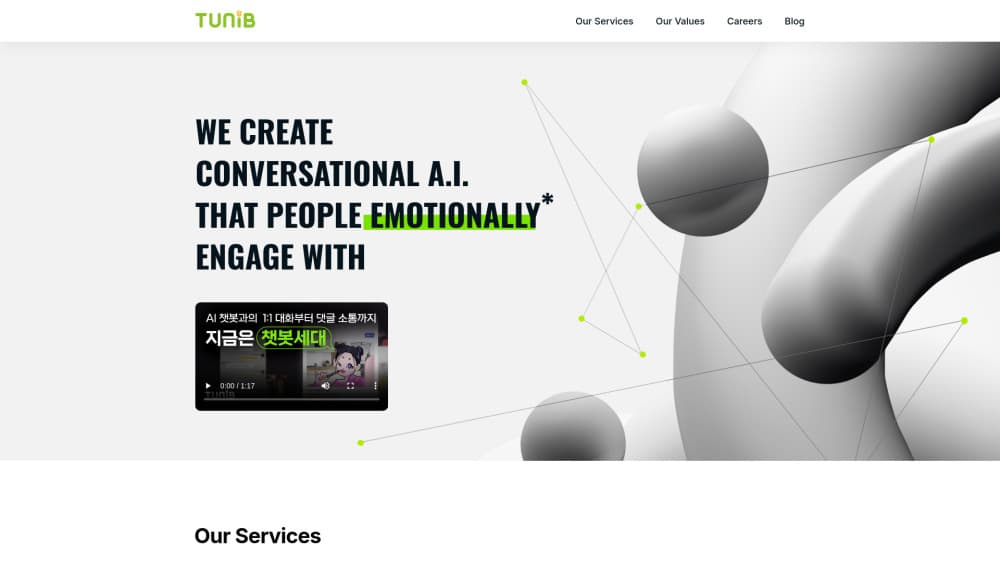
About TUNiB
What Is TUNiB
TUNiB is a South Korean AI company that builds natural language processing tools for businesses rather than end consumers. Think of it as a Korean sLLM platform first, with chatbots and moderation APIs layered on. Its work splits into three lines: small language models (sLLMs), multi-persona chatbots, and moderation APIs. If your product takes user-generated text, that third line is usually where you'd start.
The pitch is practical. Most teams don't need to train a model from scratch. They need to check text before it goes live and keep personal data out of logs. That's the job.
TUNiB's safety and privacy APIs are built for it, and the company frames its models as smaller and cheaper to run than the frontier systems. Its Polyglot model is billed as the first fully open source Korean sLLM cleared for commercial use. That matters if you're building for Korean users and don't want to depend on a closed vendor.
The catch is scope. TUNiB sells to developers and companies, so there's no simple consumer app to poke at. Pricing isn't published on the homepage, and access to the APIs runs through a sales conversation. For a solo builder wanting to test a single call, that friction is real. Is it worth it? Depends on your scale.
Getting Started
- Review the three service lines on tunib.ai and decide which one fits your use case: sLLM, chatbots, or NLP APIs.
- Open the public demos for the Safety Check and De-identification detectors to see how each one scores real text.
- Contact TUNiB through the site to request API access, since there's no self-serve signup for the moderation endpoints.
- If you need a custom model, brief the team on your domain and data so they can scope a domain-specific sLLM.
- Integrate the API into your platform and route user text through it before publishing or storing it.
Product Information
A quick look at TUNiB's pricing, supported platforms, and performance.
Best for
The users, tasks, and scenarios where this tool fits best.
Users
- Backend and platform developers who need a moderation or privacy layer in their product
- Korean-language product teams wanting a commercial-use Korean sLLM
- Trust and safety teams handling user-generated content
Tasks
- Screening user comments and posts before they go live
- Masking personal data in stored text
- Adding chat companions or virtual characters to an app
- Building a Korean-language model for a specific domain
Scenarios
- Running a community app where abusive posts need automatic flagging.
- Handling support tickets or forms that contain names, phone numbers, and addresses that shouldn't sit in a database in the clear.
- Launching a companion or roleplay feature without training a model in-house.
Key features
Safety Check API
This endpoint reads text and returns a toxicity verdict across 12 categories, each with a severity level and a probability score. You get a probability, not a flat yes or no. That lets you tune how strict your filter is per channel. A gaming chat might accept more banter than a kids' app, and the same API handles both.
De-identification API
The privacy endpoint finds and masks 14 types of personal information in text. Names, contact details, and similar identifiers get replaced before the content is stored or passed downstream. Simple idea. Big relief for anyone under data-protection rules, since it's the difference between keeping a usable log and deleting it entirely.
Open Source Korean sLLM (Polyglot)
Polyglot is presented as the first fully open source Korean small language model available for commercial use. You can deploy it on your own infrastructure, which keeps your data in-house and removes per-call API costs. It also means you take on hosting and tuning yourself.
Multi-Persona Chatbot API
Rather than one generic assistant, this gives you access to millions of pre-built persona chatbots, plus the option to commission a tailored character. It's aimed at apps that want engagement through conversation, like companion or roleplay features. Pick a persona. Ship it. That's the flow, and it runs as an API you drop into an existing product.
Domain-Specific Model Building
TUNiB works with companies to build a small language model tuned to their field, borrowing the team's experience rather than handing over a one-size-fits-all model. If your vocabulary is specialized, like legal or medical Korean, this is the option to ask about. It takes a conversation, not a checkout button.
Self-Hosting for Data Control
Because the models are small and the flagship one is open source, you can run inference on your own servers. Companies with strict data rules get to keep text on their own hardware instead of sending it to a third party. No vendor in the loop.
Pros and cons
Pros
- The Safety Check API returns probability and severity, not just a flag, so you can set your own review thresholds.
- De-identification covers 14 personal data types, which cuts what you need to store in the clear.
- Polyglot is open source and licensed for commercial use, so Korean teams avoid lock-in.
- Public demos let you test the moderation APIs before talking to sales. No signup needed.
Cons
- No published pricing and no self-serve signup for the APIs, so evaluating it means contacting the company first.
- It's a B2B platform with no consumer app, which makes hands-on trial harder for individual developers.
- The open source sLLM is Korean-focused, so it's a weaker fit if you build primarily for English or other markets.
Frequently asked questions
TUNiB sells NLP infrastructure: safety and privacy APIs, multi-persona chatbot APIs, and small language models, including a custom-build service. It's aimed at companies embedding these into their own products.
Related content
Explore related tools, skills, and articles for TUNiB.
TUNiB Alternatives

Would you pay?
Mustafa Ergisi · Marketing · BusinessWould you pay? turns indie startups into a swipe deck. Strangers swipe right only if they'd pay, and makers see the yes rate before they build more.

Timeless Code
Timeless · Coding · Productivity · BusinessTimeless Code is an AI meeting notetaker that installs inside Claude Code, records calls on a Mac, and lets you ask about any transcript without leaving the terminal.

Hopscotch AI
Hopscotch Labs · Coding · Productivity · BusinessHopscotch AI is an OpenAI-compatible LLM router. One key reaches 500+ models across providers at list price, with no token markup, spend limits and per-request cost logs.