

Spawned
Spawned, LLC · Coding
Spawned is an AI visibility engine for brands that want to show up when people ask ChatGPT, Claude, or Gemini for a recommendation. Instead of tracking blue links on Google, it watches what the big AI assistants say about you, which competitors they name first, and where those answers come from. You connect your site, run prompts, and get a running picture of how often you appear and how you're described. Think of it as a GEO platform, short for generative engine optimization, built for the AI-answer era. Pricing starts at $99 per month, so it's built for teams with real marketing budgets rather than a weekend experiment.
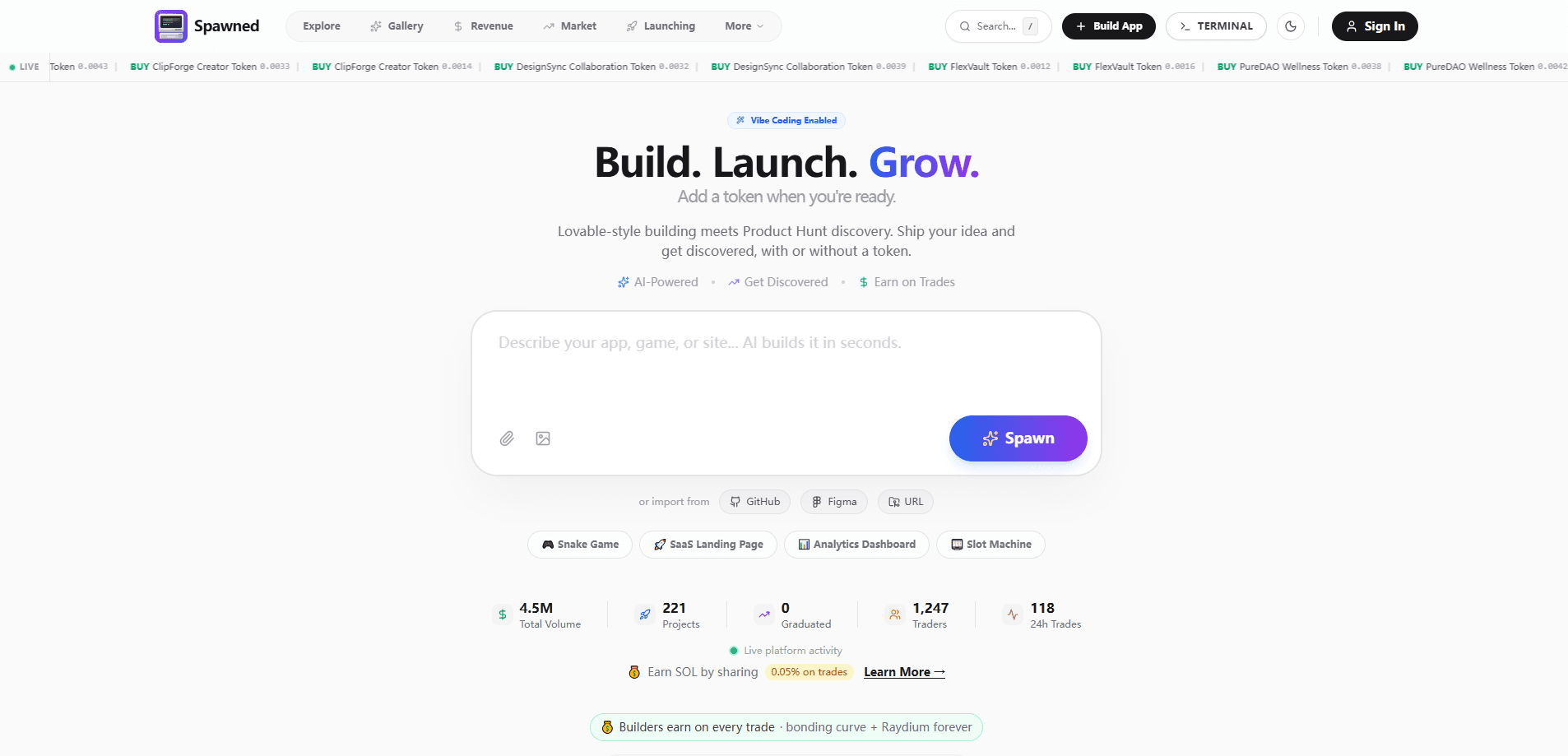
About Spawned
What Is Spawned
Spawned is a marketing platform aimed at a shift that's already happening. More people now ask an AI assistant "what's the best tool for X" and take the answer at face value, never clicking through to a website. Spawned treats that answer as the thing worth winning, and calls the work generative engine optimization.
The core job is measurement. You tell Spawned what your brand is and what you sell, then it runs your prompts across the major AI models and records if you got mentioned, where you sit in the answer, and how the model frames you. From there you can compare yourself against rivals and see which of your pages the models actually pull from. It's also a brand monitoring AI layer, in the sense that it flags how you're portrayed, not just a missing name. Want to get recommended by ChatGPT and its peers? That stops being luck and starts being something you can track week to week.
The limits are worth knowing up front. AI answers shift constantly. Any single snapshot goes stale fast, so the value depends on how often you check. Spawned also can't force a model to recommend you. It shows you the gap and the patterns, but the content and reputation work that closes it still sits on your team. And there's a gap between monitoring and actually moving the needle, which is why the price point matters.
Getting Started
- Go to spawned.com and create an account for your brand, then share your site and the products or services you want tracked.
- Add the prompts that matter to you, the questions a real customer would type into ChatGPT, Claude, or Gemini.
- Let Spawned run those prompts across the supported AI models and build your first visibility snapshot.
- Review your mention rate and positioning, then add competitors so you can see who the models favor and why.
- Check back on a regular schedule, since AI answers drift and a one-time report tells you very little.
Product Information
A quick look at Spawned's pricing, supported platforms, and performance.
Best for
The users, tasks, and scenarios where this tool fits best.
Users
- Marketing leads at software and SaaS companies
- SEO and content teams
- Brand and PR managers
- Founders of small B2B products
Tasks
- Tracking AI mentions
- Generative engine optimization
- Competitive benchmarking
- Answer monitoring
Scenarios
- Launching a new product and wanting to know if AI assistants have started recommending it yet.
- Entering a crowded category where buyers ask an AI for shortlists instead of browsing search results.
- Auditing a sudden drop in organic signups that lines up with a shift in what the models say.
- Preparing a quarterly report that has to show marketing impact beyond classic search rankings.
Key features
AI Answer Tracking
Spawned runs your chosen prompts through ChatGPT, Claude, Gemini, and other assistants, then logs what comes back. For each one you can see whether your brand appeared, at what position, and how it was described. That turns a fuzzy question, "are we showing up in AI," into a running table you can act on. The catch? It's a snapshot. The numbers mean more when you collect them consistently over weeks.
Share of Voice Reporting
Knowing you got mentioned once is fine. Knowing you get named in 30% of relevant answers while a competitor hits 55% is what drives decisions. Spawned frames your visibility as a share of the total AI conversation in your category, which makes progress easy to compare quarter over quarter. Numbers move. You act on them.
Competitor Tracking
You can watch rivals the same way you watch yourself. Add their names to your prompts and Spawned will show which brands the models lean on, and how the order shifts as their content and reputation change. This is where the tool earns its keep for anyone in a contested market, since it exposes who the AI assistants treat as the default answer. That gap is the whole game.
Citation and Source Mapping
When an AI model recommends something, it's usually leaning on content it read somewhere. Spawned tries to surface which pages and sources feed those answers, so you can see whether the models are citing your own site, a review roundup, or a competitor's blog. That pointing-back step is what connects a visibility score to a concrete content task. Fix the source, and the answer often follows.
Generative Engine Optimization Workflow
The platform is built around the idea that AI search is a separate channel from classic SEO, with its own signals and its own winners. You use the tracked prompts and citations to decide what content to write, improve, or push out, then watch whether your mention rate responds. It's a loop, not a one-time audit. The value compounds.
Pros and cons
Pros
- Tracks the AI assistants people actually use, so it reflects where buying questions are increasingly being answered.
- Turns vague "are we visible in AI" worry into a share-of-voice number that's easy to report and compare.
- Competitor tracking shows who the models favor, which is hard to get any other way.
- Source mapping connects a visibility gap to a specific piece of content you can go fix.
- Sits naturally next to an existing SEO or content workflow rather than asking the team to start over.
Cons
- No free plan. At $99/mo and up, it's hard to justify for solo founders or very early products.
- AI answers change daily, so a single report goes stale quickly and the tool only pays off with consistent, scheduled use.
- It measures and points, but it can't make a model recommend you. The writing and reputation work that closes the gap is still manual.
- Visibility tracking can't capture word-of-mouth or users who ask a follow-up in a private session, so the picture is never complete.
Frequently asked questions
Spawned tracks how often AI assistants like ChatGPT, Claude, and Gemini mention and recommend your brand, then shows how that stacks up against competitors. It's a monitoring and analysis tool for AI search visibility, not a service that writes content for you. That split matters. You still do the work.
Related content
Explore related tools, skills, and articles for Spawned.
Spawned Alternatives
Forefront
Forefront · CodingForefront is a web platform for building with open-source AI. It lets you fine-tune leading open-source language models on your own data, evaluate how they perform, and run them through an API or export them to host yourself. Developers who want the convenience of a closed-source platform but insist on owning their models and data are the target audience here.

Startkit
StartKit.AI · CodingStartkit is a boilerplate for building AI SaaS and AI wrapper products. Think of it as an AI startup boilerplate with the boring parts already wired up: authentication, Stripe and Lemon Squeezy payments, usage limits, transactional email, and an AI API starter that talks to OpenAI, Anthropic, Groq, or Llama. You clone the repo, set your price, and start on the part of your product that people actually pay for. It's Next.js under React and Tailwind, so most of the boilerplate code already feels familiar.
Testim
Tricentis · CodingTestim is an AI-powered test automation platform for building and running end-to-end tests across web, mobile, and Salesforce applications. It leans on machine learning to keep tests stable when an interface changes, so teams spend less time fixing broken selectors. Not bad for an automated testing tool you can start using today. You create tests by recording actions in a browser, then optionally add JavaScript when you need more control. It's a solid pick for busy QA teams.