

Stability AI Stable Diffusion 3.5
Stability AI · Image
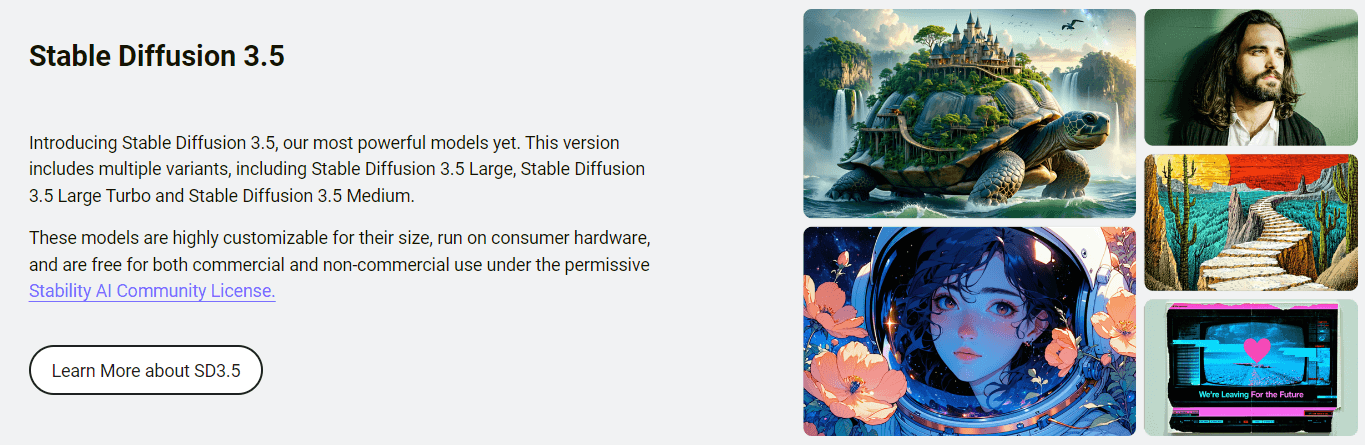
Stable Diffusion 3.5 is an open-source image generation model family from Stability AI, and it works as a text-to-image model you can run yourself: you type a written prompt and get images you own and can use commercially. It's the kind of AI image generator you install rather than subscribe to. It ships in three sizes, from a lightweight version for consumer GPUs to an 8.1-billion-parameter base model for professional work. Unlike closed image tools, you can download the weights, run them on your own machine, and fine-tune the image model for a specific style or product. No subscription required.
About Stability AI Stable Diffusion 3.5
What Is Stable Diffusion 3.5
Stable Diffusion 3.5 is the image generation family Stability AI released in October 2024, and it's the successor to Stable Diffusion 3 Medium. The company has been open about that earlier release falling short of its own standards, and 3.5 is the rebuilt answer. What matters for you: the model weights are downloadable, the code is public, and most people can use the output without paying a license fee. That's rare.
The family covers three models so you don't have to pick between speed and quality. Stable Diffusion 3.5 Large has 8.1 billion parameters and targets professional images at 1 megapixel. Stable Diffusion 3.5 Large Turbo is a distilled version that gets a usable image out in 4 steps, which makes it noticeably faster. Stable Diffusion 3.5 Medium sits at 2.5 billion parameters and runs out of the box on everyday consumer hardware, generating images between 0.25 and 2 megapixels.
The catch is that this isn't a one-click web app for beginners. You need somewhere to run it, whether that's your own GPU, a hosted platform like Replicate or ComfyUI, or the paid Stability AI API. The models also lean toward diversity over consistency: the same prompt with different seeds can give you wildly different results, which is intentional. Ask for something vague and you'll get something vague back. Specific prompts get specific images.
So which of the three sizes should you actually grab? That depends entirely on your GPU.
Getting Started
Getting Stable Diffusion 3.5 running depends on which path you take. The self-hosted route is the most flexible and free for most users.
- Pick a model size. Grab Large for maximum quality, Medium or Large Turbo if your hardware is limited.
- Download the weights from Hugging Face (stabilityai on Hugging Face hosts all three) or pull the inference code from the Stability-AI/sd3.5 repository on GitHub.
- Load the model in a compatible interface. ComfyUI and similar tools handle the workflow wiring for you.
- Write your prompt, set resolution and seed, then generate. Medium needs around 9.9 GB of VRAM to reach full performance.
- Take the output and edit further in your usual editor. You own the images you make.
If you'd rather skip the setup, sign up for the Stability AI API or a hosted platform and call the model directly. That route costs money, but it saves you hours of configuration.
Product Information
A quick look at Stability AI Stable Diffusion 3.5's pricing, supported platforms, and performance.
Best for
The users, tasks, and scenarios where this tool fits best.
Users
- Independent artists
- Developers building image features
- Hobbyists with a decent GPU
- Researchers and students
Tasks
- Generating marketing visuals
- Fine-tuning a custom style
- Prototyping before a shoot
- Building an app's image pipeline
Scenarios
- Running an image generator entirely offline
- Working on a laptop or desktop GPU rather than renting cloud compute every time.
- Shipping commercial content for a small studio where the $1M revenue ceiling isn't a concern.
Key features
Three Model Sizes for Different Hardware
Stable Diffusion 3.5 comes in Large (8.1B parameters), Large Turbo (a distilled version built for 4-step generation), and Medium (2.5B parameters). Three separate models, three different jobs. The split lets you match the model to your hardware instead of forcing one size on everyone. Medium is the accessible entry point, while Large is the one aimed at professional, 1-megapixel output.
Customizability and Fine-Tuning
The models were built to be customized, not just used. Stability AI added Query-Key Normalization to the transformer blocks specifically to make training more stable, which simplifies fine-tuning and building derivative models. You can train a LoRA, adjust the base model, or build an app around a custom workflow, and the community license explicitly allows distributing and monetizing that work. Closed tools rarely let you do this.
Runs on Consumer Hardware
Medium needs only around 9.9 GB of VRAM, excluding the text encoders, to reach full performance. That puts it within reach of many consumer GPUs, which is unusual for a modern image model of this quality. If you've been holding off on local image generation because you assumed you'd need a data-center card, this is the model that changes the math. It really does run on a gaming rig.
Open License With Commercial Rights
The Stability AI Community License is free for research and personal use, and free for commercial use for anyone under $1M in annual revenue. You also keep ownership of the generated media. That combination is the main reason small studios and indie developers pick this over closed competitors. Read the terms before you ship.
Multiple Access Routes
You don't have to self-host. The same models are available through the Stability AI API, Replicate, Fireworks AI, DeepInfra, and ComfyUI. That means you can start with a hosted endpoint and migrate to self-hosting later, or mix both depending on the workload. No lock-in either way.
Improved Prompt Adherence
Stability AI describes 3.5 as top-tier on prompt adherence, the ability of the model to actually draw what you asked for rather than an approximation. For prompting-heavy work like detailed scenes or specific compositions, that's the difference between a few attempts and a frustrating afternoon. Vague prompts still misbehave. Fine-tuning tightens the gap.
Pros and cons
Pros
- Free weights under a permissive license, so there's no per-image cost when you self-host.
- You own the images and can use them commercially if your revenue is under $1M.
- Three sizes mean you can trade speed for quality based on your GPU.
- Fine-tuning and LoRA training are supported, letting you build a custom style or product.
- Works across self-hosting, the official API, and third-party platforms, so you're not locked into one vendor.
Cons
- Not a beginner tool. There's no simple web button unless you use a hosted platform.
- Output varies a lot between seeds by design, so vague prompts give inconsistent results and you'll spend time iterating.
- Running the full Large model locally demands serious GPU memory, which rules out many laptops.
- Above $1M in annual revenue, the free commercial license ends and you need an enterprise agreement, which means contacting Stability AI for a quote.
Frequently asked questions
It generates images from text prompts, and you can use it for everything from concept art and marketing visuals to building image features into an app. Because the weights are open, it also gets used as a base for fine-tuning and custom models, which makes it a workhorse for AI art generation at scale.
Related content
Explore related tools, skills, and articles for Stability AI Stable Diffusion 3.5.
Stability AI Stable Diffusion 3.5 Alternatives

X Ray Interpreter
X-ray Interpreter · ImageX Ray Interpreter is a web-based AI radiology tool that turns X-rays, CT scans, MRI, ultrasound, and PET images into plain-language reports. You upload a scan, get a preliminary X-ray interpretation in moments, then ask follow-up questions if something needs explaining. It works as a second opinion and a learning aid, not as a medical diagnosis.

Aieasypic
AIEasyPic · ImageAIEasyPic is an AI image generator that turns plain text prompts into finished artwork in seconds. You can also train custom models on your own photos, swap faces in existing images, and create short video clips from text, all from a browser. It suits casual creators who want quick visuals and hobbyists who want to build a personal model without touching any code.

Chargen
Chargen · ImageChargen is an AI character generator and worldbuilding toolkit built for Dungeons & Dragons and other tabletop RPGs. It turns a one-line idea into a painted character portrait, spins up NPCs, monsters, maps and encounters from the same session, and keeps every creature's details close at hand. The tabletop RPG art side runs on a credit system called Gold, while the text generators stay free for everyone.