

Stakpak
Stakpak · Coding
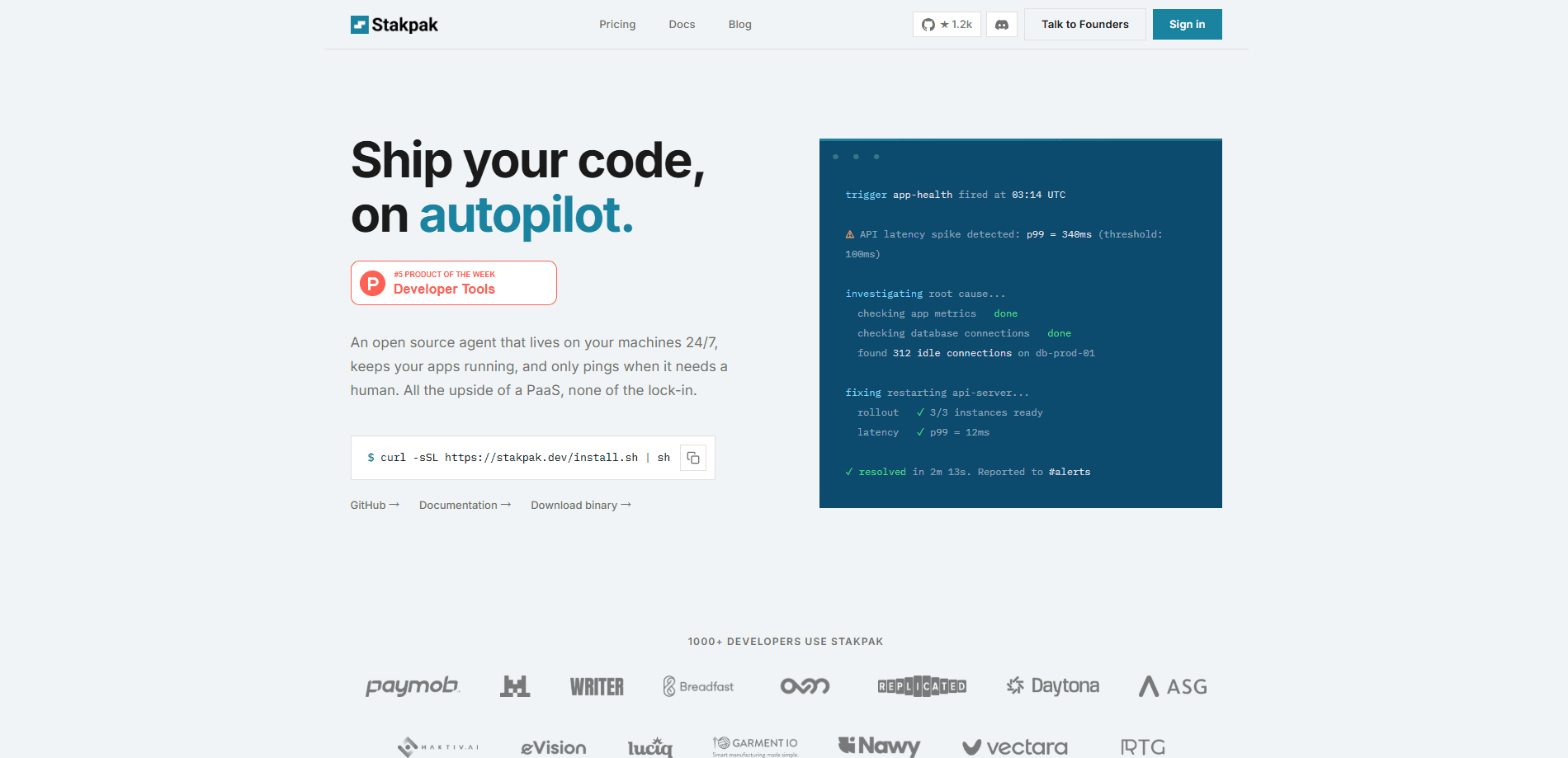
Stakpak is an open source, terminal-based AI DevOps agent written in Rust that watches your infrastructure around the clock, fixes what it safely can, and pings you only when a human is actually needed. It handles monitoring, auto-healing, cost checks, and certificate renewals while keeping your API keys and database passwords away from any model provider.
About Stakpak
What Is Stakpak
Stakpak is an open source AI agent for DevOps that lives on your own machines instead of a cloud you don't control. You install it with a single shell command, run stakpak init to let it map your stack, then start autopilot mode so it can work in the background. The pitch is simple: you get the convenience of a managed platform without handing over your servers.
Most AI coding tools sit in your editor and wait for a prompt. This one doesn't. Stakpak runs headless on the box itself. So what does it actually check? App health, database connections, certificates, and cloud spend. That's infrastructure monitoring with no dashboard to babysit. When something breaks, it investigates the root cause, applies a fix if the change is covered by your guardrail policies, and reports what it did. Anything risky gets escalated to a human. That's the whole idea behind an autonomous DevOps setup.
The catch is that it expects a real operations environment. Autopilot needs Docker installed and reachable by your user, plus at least 2GB of RAM on the target host for reliable runs. Small servers won't cut it. It's also Apache 2.0 software, so the self-hosted tier is genuinely free if you bring your own model keys. If you want someone else to run the gateway and hold your billing, the paid tiers start at $15/mo.
Getting Started
- Install the agent by running
curl -sSL https://stakpak.dev/install.sh | shin your terminal. - Run
stakpak initso the agent discovers your stack and generates an APPS.md file describing your apps. - Configure
~/.stakpak/config.tomlwith your model provider credentials, allowed tools, and auto-approve settings. - Start the autonomous agent with
stakpak up(a shortcut forstakpak autopilot up) and check readiness withstakpak autopilot doctor. - Monitor schedules, channels, and recent activity through
stakpak autopilot status, or wire notifications into Slack, Telegram, or Discord.
Product Information
A quick look at Stakpak's pricing, supported platforms, and performance.
Best for
The users, tasks, and scenarios where this tool fits best.
Users
- Solo developers and freelancers running side projects
- Small engineering teams that need after-hours coverage
- Platform teams at larger companies
Tasks
- Auto-healing failing services
- Cloud cost cleanup
- Certificate and secret rotation
- Debugging Kubernetes and configuring CI/CD
Scenarios
- Overnight incident response
- Pre-launch readiness checks
- Migrations and upgrades
Key features
Auto-Healing and Health Monitoring
The agent watches app health and database connections continuously. When a check fails, it investigates, restarts the affected service, and confirms recovery, then posts a summary to your alert channel. No human required. The result is incident response that keeps working when no one is awake.
Warden Guardrails and Network Policies
Every network request the agent makes, whether from curl, Python, or an MCP server, passes through a transparent proxy governed by Cedar policies. This means that even if permissions are configured incorrectly, the agent can't run destructive operations against production. Good news for anyone who's ever fat-fingered a production command.
Secret Substitution
Stakpak detects and swaps over 210 types of secrets with placeholders before they reach the language model, then restores the real values only at execution time. Your API keys and database passwords never travel to any model provider.
Cost Watchdog
A scheduled daily scan looks for idle cloud resources such as unused database instances and orphaned storage volumes, then generates a report with the recoverable spend. Money left on the table. It's aimed at the kind of waste that finance would flag weeks later. Infrastructure automation like this pays for itself fast.
Rulebooks and Memory
You teach Stakpak your own procedures through markdown-based SOPs covering deployments, upgrades, and migrations. The agent stores reusable knowledge across sessions, so it applies your way of doing things instead of a generic playbook.
Session Audit and Rollback
Every action, file edit, and command is logged with full context, and changes are backed up both locally and over SSH before modification. Any session can be replayed, traced, or rolled back. Nothing hidden.
Multi-Channel Notifications
Autopilot routes alerts and reports into Slack, Telegram, or Discord, configured per agent. You can also investigate incidents by chatting with your infrastructure through the Slack integration, without opening a terminal.
Pros and cons
Pros
- Fully open source under Apache 2.0, so the self-hosted tier costs nothing and you can inspect the code.
- Runs entirely on your own machines with mTLS encryption, which keeps data inside your environment.
- Secret substitution plus Warden guardrails reduce the risk of an AI agent damaging production.
- Covers the full maintenance loop: monitoring, healing, cost checks, and certificate renewals in one tool.
- Notifications land in Slack, Telegram, or Discord, so you don't need to install another dashboard.
Cons
- Autopilot needs Docker and at least 2GB of RAM on the host, which rules out very small or locked-down servers.
- The terminal-first workflow won't appeal to anyone expecting a point-and-click interface. Not everyone lives in a shell.
- Cost Watchdog and auto-healing are focused on cloud infrastructure, so pure on-prem setups see less benefit.
- Several advanced features sit behind paid tiers, so the free plan is best for single-machine use.
Frequently asked questions
It's an autonomous AI agent that monitors, secures, and maintains your infrastructure. It runs on your machines, auto-heals failing apps, tracks cloud costs, and alerts you only when a decision needs a human. Simple as that.
Related content
Explore related tools, skills, and articles for Stakpak.
Stakpak Alternatives
Forefront
Forefront · CodingForefront is a web platform for building with open-source AI. It lets you fine-tune leading open-source language models on your own data, evaluate how they perform, and run them through an API or export them to host yourself. Developers who want the convenience of a closed-source platform but insist on owning their models and data are the target audience here.

Startkit
StartKit.AI · CodingStartkit is a boilerplate for building AI SaaS and AI wrapper products. Think of it as an AI startup boilerplate with the boring parts already wired up: authentication, Stripe and Lemon Squeezy payments, usage limits, transactional email, and an AI API starter that talks to OpenAI, Anthropic, Groq, or Llama. You clone the repo, set your price, and start on the part of your product that people actually pay for. It's Next.js under React and Tailwind, so most of the boilerplate code already feels familiar.
Testim
Tricentis · CodingTestim is an AI-powered test automation platform for building and running end-to-end tests across web, mobile, and Salesforce applications. It leans on machine learning to keep tests stable when an interface changes, so teams spend less time fixing broken selectors. Not bad for an automated testing tool you can start using today. You create tests by recording actions in a browser, then optionally add JavaScript when you need more control. It's a solid pick for busy QA teams.