

Straion
Straion · Coding
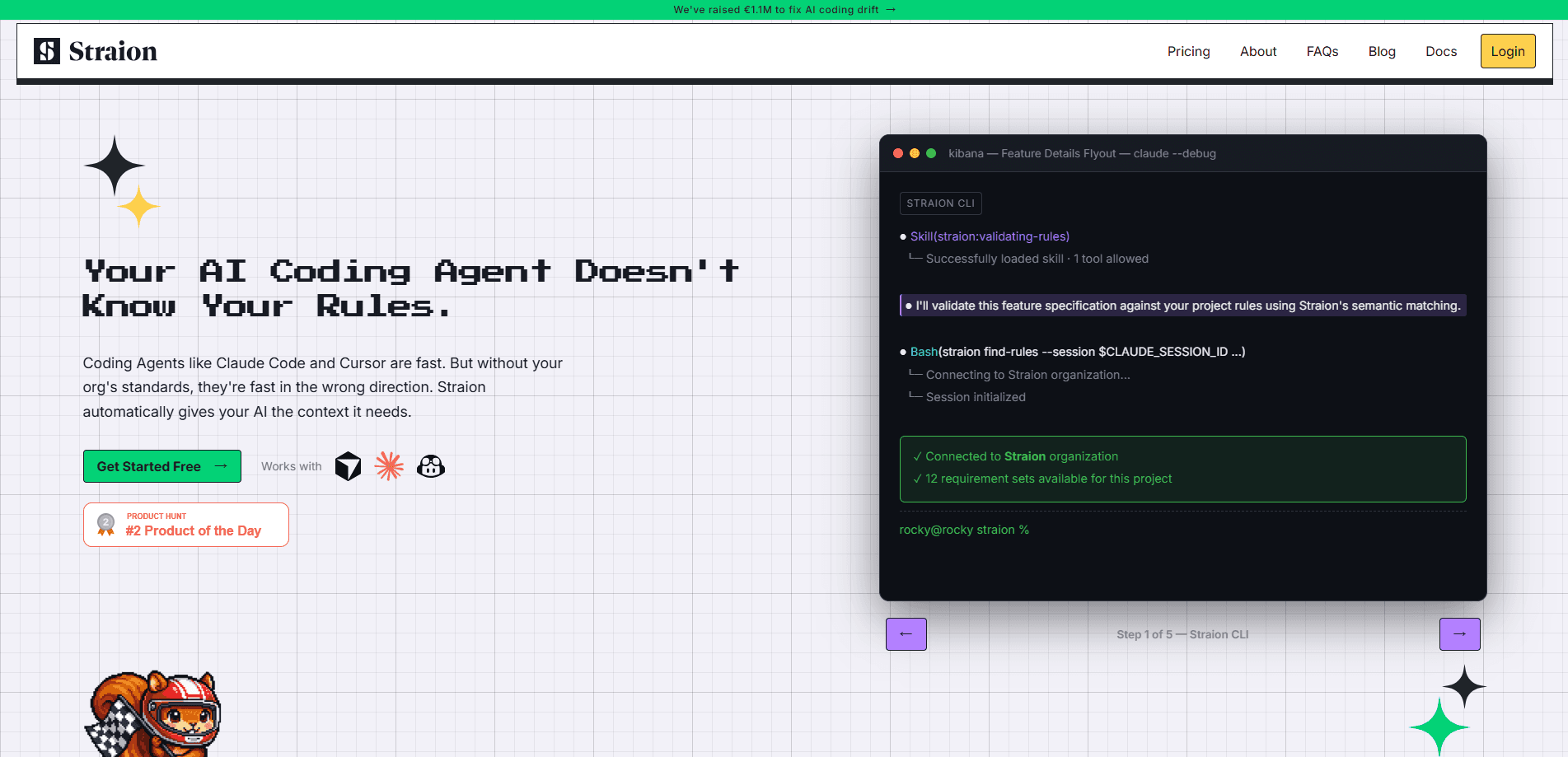
Straion is an AI coding governance platform that pushes your architecture rules, security policies, and coding standards into every developer's AI agent before it writes code. Instead of duplicating a CLAUDE.md file across repos and hoping agents follow it, Straion turns each applicable rule into a decision the agent has to resolve. It works with Claude Code, GitHub Copilot, and Cursor, and it targets teams that need AI-generated code to stay inside defined guardrails.
About Straion
What Is Straion
Straion is a SaaS platform built around one problem: AI coding agents know how to write code, but they don't have to follow your rules. Teams write standards into files like CLAUDE.md and AGENTS.md, yet those files get out of sync across repos and give the agent no way to prove it complied. Straion replaces that guesswork with a system. Your rules live as plain files on a dedicated branch in your own Git, versioned and reviewed like code, and the CLI fetches the relevant ones for each task.
The enforcement model is the part that stands out. When an agent's plan breaks a rule, it can't finish its turn until the rule is resolved. There are three outcomes: fix it, accept the violation, or mark the rule not applicable here. Fixes happen quietly. The other two route to a named reviewer, and approving one records the rule, the reason, the file, who signed off, and when. That audit trail is the answer you hand back six months later when someone asks why a service does something your rules say it shouldn't.
There are real limits. Straion is a governance layer for coding agents, not a code generator, so it only helps if your team already uses one. Pricing starts on a paid Team plan after a 14-day trial, with several governance features locked to Enterprise. And it's aimed at teams, not solo developers, which shows up in both the price and the setup.
Getting Started
- Start the 14-day free trial and install the Straion CLI.
- Connect the CLI to your coding agent. Straion works with Claude Code, GitHub Copilot, and Cursor.
- Point Straion at your repo. It creates a dedicated branch and migrates your existing AGENTS.md and CLAUDE.md files into rules.
- From then on, rule changes happen as commits and pull requests, reviewed like any other code.
- Let the CLI fetch the applicable rules per task and validate the agent's plan before code is written.
Product Information
A quick look at Straion's pricing, supported platforms, and performance.
Best for
The users, tasks, and scenarios where this tool fits best.
Users
- Platform and DevOps engineers responsible for keeping agent output consistent across repos
- Engineering managers at small-to-medium teams tired of duplicating CLAUDE.md in every repository
- Embedded and safety-critical developers working to MISRA-style standards
Tasks
- Enforcing coding standards on AI-generated code before it reaches review
- Converting existing CLAUDE.md and AGENTS.md files into versioned rules
- Producing an audit trail for deviations
- Reviewing code changes for design and intent instead of rule compliance
Scenarios
- A team spreads across multiple repos under one GitHub organization and wants shared conventions that stay in sync.
- An agent submits a plan that breaks an architecture rule and needs a reviewer's decision before it proceeds.
- An auditor asks, months later, why a specific file doesn't follow a documented standard.
- A security or architecture policy changes and you want every agent to pick up the new rule on the next task.
Key features
Rule Enforcement During the Agent's Turn
Straion's core change is timing. An agent that breaks a rule can't complete its turn until that rule is resolved, so the violation is dealt with before you ever see the diff. Each matched rule requires one of three decisions. Fixing is silent and blocks until the fix lands. The platform interrupts you only when something is about to ship broken on purpose.
Rules Stored in Your Own Git
Where do your coding standards actually live? With Straion, they live as plain files on a dedicated branch in your repository and sync on every commit through your existing CI. That means a rule change is a commit and a pull request, reviewed and permissioned like code rather than edited in a vendor dashboard. GitHub, GitLab, Bitbucket, and self-hosted providers are supported on the Enterprise plan.
Integration with Claude Code, Cursor, and GitHub Copilot
The CLI connects to the coding agent your team already uses, including Claude Code, Cursor, and GitHub Copilot. It fetches the rules relevant to the current task, so the agent has the right context before writing rather than a generic dump of every policy you've ever written.
Audit Trail for Every Deviation
When a reviewer accepts a violation, Straion records the rule as written, the agent's stated reason, the affected file, who approved it, and when. Approvals are captured by the tooling at the moment they're given, not reported afterward by the agent. You can post the trail on your PRs or store it alongside your own records.
Plan Validation Before Code Generation
Straion validates the agent's task plan against your rules before tokens are spent on code. Catching a mismatch at the plan stage is cheaper than catching it in review, and it keeps the agent from building on top of a flawed approach that would have to be reworked anyway.
Embedded and Safety-Critical Support
For teams building embedded software, Straion applies the MISRA rules that fit the task and puts every deviation on the record with its reason and approver. That matters when one undocumented deviation becomes a finding you have to defend at audit.
Pros and cons
Pros
- Enforcement happens before the PR, so reviewers spend their time on design and intent instead of rule compliance.
- Rules live in your own Git as reviewable files, which removes the drift that makes duplicated CLAUDE.md files unreliable.
- Every accepted deviation carries a name, a reason, and a timestamp, turning scattered exceptions into a searchable record.
- Works with the agents teams already run, including Claude Code, Cursor, and GitHub Copilot.
- Supports off-the-shelf standards like MISRA for embedded work, not just house rules.
Cons
- There's no free tier. You get a 14-day trial, then Team starts at €18 per user per month, so casual or solo use isn't economical.
- Managing rules in your own Git, along with SSO/SAML and priority support, sits on the Enterprise plan, so smaller teams can't get the full picture at the Team price.
- It's useless without an AI coding agent already in your workflow, since Straion enforces rules for agents rather than writing code itself.
- Setup takes more than an install. Migrating AGENTS.md and CLAUDE.md into rules touches your repos, so it needs an owner who understands your team's conventions.
Frequently asked questions
It feeds your coding standards and architecture rules to AI coding agents and makes them resolve any rule they break before finishing their turn. Fixes happen quietly, and anything that ships as a deviation goes to a named reviewer for approval.
Related content
Explore related tools, skills, and articles for Straion.
Straion Alternatives
Forefront
Forefront · CodingForefront is a web platform for building with open-source AI. It lets you fine-tune leading open-source language models on your own data, evaluate how they perform, and run them through an API or export them to host yourself. Developers who want the convenience of a closed-source platform but insist on owning their models and data are the target audience here.

Startkit
StartKit.AI · CodingStartkit is a boilerplate for building AI SaaS and AI wrapper products. Think of it as an AI startup boilerplate with the boring parts already wired up: authentication, Stripe and Lemon Squeezy payments, usage limits, transactional email, and an AI API starter that talks to OpenAI, Anthropic, Groq, or Llama. You clone the repo, set your price, and start on the part of your product that people actually pay for. It's Next.js under React and Tailwind, so most of the boilerplate code already feels familiar.
Testim
Tricentis · CodingTestim is an AI-powered test automation platform for building and running end-to-end tests across web, mobile, and Salesforce applications. It leans on machine learning to keep tests stable when an interface changes, so teams spend less time fixing broken selectors. Not bad for an automated testing tool you can start using today. You create tests by recording actions in a browser, then optionally add JavaScript when you need more control. It's a solid pick for busy QA teams.