

Synlets
Synlets · Coding · Productivity
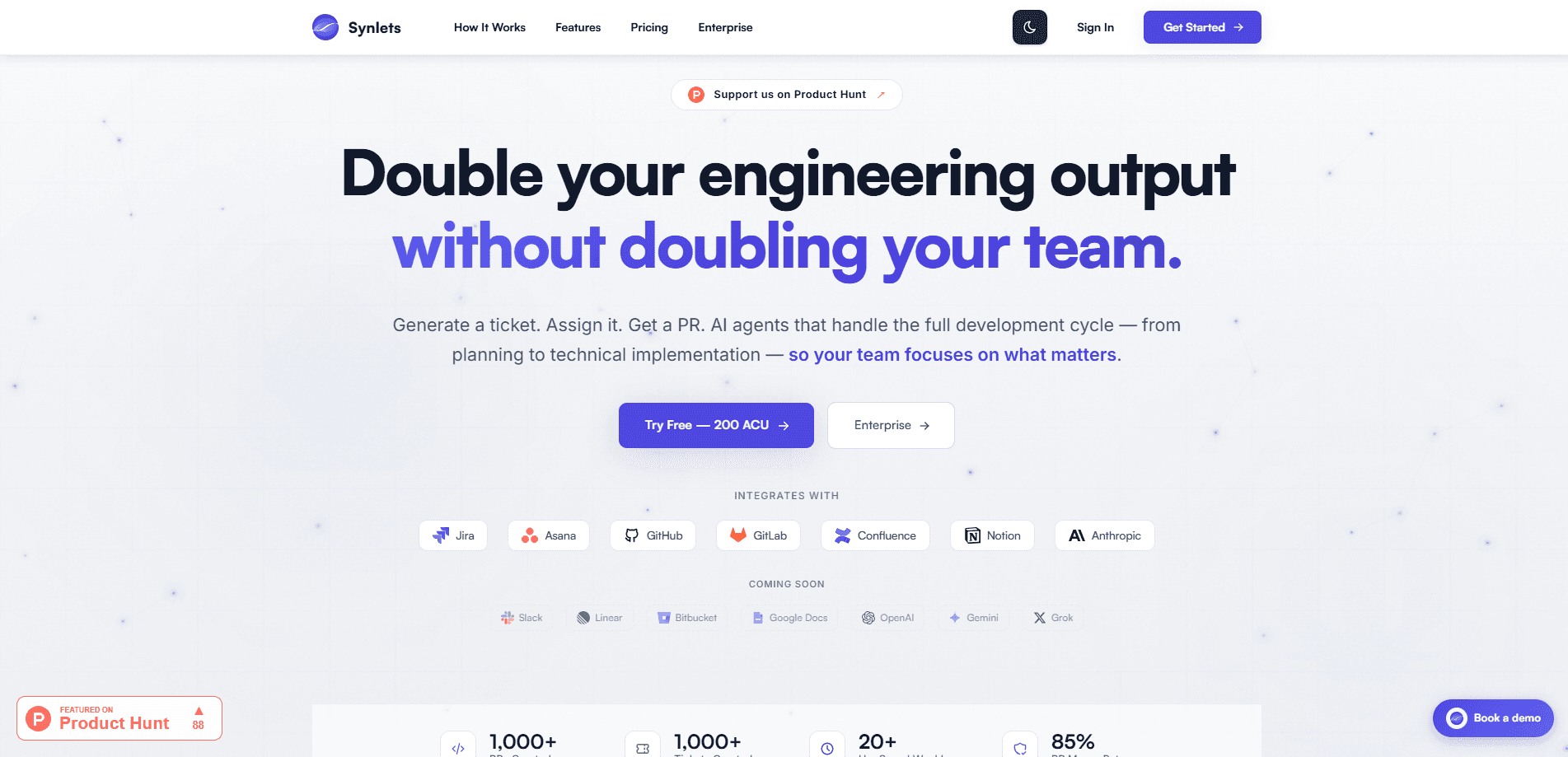
Synlets is an AI-powered autonomous software development platform that covers the full delivery cycle. It turns natural language tickets into working pull requests, so product managers, engineering leads, and developers can hand off routine work to AI agents. Human attention stays on the harder problems. Teams use it to draft well-defined tickets, fix bugs, build small features, and get preliminary code reviews without waiting on a crowded queue.
About Synlets
What Is Synlets
Synlets is an autonomous software development platform built around AI agents that work inside your codebase. Instead of stopping at suggestions in an editor, the agents pick up a ticket, write the code, open a pull request (a proposed set of code changes), and respond to review feedback in further rounds. The pitch is simple. It handles the parts of software delivery that are routine and repetitive, and it leaves the parts that need human judgment to your team. Agents work around the clock, and your engineers stay in control.
The platform is organized around roles rather than a single tool. Product managers use it to create well-defined tickets with full codebase context and assign them straight to agents. Engineering leads use it to offload bug fixes, minor features, and reviews. Developers use it to get thorough preliminary reviews in minutes, which means the senior engineer who finally opens the pull request is looking at something that has already been checked against the team's own standards rather than a first draft. Security and compliance teams get automated checks that run every PR against coding standards and policies, and executives get reports on quality, security, and velocity.
The main limitation is scope. Synlets targets small-to-medium features, bug fixes, refactoring, and reviews. It isn't a shortcut for large architectural work, and its output still depends on clean tickets and a codebase that agents can read. If your tickets are vague or your standards aren't written down, the agents have less to work with, and you'll spend more time correcting their output than you saved by handing the work over in the first place.
Getting Started
- Sign up on the Synlets website and connect the repository or codebase you want the agents to work in.
- Set your team's coding standards, security policies, and architectural guidelines so reviews and checks follow your rules.
- Create a ticket in natural language, or let the platform draft one with codebase context, then assign it to an agent.
- Review the pull request the agent opens, leave feedback, and let it iterate until the change is ready to merge.
- Use the insights and reports dashboard to track project status, code quality, and security posture.
Product Information
A quick look at Synlets's pricing, supported platforms, and performance.
Best for
The users, tasks, and scenarios where this tool fits best.
Users
- Product managers
- Engineering leads
- Developers
- Security and compliance teams
Tasks
- Bug fixes
- Small-to-medium feature development
- Code review
- Refactoring and optimization
- Ticket creation
Scenarios
- Clearing a backlog of routine fixes
- Shipping a small feature without sprint delays
- Giving a founder visibility
- Enforcing standards continuously
Key features
Autonomous AI Ticket-to-PR Workflow
Synlets takes a natural language ticket and carries it through to a working pull request. The agent reads the codebase, makes the change, opens the PR, and responds to feedback in further iterations. Routine work moves forward without a human writing the first draft of the code.
Ticket Creation With Codebase Context
Instead of a bare description, Synlets drafts tickets that already understand your codebase. Product managers and leads get well-defined work items they can assign directly to agents. That removes a common source of vague tickets and wasted cycles. Good tickets in, cleaner pull requests out.
Automated AI Code Review
Every PR can be reviewed against your team's coding standards, security policies, and architectural guidelines. The review is preliminary. It isn't a replacement for a senior engineer, but it covers the basics before a human looks. Developers spend less time waiting on review and more time iterating. That's the whole point.
Bug Fixes and Root Cause Analysis
Agents resolve issues and dig into why they happened, not just where the symptom showed up. A root cause analysis attached to a fix helps reviewers trust the change. It also reduces the odds of the same bug returning. This kind of work eats an engineer's week. Offloading it matters. It isn't glamorous. Still, a backlog of small fixes is exactly what slows a team down over a quarter, because each one looks harmless on its own until the pile gets tall enough that nobody wants to touch the release.
Feature Development From Tickets
Synlets handles small-to-medium features end to end. The ticket goes in, and a pull request comes out. It's aimed at the middle band of work. Too big to ignore, too small to justify a full sprint. Teams use it to keep a steady stream of improvements moving alongside larger projects.
Refactoring Across the Codebase
Refactoring and optimization changes are among the most deferred tasks in any codebase because they rarely win against feature work. Synlets can take those on as agent assignments, so cleanup happens without pausing the roadmap. The result is code that stays maintainable over time. Cleanup is boring, and skipping it gets expensive fast.
Insights and Reports
The platform reports on project status, code quality, and security posture. It answers questions like "how is the project tracking?" with real data instead of a guess. Leaders get visibility without chasing updates. Recommendations for new features and improvements come attached to that picture. This part of the tool serves founders and executives most directly.
Pros and cons
Pros
- Covers the whole cycle, from ticket creation through code review, so teams don't stitch together separate agents.
- Role-based design means product, engineering, security, and leadership each get a relevant entry point.
- Agents work 24/7 alongside the team, which helps teams ship more without adding headcount.
- Automated reviews and compliance checks catch basics before a senior engineer spends time on them.
- Reporting on quality, security, and velocity gives leaders concrete data instead of status guesses.
Cons
- No public pricing page, so you have to contact the vendor to learn what it costs.
- The agents work best on small-to-medium tasks, so large architectural work still needs humans.
- Output quality depends on clean tickets and clearly written standards; vague input means weaker results.
- Review is preliminary by design, so a human still has to sign off before anything merges.
Frequently asked questions
Synlets is an AI development agent platform that takes a natural language ticket and produces a working pull request. As an AI coding agent, it also drafts tickets, reviews code, fixes bugs, and reports on project status, covering the full cycle from ticket to review.
Related content
Explore related tools, skills, and articles for Synlets.
Synlets Alternatives
Forefront
Forefront · CodingForefront is a web platform for building with open-source AI. It lets you fine-tune leading open-source language models on your own data, evaluate how they perform, and run them through an API or export them to host yourself. Developers who want the convenience of a closed-source platform but insist on owning their models and data are the target audience here.

Startkit
StartKit.AI · CodingStartkit is a boilerplate for building AI SaaS and AI wrapper products. Think of it as an AI startup boilerplate with the boring parts already wired up: authentication, Stripe and Lemon Squeezy payments, usage limits, transactional email, and an AI API starter that talks to OpenAI, Anthropic, Groq, or Llama. You clone the repo, set your price, and start on the part of your product that people actually pay for. It's Next.js under React and Tailwind, so most of the boilerplate code already feels familiar.
Testim
Tricentis · CodingTestim is an AI-powered test automation platform for building and running end-to-end tests across web, mobile, and Salesforce applications. It leans on machine learning to keep tests stable when an interface changes, so teams spend less time fixing broken selectors. Not bad for an automated testing tool you can start using today. You create tests by recording actions in a browser, then optionally add JavaScript when you need more control. It's a solid pick for busy QA teams.