

Tanka
Tanka · Productivity · Leaning
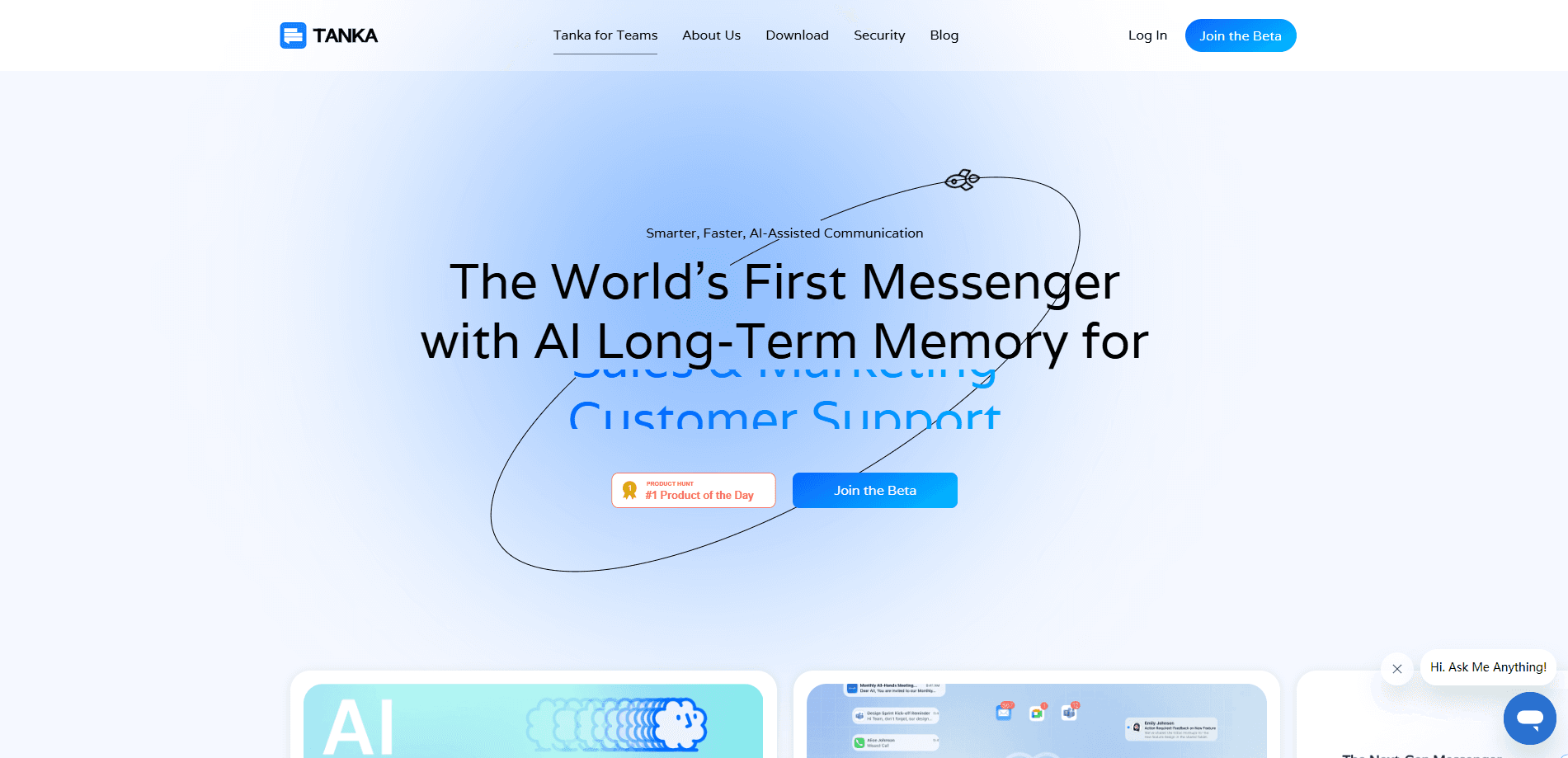
Tanka is an AI team messaging app that turns chats, files, and calls into a shared long-term memory. This AI memory assistant fits founders and small teams.
About Tanka
What Is Tanka
Tanka is a business messaging and workspace app built by Tanka, backed by Shanda Group. The pitch is simple: chat tools like Slack and Microsoft Teams store your conversations in silos, so the reasoning behind a decision gets lost the moment the thread scrolls away. Tanka keeps that reasoning. Every message, file, call, and email becomes part of a memory layer the company can search and build on, and that's the case for treating it as your team collaboration platform rather than one more chat app.
That memory is the whole product. Ask Tanka what your team decided about pricing last quarter and it looks across your own history, not the open web, then answers with a citation you can check. It doesn't just reply either. Tanka's agents draft documents, assign follow-ups to owners, and push updates into the tools you already run, so a decision made in chat can turn into a spec in Drive and an event in your calendar.
Two limits matter before you commit. Tanka is young, launched publicly in early 2025, and its team is small, so support and features are still moving fast. It also asks you to trust it with deep access to messaging, email, and files, which is exactly the data most teams guard. The company says it doesn't train models on your content and gives you export controls, but that trade-off is worth weighing for any workspace that holds sensitive material.
Getting Started
- Open tanka.ai and start a free workspace, or install the iOS or Android app. No credit card is needed to begin.
- Connect the tools you already use, such as Slack, Gmail, Outlook, WhatsApp, Drive, Notion, or Dropbox. Tanka only ingests what you allow.
- Invite your team and pick where the shared memory should pull from.
- Open the AI assistant in chat and ask for something real, like a draft update, a summary of a thread, or next steps from a meeting.
- Review the output, then let Tanka's agents route follow-ups and keep related tasks moving.
Product Information
A quick look at Tanka's pricing, supported platforms, and performance.
Best for
The users, tasks, and scenarios where this tool fits best.
Users
- Startup founders
- Small teams without a dedicated ops role
- New hires
Tasks
- Turning a chat thread into a deliverable
- Keeping follow-ups from slipping
- Finding what the team forgot
Scenarios
- When a key person leaves and you need their context to stay in the company, not walk out the door.
- When you're preparing an investor update and want to pull real numbers and decisions from past threads in one place.
- When your inbox, Slack, and WhatsApp get noisy and you want one triage view so you can reply in context.
Key features
Long-term team memory
Tanka builds a shared memory from your chats, files, and calls. Instead of re-explaining background every time, you ask once and the assistant answers from the company's own history. That's what separates it from a standard chatbot bolted onto a chat app.
AI assistant that acts
This AI memory assistant doesn't stop at a paragraph. When it spots an intent, Tanka's agents route the task to an owner, draft the follow-up, and update your systems. A decision in chat can become a spec in Drive and a sprint in your calendar without a person copying it over.
100+ app integrations
Tanka connects messaging, email, CRM, data, and productivity tools into one knowledge base. Slack, Gmail, Outlook, WhatsApp, Drive, Notion, Dropbox, and calendars are among the supported sources, so the memory reflects the tools your team actually uses.
Flow for everyday work
Flow links the team's memory to daily tasks. As decisions stack up, it turns them into outputs like drafts, research, and next steps. The pitch is that work keeps moving while the context is still fresh, rather than sitting idle until someone picks it up.
SOPs from real decisions
You can build standard operating procedures from decisions made inside Tanka. New hires follow a playbook grounded in how the team actually works, which makes onboarding faster and keeps knowledge from leaving with the person who had it.
Search with citations
Search in this AI workspace looks across messages, docs, and email by meaning, not just keywords. Results come with citations, so you can pull the exact slide, metric, or quote and trust that it's real before you reuse it.
Pros and cons
Pros
- Memory is the core product, so answers come from your team's own history instead of generic training data.
- Integrations cover the messaging, email, and file tools most small teams already run.
- Agents do more than draft, routing tasks and updating systems on their own.
- A free plan and a quick migration claim keep the barrier low for trying it.
- Export controls and a no-training-on-your-data policy address the biggest worry about handing over company chat.
Cons
- The company is young and its public track record is short, so you're betting on a small team to keep the service running.
- Deep access to messaging, email, and files is a real trust decision, and some regulated teams won't be able to sign off on it.
- Public details on model choice, data handling, and API access are thin, so you should test it on a small workspace first.
- Per-seat pricing adds up for larger teams, and the free tier's limits aren't spelled out on the site.
Frequently asked questions
Tanka is a business messaging app with a memory layer underneath. It stores your team's chats, files, and calls, then uses that history to answer questions, draft documents, and push follow-ups, so context doesn't get lost when a thread scrolls away.
Related content
Explore related tools, skills, and articles for Tanka.
Tanka Alternatives

Maildun for Mac
Dunn · Productivity · Marketing · BusinessMaildun for Mac is a free macOS email builder for designing on-brand emails by hand, with an AI assistant, or over MCP, then exporting HTML that holds up in Outlook and Gmail.

Lune
Retrograde Labs · Productivity · LeaningLune is a research search engine for scientific AI agents. It runs as an MCP server that lets Claude, ChatGPT and Cursor search peer-reviewed computer science papers and cite them.

Skreno
Skreno · Video · ProductivitySkreno is a browser screen recorder that captures a tab, a window or your whole display, then attaches AI transcripts, summaries and console logs to one share link.