

Tellers AI
Tellers, Paris, France · Video
Tellers is an AI video editing agent that turns a brief, a script, or raw footage into an editable multi-track timeline, then renders the finished cut in your browser.
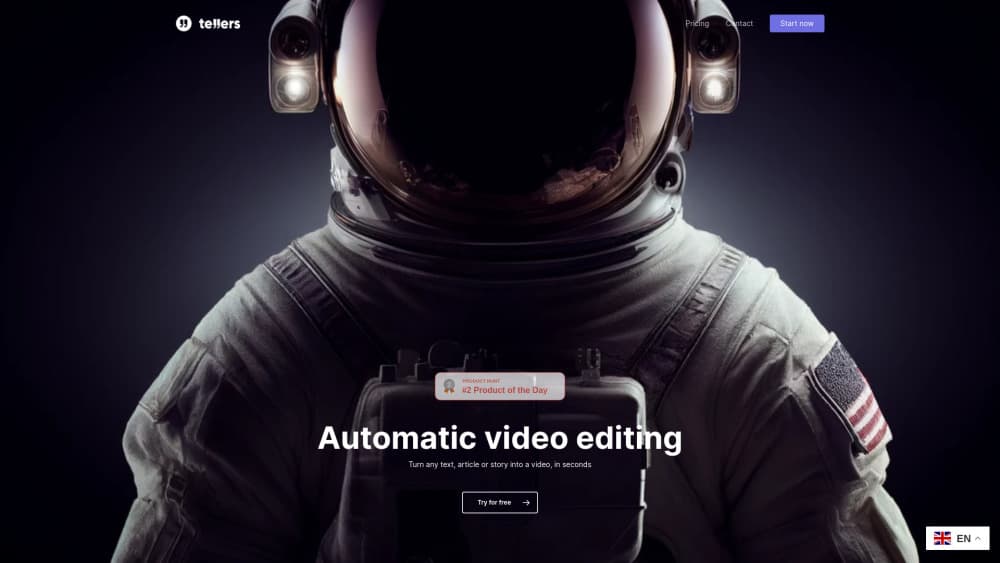
About Tellers AI
What Is Tellers
Tellers is a browser-based video editor with an AI agent sitting on top of it. You describe the video you want, and the agent searches your media, builds a timeline, adds captions, music, voice-over, and motion graphics, then renders the result. The company is based in Paris and sells the product to creators, agencies, marketing teams, and post-production shops.
The part that separates Tellers AI from a text to video generator is what happens after the first cut. Every result stays open as a multi-track timeline you can trim, reorder, and grade by hand. Ask for another revision in the same chat, or drag clips yourself. Both routes edit the same project, so the agent never locks you out of the composition.
That openness comes with a cost model worth understanding. Tellers bills in tokens, and a token roughly maps to a minute of edited video on the base allowance, but model choice changes the burn rate. Long projects, several revisions, and premium video models add up. The editor is also browser-only and renders in the cloud, so a weak upload link makes big footage painful to work with.
Getting Started
- Create an account at app.tellers.ai. No card is needed to start editing.
- Start a project and upload footage, paste a script or article link, or describe the video from scratch.
- Let the agent index your media, then ask for a first cut in plain language, such as a 30 second vertical edit.
- Review the timeline, request changes in chat, or adjust clips, captions, and audio by hand.
- Render the final video in the cloud, or export the timeline to Premiere Pro, Avid, or DaVinci Resolve.
Product Information
A quick look at Tellers AI's pricing, supported platforms, and performance.
Best for
The users, tasks, and scenarios where this tool fits best.
Users
- Solo creators and YouTubers
- Agencies and marketing teams
- Post-production studios
Tasks
- Turning a blog post into a short video
- Cutting a long interview into clips
- Producing a first assembly from a script
Scenarios
- A weekly social calendar
- A client revision round
- An automated pipeline
Key features
Prompt Based Editing on an Open Timeline
Prompt based video editing here means typing a request and letting the agent restructure the cut: reorder scenes, tighten pacing, change the aspect ratio, add titles. The output is a standard multi-track timeline, not a locked render. That means a prompt can be a starting point rather than a final answer, and manual trimming still works on the same project.
Search Across Indexed Footage
Uploaded media gets transcribed and indexed, so you can ask for a reaction, a line of dialogue, or a piece of b-roll by describing it. The agent pulls the matching moment into the timeline. This is the feature that saves the most time on documentary and interview work, where finding the shot is the real job.
One Balance Across Many AI Models
A Tellers subscription covers video generation, image generation, voice, music, sound effects, and stock media in one place. The lineup includes Google Veo, Runway, ByteDance Seedance, Alibaba Wan, ElevenLabs, OpenAI Whisper, and Pexels stock, among others. Instead of paying five vendors, you spend from one token balance, and the agent picks a tool that fits the request. The model list changes often, so check what is live before you plan a workflow around a specific one.
Specialized Agents for Repeatable Formats
Beyond the general editor, Tellers ships assistants tuned for specific outputs: music videos with lyric animation, instrument tutorials, article to motion videos, talking head edits, and ad variants. Each one comes with a preset structure, which cuts the setup time on formats you produce every week.
Timeline Export to Professional Editors
Finished work can be rendered in the cloud, or exported as an editable timeline in the OTIO based format Tellers publishes. Premiere Pro, Avid, and DaVinci Resolve can pick it up, so a shop with an established finishing pipeline keeps its color, sound, and delivery steps. The handoff is optional, which is the point.
API, CLI, and MCP Access
The video editing API lets a product upload media, search it, build or revise a timeline, preview, and request a render. A CLI handles local scripting, and an MCP server gives an AI assistant direct access to the same operations. Teams building their own tools get the composition as data instead of a finished file.
Pros and cons
Pros
- The agent edits a real timeline, so you can fix a bad cut by hand instead of regenerating the whole video.
- One token balance covers generation, voice, music, and stock, which removes several separate subscriptions.
- Media search finds moments inside long footage by description, which is the slowest part of interview editing.
- Editable timeline export to Premiere, Avid, and Resolve keeps professional finishing workflows intact.
- The API, CLI, and MCP server make it usable inside automated production rather than only in the browser.
Cons
- Token pricing makes costs hard to predict, since a revision with a premium video model can burn far more than a trim.
- There's no unlimited tier. Heavy volume means the $499 pack or a monthly plan with extra token purchases.
- Browser-only editing and cloud rendering depend on a solid connection, and large uploads take time.
- The model lineup shifts quickly, so a tutorial or an internal workflow can go stale when a provider is swapped out.
Frequently asked questions
It edits video from a description. You supply footage, a script, or just an idea, and the agent assembles a timeline with visuals, narration, captions, and music. You can then revise it by prompt or by hand, and render the final file.
Related content
Explore related tools, skills, and articles for Tellers AI.
Tellers AI Alternatives

ngram 2.0
ngram · Video · Marketingngram 2.0 is an AI video generator for teams. It turns a prompt, a screen recording, or a product URL into a narrated explainer, product demo, or AI avatar video, and every scene stays editable.

OpenScreen 2
OpenScreen (open-source project) · Video · ProductivityOpenScreen 2 is a free, open-source screen recorder and demo video editor for Windows, macOS, and Linux, with automatic zooms, styled frames, local captions, and agent edits.

Skreno
Skreno · Video · ProductivitySkreno is a browser screen recorder that captures a tab, a window or your whole display, then attaches AI transcripts, summaries and console logs to one share link.