

Tencent EdgeOne
Tencent Cloud · Video
Tencent EdgeOne is an integrated content delivery network and edge computing platform that runs acceleration and security from the same global node network. It pairs Asia-optimized delivery with built-in DDoS protection, a web application firewall, bot management, and serverless edge functions for web apps, APIs, and media. One dashboard, not three. Teams that need that instead of stitching together a standalone CDN, a separate WAF, and a scrubbing service usually start here.
About Tencent EdgeOne
What Is Tencent EdgeOne
Tencent EdgeOne is Tencent Cloud's edge security and acceleration platform, positioned as a next-generation CDN. The pitch is simple: traditional setups force you to buy delivery from one vendor and security from another, then hope they cooperate. EdgeOne puts both on the same nodes, so traffic gets cleaned and accelerated at the point closest to the user. The company calls this an all-in-one edge architecture.
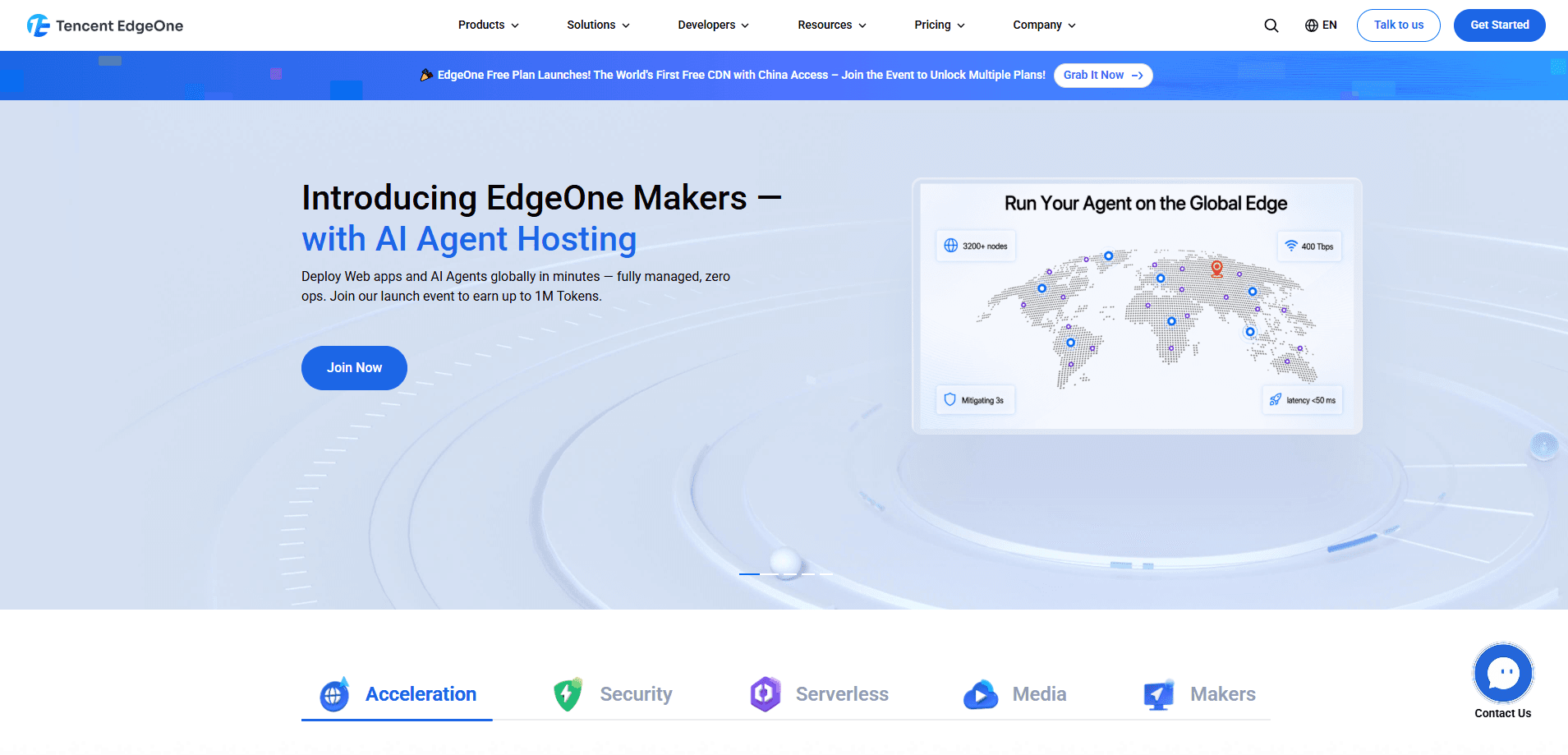
The platform covers websites, APIs, live and on-demand video, and multiplayer games. Its strongest coverage is Asia, where Tencent has spent years building carrier relationships and peering. According to Tencent, the network spans more than 3,200 edge nodes worldwide, with over 2,500 of them in Asia, backed by 400 Tbps of global bandwidth.
The main limitation is pricing transparency. Base CDN, WAF, and DDoS protection sit on a free plan. Advanced features like smart acceleration, bot management, and dedicated DDoS scrubbing are usage-based or locked to enterprise contracts, so getting a firm monthly number takes a sales conversation. The dashboard also assumes you know your way around DNS records and origin configuration. It isn't a one-click tool for total beginners.
Getting Started
- Sign up for a Tencent Cloud account and open the EdgeOne console; the free plan needs no credit card.
- Add your domain and pick an acceleration region. EdgeOne accepts either NS access or CNAME access, depending on how much control you want to keep over your DNS.
- Point your site's DNS at EdgeOne and configure your origin server, so the platform knows where to pull fresh content from.
- Apply the built-in security ruleset, turn on the WAF rules, and set any rate limits or bot rules you need.
- Verify the free SSL certificate, then watch traffic in the analytics and log views before scaling up.
Product Information
A quick look at Tencent EdgeOne's pricing, supported platforms, and performance.
Best for
The users, tasks, and scenarios where this tool fits best.
Users
- Game studios pushing large updates to players worldwide
- Ecommerce teams running flash sales
- Media and streaming operators
Tasks
- Speeding up a global website for users in Asia
- Blocking attacks before they reach your origin
- Shipping code to the edge
Scenarios
- Launching a product in multiple countries at once
- Absorbing an unexpected traffic spike
- Getting to production fast with Infrastructure as Code
Key features
All-in-One Delivery and Security
EdgeOne runs content delivery and protection from the same node network, so cleaned traffic continues toward your origin without a second hop. That matters when an attack and a traffic surge hit at the same time. Tencent reports DDoS mitigation efficiency of 99.995%, with most attacks flagged within three seconds. The practical benefit is fewer moving parts to configure and monitor.
Global CDN with Heavy Asia Coverage
The delivery layer leans on 3,200-plus edge nodes, with the majority concentrated in Asia, alongside 400 Tbps of global bandwidth. For audiences spread across China, Southeast Asia, and Northeast Asia, requests land on a nearby node and return faster. Outside Asia the network still works, but that's where the regional edge is sharpest.
DDoS, WAF, and Bot Protection
Security runs across layers L3 through L7. DDoS protection scrubs volumetric attacks, the WAF ruleset blocks SQL injection and XSS attempts in real time, and bot management tells real users apart from automated traffic. Rate limiting handles abusive request patterns. Dedicated DDoS scrubbing for high-value targets is reserved for the enterprise tier.
Serverless Edge Functions and KV Storage
Edge functions let developers run JavaScript directly on edge nodes, with cold starts under half a millisecond, according to Tencent. You can add authentication, rewrite routes, or serve localized content without maintaining a server. A companion KV store keeps small pieces of data close to the user, which removes a round trip to a central database for things like feature flags.
Smart Acceleration for Fast Content
Static files cache easily. Harder to speed up are requests that change per user. Smart acceleration probes network latency in real time and picks faster routes for that traffic, covering protocols like QUIC and HTTP/3. It's billed per VAU, so cost scales with the traffic you actually send through it.
Image Processing at the Edge
EdgeOne can resize, convert, and cache images at edge nodes, which means you store originals and let the platform handle format and size on delivery. Fewer variants to manage. Lighter pages for viewers. The feature is free for a limited time, according to the pricing page.
API Acceleration and Delivery
APIs carry traffic that can't be cached the way a page or image can. EdgeOne handles API acceleration by routing requests over the same fast network it uses for sites, so calls between users and your backend skip slow public paths. For teams running mobile apps or microservices, that turns an unpredictable response time into a steadier one.
Analytics and Real-Time Logs
The platform ships with multidimensional analytics plus log delivery for HTTP requests, responses, and security engine events. When something breaks or an attack pattern shifts, you can trace it without exporting data to a separate tool. That visibility saves a late-night debugging session.
Infrastructure as Code via Terraform
Terraform API support lets you define EdgeOne configuration as code and roll it out across environments. Teams already managing cloud resources with IaC can fold delivery and security into the same pipeline instead of clicking through a console for every change.
Pros and cons
Pros
- Delivery and security live on one network, cutting the number of vendors and dashboards you juggle.
- Asia-focused node density is a real advantage for apps with audiences in China, Southeast Asia, and Northeast Asia.
- A genuinely usable free plan covers CDN, WAF, and DDoS protection with no credit card required.
- Edge functions with sub-millisecond cold starts let you ship logic without running servers.
- Terraform support fits teams that automate their infrastructure.
Cons
- Advanced features like bot management and smart acceleration are priced per VAU, so bills scale with traffic in ways that take effort to forecast.
- Dedicated DDoS scrubbing and full bot rules sit behind enterprise contracts, which means a sales call before you can price a serious deployment.
- The console expects comfort with DNS and origin settings, so smaller teams without a technical lead may find setup tedious.
Frequently asked questions
It's used to speed up and protect websites, APIs, apps, and games. EdgeOne delivers content through a global CDN while handling DDoS attacks, web attacks, and bot traffic on the same nodes, so you don't need separate vendors for acceleration and security.
Related content
Explore related tools, skills, and articles for Tencent EdgeOne.
Tencent EdgeOne Alternatives

ngram 2.0
ngram · Video · Marketingngram 2.0 is an AI video generator for teams. It turns a prompt, a screen recording, or a product URL into a narrated explainer, product demo, or AI avatar video, and every scene stays editable.

OpenScreen 2
OpenScreen (open-source project) · Video · ProductivityOpenScreen 2 is a free, open-source screen recorder and demo video editor for Windows, macOS, and Linux, with automatic zooms, styled frames, local captions, and agent edits.

Skreno
Skreno · Video · ProductivitySkreno is a browser screen recorder that captures a tab, a window or your whole display, then attaches AI transcripts, summaries and console logs to one share link.