

Thentic
Thentic · Coding
Thentic, now sold as Thentic Pay, is a non-custodial crypto payment gateway. Businesses accept 30+ tokens across 16 blockchains, run on-chain subscriptions, and pay a 1% fee with no monthly charge.
About Thentic
What Is Thentic
Thentic Pay is payment infrastructure for businesses that want crypto revenue to land in their own wallet instead of a processor's account. A merchant signs up, connects a wallet, and gets a merchant ID. From there, a checkout can go live through an embeddable button, a REST API call, or a WooCommerce plugin.
The product exists because card rails are expensive and reversible. Card networks charge a percentage plus a fixed fee, and a customer can dispute a charge weeks after delivery. Thentic routes payments over public blockchains instead. Settlement takes seconds on Base and Polygon, and the merchant signs transactions on-chain, so a mistyped address can't quietly drain a balance.
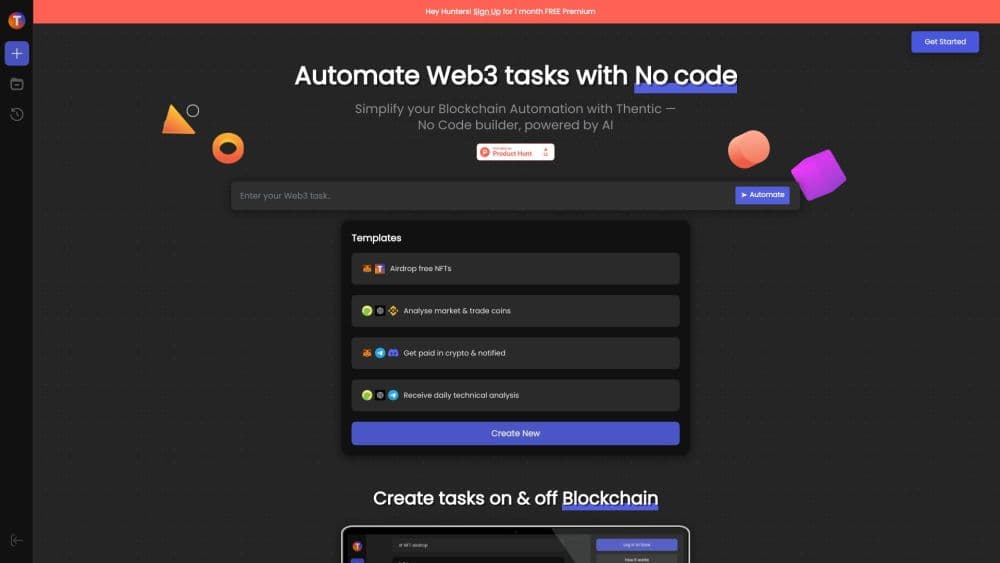
The company started with a no-code builder for Web3 automation, which is why older directory listings describe it as a no-code platform. The current product centers on payments. That shift matters if you're evaluating it today: the automation builder is no longer the main pitch, and the payment stack is what the documentation, pricing, and dashboard now cover.
The biggest limitation is simple. Crypto only. A customer without a wallet and without tokens can't check out. Most merchants use it to accept crypto payments next to cards, so it works as an added payment method rather than a full replacement.
Getting Started
- Sign up at thentic.tech and connect a crypto wallet. The merchant ID appears in the dashboard, and there's no KYC step at signup.
- Pick an integration: drop in the iframe pixel for a "Pay with Crypto" button, call
POST /api/payment/create, or install the WooCommerce plugin. - Set the amount, token, chain, recipient address, and a webhook URL. Custom parameters such as an order ID travel with the payment.
- Send the customer to the returned payment URL. Funds arrive in your wallet after confirmation, and the webhook reports status plus screening results.
Product Information
A quick look at Thentic's pricing, supported platforms, and performance.
Best for
The users, tasks, and scenarios where this tool fits best.
Users
- Online store owners selling digital goods
- SaaS teams billing recurring plans
- Marketplaces with cross-border sellers
Tasks
- Adding a crypto checkout to an existing site
- Setting up recurring billing
- Screening incoming payments
- Taking payments in person
Scenarios
- A WooCommerce store that wants to accept USDT without handing custody to an exchange
- A subscription business tired of chargebacks
- A small team selling to customers in markets where card acceptance is slow or expensive
Key features
Non-Custodial Settlement
Payments move from the customer's wallet to yours, and Thentic never holds the balance. You sign the transaction on-chain, which removes the risk of a processor freezing funds or an address being copied wrong. Settlement finishes in under two seconds on Base and Polygon, and longer on slower networks.
One-Call Payment API
A single JSON request creates a payment and returns a hosted URL you can paste anywhere. There are no SDKs to install and no dependency chain to maintain, which keeps integration work to an afternoon for most teams. Webhooks report status changes with custom metadata, so an order ID or customer reference stays attached.
On-Chain Crypto Subscriptions
The subscription endpoints let you create, list, and cancel recurring plans that run on native ERC-20 approvals. Billing can be daily, weekly, or monthly, and no card network sits in the middle. That means no chargebacks and no expired-card failures. A customer who revokes the approval stops the plan on their side.
Built-In AML and OFAC Screening
Every transaction is screened against the U.S. Treasury SDN list and the Scorechain API, which also covers EU and UN programs. Screening logs, timestamps, and sanction details arrive in the webhook payload, so a compliance team has an audit trail without extra tooling. If Scorechain is unreachable, local OFAC checks keep running.
Multi-Chain Coverage
The gateway supports 16 blockchains, including Ethereum, Polygon, Base, Arbitrum, Optimism, BNB Chain, Avalanche, and Cronos. More than 30 tokens are accepted, from USDT and USDC to WBTC, WETH, and DAI. A buyer pays on the network where the funds already sit, which cuts failed checkouts caused by bridge friction.
Merchant Dashboard and Webhooks
The portal tracks payment volume by day, week, month, and quarter, with breakdowns by token and chain. You can export CSV files for accounting and watch subscription counts in the same view. Webhook events cover completed, pending, and failed payments, plus screening outcomes.
Pros and cons
Pros
- The 1% fee is charged per transaction with no monthly minimum, and customers cover the commission at checkout.
- Funds settle directly to a wallet you control, so there's no custodial account to withdraw from.
- AML and OFAC screening ships with every merchant account at no extra cost, including audit logs.
- Integration is light: an iframe, one REST endpoint, or a WooCommerce plugin covers most stacks.
- Subscriptions run on-chain, which removes chargebacks and card expiry failures from recurring billing.
Cons
- Checkout is crypto only, so customers without a wallet or tokens can't pay, and most stores still need cards alongside it.
- The 1% rate costs more than flat-fee processors once volume climbs into six figures per month.
- Fiat settlement isn't self-serve. Converting to a bank balance requires the Enterprise plan and a custom integration.
- Crypto payments are irreversible, so buyers have no dispute path if an order goes wrong, and merchants absorb that trust problem.
Frequently asked questions
Thentic is used to accept cryptocurrency payments on a website or in person. It creates a payment link, routes funds to the merchant's wallet, and reports status through webhooks. It also handles recurring on-chain subscriptions and sanctions screening.
Related content
Explore related tools, skills, and articles for Thentic.
Thentic Alternatives
Forefront
Forefront · CodingForefront is a web platform for building with open-source AI. It lets you fine-tune leading open-source language models on your own data, evaluate how they perform, and run them through an API or export them to host yourself. Developers who want the convenience of a closed-source platform but insist on owning their models and data are the target audience here.

Startkit
StartKit.AI · CodingStartkit is a boilerplate for building AI SaaS and AI wrapper products. Think of it as an AI startup boilerplate with the boring parts already wired up: authentication, Stripe and Lemon Squeezy payments, usage limits, transactional email, and an AI API starter that talks to OpenAI, Anthropic, Groq, or Llama. You clone the repo, set your price, and start on the part of your product that people actually pay for. It's Next.js under React and Tailwind, so most of the boilerplate code already feels familiar.
Testim
Tricentis · CodingTestim is an AI-powered test automation platform for building and running end-to-end tests across web, mobile, and Salesforce applications. It leans on machine learning to keep tests stable when an interface changes, so teams spend less time fixing broken selectors. Not bad for an automated testing tool you can start using today. You create tests by recording actions in a browser, then optionally add JavaScript when you need more control. It's a solid pick for busy QA teams.